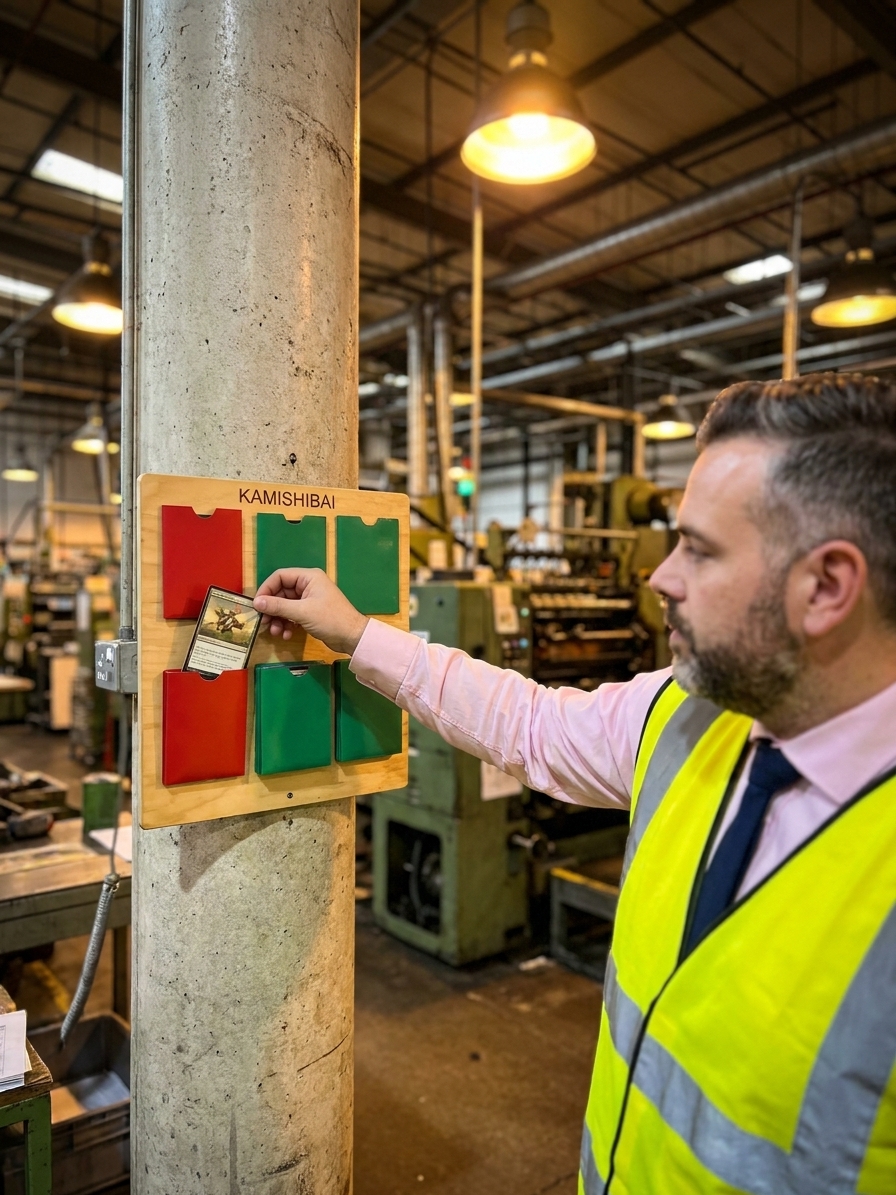
Walk into any factory claiming a lean transformation and you will find a board with index cards tucked into red and green sleeves. Some cards are flipped to green, meaning checked and acceptable. Others remain red, meaning not yet audited this cycle. The plant manager walks past it every morning. So does the shift supervisor. Nobody picks up a card. The board becomes furniture.
This is the Kamishibai Board — a tool that originated inside Toyota's production system to structure leader standard work, enforce layered process audits, and make abnormality visible at a glance. In the hands of a disciplined leadership team, it is one of the most effective process-confirmation tools ever designed. In the hands of a team going through the motions, it is decoration with a Japanese name.
I have installed Kamishibai Boards in automotive and aerospace plants across three continents. Some worked. Most failed. The difference was never the board, the cards, or the location. The difference was always whether leadership treated the board as a compliance ritual or as a discovery mechanism. The failure modes are predictable, and the fixes are structural.
What a Kamishibai Board Actually Does
The word kamishibai translates roughly to paper drama. It refers to a Japanese storytelling tradition where a narrator uses illustrated cards inside a small wooden stage. Toyota adapted this concept for factory floor management. The stage is a board mounted at the gemba. The cards are audit checklists, each focusing on a specific process, safety point, quality parameter, or 5S standard.
Each card sits in a two-sided sleeve: red on one side, green on the other. A leader picks a card according to a defined schedule, walks to the process, and observes the actual work against the checklist. If the standard is met, the card is flipped to green. If an abnormality is found, the card stays red and the leader initiates a countermeasure — not a report, but a conversation with the people doing the work.
The board resets at the start of each audit cycle. All cards return to red. Nothing is assumed to be still acceptable from last time. This reset mechanism is the single most important design feature of the system. Without it, green becomes the default state and the audit function dies.

The Four Failure Patterns
I once visited a plant where the Kamishibai Board had forty-seven cards. Every single one was green. I asked the plant manager how long they had all been green. He said about three months. I asked when someone last picked up a card and walked to the process. He did not know. The board had become a visual signal of compliance rather than a tool for discovery.
The decoration pattern is the most common. The board is installed during a lean event, photos are taken, a presentation is made, and nobody touches it again. The cards yellow with age. The sleeves fade. The board becomes part of the factory background, as invisible as a fire extinguisher behind a stack of totes.
The rubber-stamp pattern is more damaging because it looks like compliance. Leaders do walk to the process, but they flip the card to green before the walk is finished. Sometimes before it starts. The audit becomes a formality so the monthly report can say all Kamishibai audits were completed on time. The word completed does all the heavy lifting. The word audit does none.
The fear pattern is the worst. A red card is treated as a failure held against the team leader. So nobody ever leaves a card red. Abnormalities are handled informally, meaning ignored or buried. The board shows a perfect green wall while the process continues to produce defects that nobody officially observed. Complexity kills the rest: someone adds ninety cards covering everything, no leader has time to audit them, and the system collapses.
Why Kamishibai Boards Fail Versus How They Work
What teams do
- Install 40+ cards during a kaizen event and never prune them
- Flip cards to green to satisfy a monthly compliance metric
- Treat red cards as operator failures requiring discipline
- Leave the board static for months without retiring stable items
What works
- Start with 5-12 cards tied to critical-to-quality characteristics
- Treat red cards as signals that trigger a coaching conversation
- Audit the auditors — verify that leaders actually walked the process
- Retire consistently green cards after three months and replace them
Designing Cards That Are Observable
A good Kamishibai card describes something you can see, not something you have to interpret. Verify that the torque wrench calibration sticker is current and the tool log is signed is a functional card. You check the sticker, you check the log, you confirm. Ensure quality mindset is a useless card. What does acceptance look like? Who decides? How do you audit it?
Each card must have five elements: a clear title naming the process being audited, a specific location telling the auditor where to stand, observable criteria defining exactly what compliance looks like, a defined action if the check fails, and a space for the auditor's initials and date. Without these elements, the audit becomes subjective and the data becomes noise.
The card content must rotate. Cards that are consistently green for three months should be reviewed. If the process is genuinely stable and capable — verified by Cpk data, not by assumption — the card is retired and replaced with one targeting a different risk. A Kamishibai Board is a living system. A board that never changes is a board that nobody is using.
Layered Frequency and Ownership
Layered process audits only work when each layer audits a different focus area. The team leader checks basic standard work adherence and safety devices daily at shift start. The shift supervisor checks quality parameters and process settings mid-shift. The department manager audits system effectiveness weekly. The plant manager audits whether leaders are actually doing their audits.
Ownership must be personal. Each card needs a name on it — not a department, not a role, a person. When that person is on vacation, a named backup appears on the card. No ambiguity. No default assumption that someone should check that. The plant manager's job is to verify the verification. He picks a green card at random, walks to the process, and confirms the standard is actually being met.
The Kamishibai Audit Cycle
- 01Select and walkLeader picks a card, walks to the specified gemba location
- 02Observe against criteriaCompare actual process state to the observable standard on the card
- 03Respond to findingGreen if standard met; red if abnormality found triggers coaching
- 04Escalate if systemicRecurring red opens a corrective action tracked to closure
- 05Reset all cardsEvery card returns to red at the start of the next audit cycle
Connecting the Board to Your QMS
A Kamishibai Board is not a standalone tool. It connects directly to your ISO 9001 or IATF 16949 quality management system. The cards on the board are your layered process audit checklists — the most critical subset. You do not need a separate three-ring binder of audit forms that nobody opens. The board is the audit system, visible and alive at the point of execution.
When a card stays red, it must trigger a defined escalation path. Abnormality found, coach the operator or adjust the process, if the issue is systemic open an 8D corrective action, track closure, verify effectiveness, then update the card if the standard changed. This closed loop is what separates a Kamishibai system from a suggestion box.
A board that is all green is not a sign of excellence. It is a sign of fear, complacency, or dishonesty.
Each leader's daily routine must include a specific block of time for Kamishibai audits — written into leader standard work, not squeezed in when time allows. The board also generates management review data: audit completion rate, abnormalities found, corrective actions opened, closure rate. This data gives leadership an honest picture of process discipline that monthly reports rarely capture.
I have audited plants where the Kamishibai data fed directly into the Tier 1 daily management board. The integration was seamless. When a red card escalated to a corrective action, it appeared on the daily board within the same shift. The escalation time from finding to action was measured in hours, not weeks. That is what a connected system looks like.
What a Functional Board Looks Like on the Floor
The healthiest Kamishibai Boards I have ever audited had at least ten percent red cards at any given time. Not because the process was bad, but because the leaders were actually looking. Real processes are never perfect, and honest audits always find something. If your board has been all green for more than a week, either your process is flawlessly capable or your leaders are not doing the work.
When I walk into a plant and see a Kamishibai Board, I look at the sleeves first. If the red sides are faded and dusty, the board has been green for too long. If the sleeves show signs of frequent handling — slightly worn, recently flipped — someone is using the system. The physical condition of the sleeves tells me more about the plant's quality culture than any audit report ever could.
Start with five to ten cards. Never exceed twenty on a single board. If you need more, you need more boards, each focused on a specific process area. If a leader cannot spare ten minutes per day to confirm that critical process standards are being followed, that leader is not managing the process — they are reacting to it. The audit is not additional work. It is the work.
A Kamishibai Board costs less than two hundred dollars in materials. It requires no software, no licensing fees, no IT support. What it requires is leaders willing to walk to the floor, observe the actual process, and act on what they find. The board does not fix processes. Leaders do. The board makes it visible whether they are doing it.