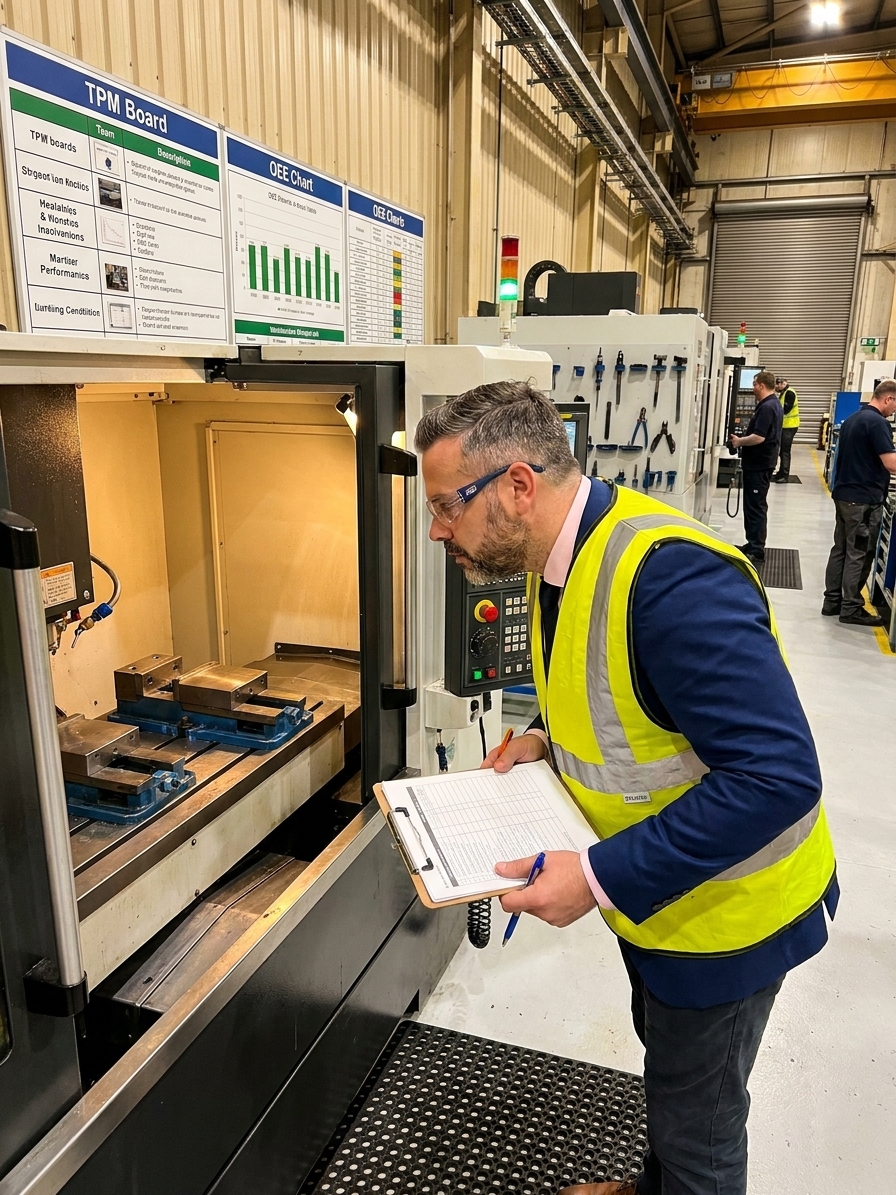
Total Productive Maintenance (TPM) arrived in Western manufacturing wrapped in the authority of post-war Japanese production engineering. The methodology promised equipment effectiveness climbing above 85% and breakdown rates dropping by 90%. Instead of waiting for machines to fail, organisations would maintain them proactively, involve operators in daily care, and systematically eliminate the six big losses that rob production capacity.
The eight pillars of TPM — autonomous maintenance, planned maintenance, focused improvement, quality maintenance, early equipment management, training, safety, and office TPM — form a comprehensive production system. But comprehensive systems are fragile. In my experience auditing automotive and aerospace plants, most organisations hollow out the methodology within six months while retaining all the visual indicators of compliance.
The failure mechanism is consistent. Leadership adopts the visual vocabulary of TPM — the checklists, the shadow boards, the OEE dashboards — without building the underlying data and human capability infrastructure. The result is maintenance theatre: a program that satisfies auditors but fails to prevent equipment degradation or improve output.
The Six Big Losses Nobody Measures
The theoretical foundation of TPM is the elimination of six equipment losses: breakdowns, setup and adjustment time, idling and minor stops, reduced speed, process defects, and startup yield losses. Together, these determine Overall Equipment Effectiveness (OEE). The premise is that most plants operate at 40-60% OEE without knowing it because they have never measured these losses individually or accurately.
This is where implementations fail first. When you ask a maintenance manager what percentage of minor stops are captured, the answer is usually silence. Minor stops — the three-to-five-second micro-jams that happen dozens of times per shift — are almost never logged. The operator hits the reset button, the shift record shows full production, and the OEE number on the wall is calculated from whatever data was easiest to collect.
If the data is wrong, every improvement target derived from it is arbitrary. The six losses framework requires granular data capture at the machine level. Most organisations are unwilling to invest in the automated monitoring or the operator discipline needed. They estimate, round, and exclude anomalous shifts. Within months, the OEE dashboard becomes a negotiated figure rather than a measured fact that drives maintenance action.
The Six Big Losses Driving OEE
Autonomous Maintenance as Custodial Work
Autonomous maintenance is the pillar organisations implement first because it produces immediate visible results. The principle is sound: operators perform basic tasks — cleaning, lubrication, tightening, inspection — and develop an intimate understanding of the equipment. They become the first line of defence, noticing the abnormal vibration or temperature change that precedes a catastrophic failure.
In practice, autonomous maintenance usually degrades into a cleaning schedule. Operators receive checklists, wipe down machines, initial boxes, and file the paper. Nobody analyses trends. Nobody uses the inspection findings to plan interventions. The fundamental error is treating autonomous maintenance as a task to be completed rather than a diagnostic skill to be developed.
I have audited plants where autonomous maintenance checklists ran for three years without a single operator understanding what an abnormal lubrication condition looked like. The checklist asked 'Lubrication OK?' The operator checked 'Yes' every day until the bearing failed catastrophically and shut down the line. The cleaning was supposed to be the context for learning to see abnormalities. Instead, it became compliance paperwork.

The Planned Maintenance Calendar Trap
Planned maintenance is where organisations discover that scheduling interventions by time interval is expensive and often counterproductive. Genuine TPM advocates condition-based maintenance: monitoring actual equipment health via sensors and oil analysis, and intervening only when the data demands it. But condition-based maintenance requires analytical capability and the discipline to act on the findings.
Most plants default to calendar-based preventive maintenance because it only requires a spreadsheet. They build schedules using the manufacturer's generic recommendations — the same intervals written for any installation regardless of load, environment, or duty cycle. They discover they are maintaining equipment that does not need it, while ignoring equipment that degrades faster than the schedule predicts.
The worst iteration is the plant that converts from reactive firefighting to calendar-based maintenance and declares victory. The maintenance budget doubles. Equipment availability does not improve. Unplanned breakdowns continue at the same rate because the calendar addresses the wrong failure modes. If you are not monitoring actual equipment condition to drive maintenance decisions, you are running a scheduled lubrication route, not TPM.
Focused Improvement and the OEE Obsession
Focused improvement, or kobetsu kaizen, targets chronic, systemic losses. The methodology requires cross-functional teams with dedicated time, analytical tools, and the authority to implement changes without climbing the management hierarchy. Most plants convert this pillar into a suggestion box scheme. The easy ideas get implemented; the complex, chronic losses that actually limit capacity are ignored because they require structured root cause analysis, not a five-minute idea.
When OEE becomes the metric a manager's bonus depends on, the components get optimized in the easiest ways possible.
Goodhart's Law applies to OEE with devastating precision. When the composite metric becomes a target, teams optimise the number rather than the equipment. Availability improves by reclassifying planned downtime. Performance improves by running machines at a conservative speed — the opposite of TPM's intent. Quality improves by reworking scrap internally before it gets counted as a reject. I have audited plants reporting world-class 85% OEE while producing scrap at a rate that would horrify the customer.
OEE is a diagnostic compass, not a scorecard. Use it to identify where to investigate. Evaluate individual and team performance on capability development and problem-solving effectiveness, not on whether a composite metric moved in a favourable direction. The moment you tie performance rewards to OEE, you manufacture the incentive to manipulate it.
Rebuilding the Human Capability System
The training pillar is usually the first cut when budgets tighten, which guarantees the failure of every other pillar. Autonomous maintenance requires operators who understand equipment physics. Planned maintenance requires technicians who can interpret vibration and oil data. Focused improvement requires teams who can apply structured problem-solving frameworks like 8D. None of these capabilities survive a two-day kickoff workshop.
Real TPM training is ongoing. It involves structured skill development, hands-on practice with real equipment under the guidance of experienced technicians, and assessment to confirm that the learning has actually occurred. It takes months and costs money. It is the single most important investment in the program because TPM is fundamentally a human capability system. Without skilled people, the eight pillars are just text on a poster.
Culture determines whether this capability survives. TPM requires transparency, where operators stop the line for abnormalities without fear of blame. It requires leadership that visits the shop floor to learn, not just to audit. When the overriding priority is hitting the shift target at all costs, production teams will tolerate maintenance activities during ISO 9001 or IATF 16949 audits and ignore them during normal operations. Changing this behaviour requires sustained leadership commitment over years.
Effective TPM Execution Sequence
- 01Capture True LossesAutomate tracking of minor stops and micro-stoppages; stop estimating OEE.
- 02Develop Diagnostic SkillTrain operators to identify abnormalities, not just initial checklists.
- 03Shift to Condition-BasedReplace calendar intervals with sensor data and predictive analytics.
- 04Protect Improvement TimeProvide dedicated, cross-functional hours for complex root cause analysis.
The Single Diagnostic Question
Plants that succeed with TPM share identifiable traits. They measure accurately, refusing to negotiate OEE. They develop people before deploying tools. They protect dedicated time for focused improvement. They use metrics diagnostically. And their leadership accepts that TPM is a multi-year engineering transformation, not a quarterly initiative.
To evaluate whether your program is real or theatre, ask one question: when was the last time an operator stopped production because they noticed an abnormality during autonomous maintenance, and what happened to that operator afterward?
If the answer is that they got praised, maintenance was called, and the breakdown was averted, you are doing TPM. If the answer is that they got reprimanded for stopping the line, you have your diagnosis. The methodology is not broken. The implementation simply failed to build the capability and culture the methodology requires.