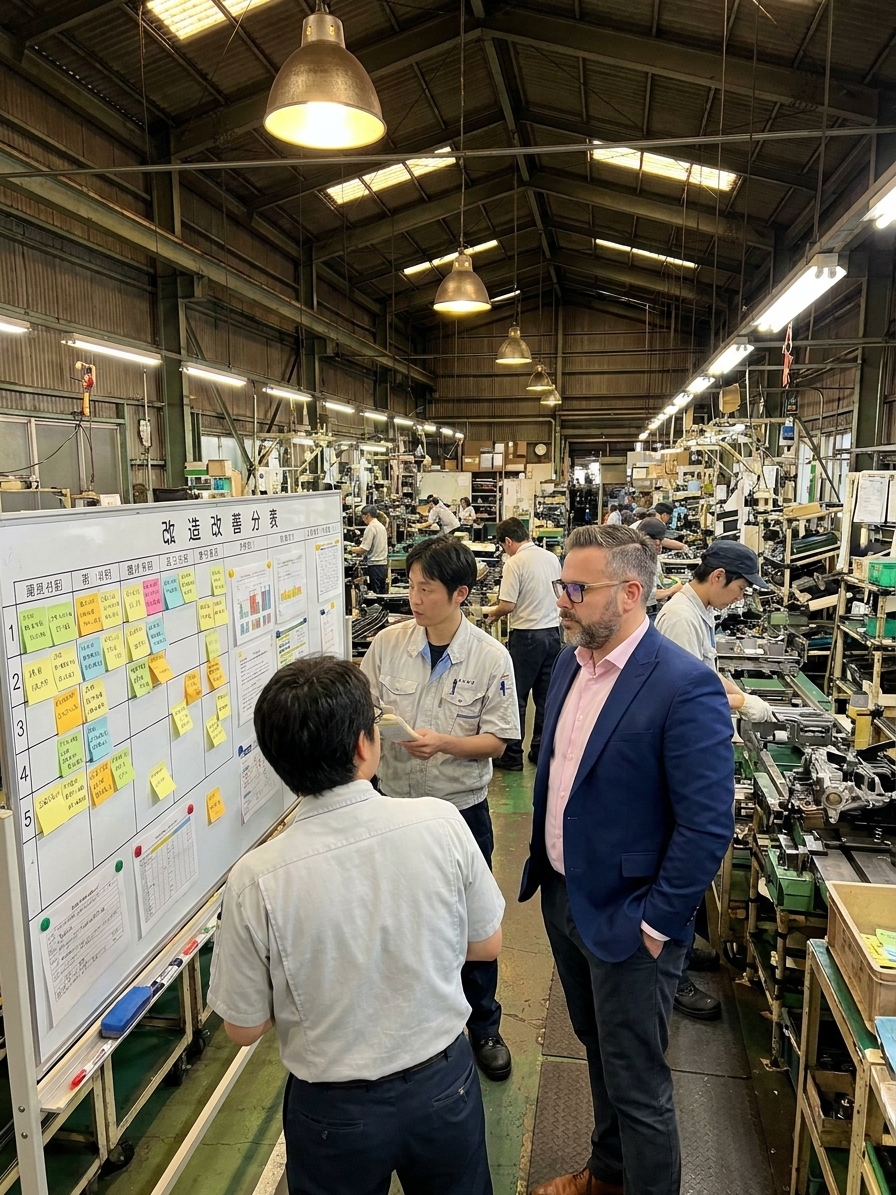
Kaizen is the Toyota Production System's heartbeat. The word translates simply: change for the better. Not revolutionary change, but small, incremental, continuous change. The concept is democratic: every worker, every day, looks at their workspace and asks what one thing they could improve. Over years, those small improvements compound into transformational results.
It is beautiful in theory. It is also one of the most corrupted concepts in modern manufacturing. Walk into any factory that claims to practice kaizen and you will find one of two failures. Either kaizen is a slogan on a banner above a production line where nothing has changed in three years, or it has metastasized into a relentless churn of changes that never settle and never deliver compounded benefits.
The first failure is obvious. The second is the one nobody talks about. I have audited plants where the improvement program was so aggressive that defect rates actually increased after it launched. Each new improvement introduced a new variable. Each new variable created new variation. The factory was improving itself into chaos.
Standard Work as the Anchor
At Toyota, kaizen was never just 'make changes.' It was a structured discipline built on standard work. You could not improve what you had not standardized. The sequence was strict: establish a standard, follow the standard, find a better way, make that the new standard, and repeat. The standard was the anchor. The improvement was the wave.
Taiichi Ohno, the architect of the Toyota Production System, was emphatic about this. He did not want creative people inventing new methods every day. He wanted people who would follow the standard exactly, observe the gaps between standard and reality, propose a specific improvement, test it, and only if it worked make it the new standard. The creativity was in the observation and the experiment, not in constant reinvention.
This is the part most manufacturers miss. Without the anchor of an enforced, stable standard, you are not improving. You are drifting. Quality requires repeatability, repeatability requires stability, and stability requires a process that stays the same long enough to be understood. Change the process every week and you can never establish a baseline or identify special-cause variation.
When changes happen faster than the organization can stabilize them, you lose standard work entirely. When you lose standard work, you lose quality. This is not a hypothesis. It is a mathematical certainty. You cannot achieve a Cpk of 1.33 on a process that shifts before the measurement system can even baseline it.
The Kaizen Event Industrial Complex
The most common corruption of kaizen in Western manufacturing is the 'kaizen event' — also called a kaizen blitz or rapid improvement event. The format is familiar: pull five to ten people off their normal jobs for three to five days, give them a facilitator, point them at a problem, and expect dramatic results by Friday afternoon. Some of these events produce genuine improvements. Many produce theatre.
The deadline distorts the problem. When you have five days to show results, you do not tackle the hardest problem. You tackle the problem you can solve in five days. Structural issues — the ones causing the majority of waste — sit untouched while teams rearrange workbenches and add shadow boards. The visible energy is high. The actual impact is low. But leadership sees busy people and declares victory.
The team composition is equally flawed. A kaizen event team is often assembled from people who do not own the process being improved. They are smart and mean well, but they walk away on Friday and never touch the process again. The operators who run it every day are frequently excluded or included as a single voice drowned out by engineers and managers. You get solutions designed for operators without operators.
Then there is the sustainment plan. Every kaizen event ends with a report-out that includes a slide pledging monthly audits. Nobody audits monthly. Nobody holds the gains. Within six weeks the shadow boards are empty, the new standard work is ignored, and the process has reverted. Except now there is residual cynicism about the next event, because everyone remembers the last one changed nothing that lasted.
Change Fatigue and System Interactions
The deeper damage from corrupted kaizen is change fatigue, and it is the most dangerous failure mode because it is invisible until it is catastrophic. A factory decides to embed kaizen into the culture. Every team must implement at least one improvement per month. Some set a quota: five improvements per person per year. The metrics look great. The improvement boards are covered with sticky notes. Leadership celebrates the count.
But each improvement changes the process. Each change requires retraining. Each retraining requires time. And each change interacts with every other change in ways nobody anticipated, because nobody is managing the system holistically. Operator A's improvement to the feed mechanism interacts with Operator B's improvement to the inspection station. The result is a new failure mode that neither caused individually.
This is why an uncontrolled improvement program directly attacks your PPAP and PFMEA foundations. A process validated for automotive production under IATF 16949 cannot absorb weekly undocumented changes. When operators modify station sequences without updating the control plan, the PFMEA no longer reflects reality. You are running unvalidated processes with documentation that lies.
The True Cost of Disruption
Let me quantify what this costs, because the expense is the part that gets ignored. A typical kaizen event consumes 40 person-days of effort. At a fully loaded labor rate, that is roughly $19,200 per event in direct labor alone. Add facilitator costs, materials, lost production, and the overhead of reporting, and you are at $30,000 to $50,000 per event. Now ask how many of last year's events produced improvements still in effect today.
If the answer is less than half — and in most organizations it is — then you are spending $25,000 or more per event to generate temporary changes that revert within months. That is a recurring expense disguised as an investment. The opportunity cost is worse. While your best people run kaizen events on minor problems, the major problems go unaddressed.
| Real Kaizen | Performance-Art Kaizen |
|---|---|
| Rooted in a stable, documented standard work | Rooted in 'before' and 'after' photos |
| Targets the structural issue causing 80% of waste | Targets the visible mess solvable in five days |
| Measured by defect reduction and Cpk improvement | Measured by counting implemented improvements |
| Changes are tested, proven, then permanently adopted | Changes are celebrated, reported, and quietly abandoned |
The supplier quality issue that causes 60% of your field returns does not get solved in a five-day event. The equipment reliability problem that causes your biggest capacity constraint does not get solved by a team that includes no maintenance engineers and no capital budget. Real problem-solving requires depth, time, and authority — the three things kaizen events are structurally designed to avoid.
There is a third failure mode that is the most insidious because it is the hardest to detect from the outside. This is when kaizen becomes a performance, something done to demonstrate engagement rather than achieve results. The improvement board has before and after photos. The improvement was: we cleaned up. This is housekeeping presented as innovation.
A factory that changes everything and stabilizes nothing is not improving. It is manufacturing disruption at great expense.
Diagnostic Signs Your Program Is Broken
There are clear diagnostic signs that your improvement program has become a disruption engine. If three or more of these are true in your organization, your kaizen program is producing churn rather than improvement. The most obvious sign is that you count improvements rather than measuring their impact.
If your kaizen metric is 'number of improvements implemented,' you are optimizing for activity. Organizations that benefit from kaizen measure outcomes: defect rates, cycle times, cost per unit, OEE. They treat improvements as means, not ends. Another sign is that your standard work documents change more than once a quarter. If operators cannot remember the current standard because it changed last week, you do not have standard work. You have a draft.
Look at whether the same problems appear on the kaizen board year after year. If you are continuously improving the same bottleneck for the third year in a row, your improvements are not compounding. They are replacing each other. Check whether improvements are concentrated in low-impact areas like 5S while your top three quality issues have never been the subject of focused problem-solving.
Finally, the clearest sign: your improvement rate goes up while your quality metrics stay flat. More improvements with no quality improvement means the improvements are not improvements. They are changes. And each change adds a variable that makes the next 8D investigation harder, because nobody knows which undocumented modification caused the defect.
The Recovery Plan: Discipline Over Activity
If your kaizen program has become a disruption engine, you must reset. Freeze all kaizen events for 60 days. Use the time to audit which previous improvements are still in effect. Be honest. If fewer than 50% have survived, your process for generating improvements is broken and needs to be redesigned before you generate more. Do not add to the wreckage.
Re-establish standard work before you improve anything. You need a stable baseline. Document the current state of your top three production processes — not the ideal state, but the actual state as practiced on the floor, including all workarounds and deviations. This is your starting point. A process you have not standardized cannot be improved, only changed.
The Real Kaizen Cycle
- 01Establish standardDocument the current best practice as the baseline
- 02Follow the standardOperators execute exactly as documented, no deviations
- 03Observe the gapIdentify the specific difference between standard and reality
- 04Test the countermeasureRun a controlled trial against the current standard
- 05Adopt and updateOnly proven improvements become the new standard work
Shift from event-based to problem-based. Instead of scheduling a kaizen event every month and looking for a problem to solve, identify your top three quality or efficiency problems and charter a team to solve each one. Give the team as long as it takes. Measure success by whether the problem is solved, not by whether the team finished in five days.
Change the metric. Stop counting improvements. Start measuring what percentage of your standard work documents have been stable for more than 90 days. Measure how many of your top-ten quality issues from last year have been permanently resolved. Measure how many kaizen improvements from twelve months ago are still being followed today. These metrics tell you whether you are improving or just churning.
Protect the standard. Make it harder to change standard work, not easier. Require that any proposed improvement be tested in a controlled trial, measured against the current standard, and reviewed by the process owner before adoption. This is not bureaucracy. It is quality control for your improvement process itself.
Durability Over Speed
Real kaizen is slower than you want it to be. That is not a bug. It is the design. At Toyota, a worker on the line who notices a problem does not immediately change the process. They signal for their team leader and the problem is addressed in the moment. If it is recurring, it goes to a problem-solving team that investigates root cause, proposes a countermeasure, tests it, and only after it is proven updates the standard work.
This can take weeks for a single improvement. It is methodical, deliberate, and because of that, the improvements stick. The rate of improvement at Toyota is not dramatic on any given day. But over a year, over a decade, the compounding is extraordinary. The power of kaizen done right is not the speed of change but the durability of change.
The organizations that try to accelerate kaizen — pushing for more events, more improvements, more sticky notes, more activity — almost always end up with less actual improvement than organizations that slow down, standardize rigorously, solve one problem at a time, and make each solution permanent before moving to the next.
Kaizen is not about change. It is about better. Those are not the same thing, and confusing the two is the most expensive misunderstanding in modern manufacturing. Your operators already know this. They watch improvement programs come and go, fill out the forms, participate in the events, and then return to doing the job the way they have always done it. The question is whether your organization can make one improvement that is still working on the day you retire.