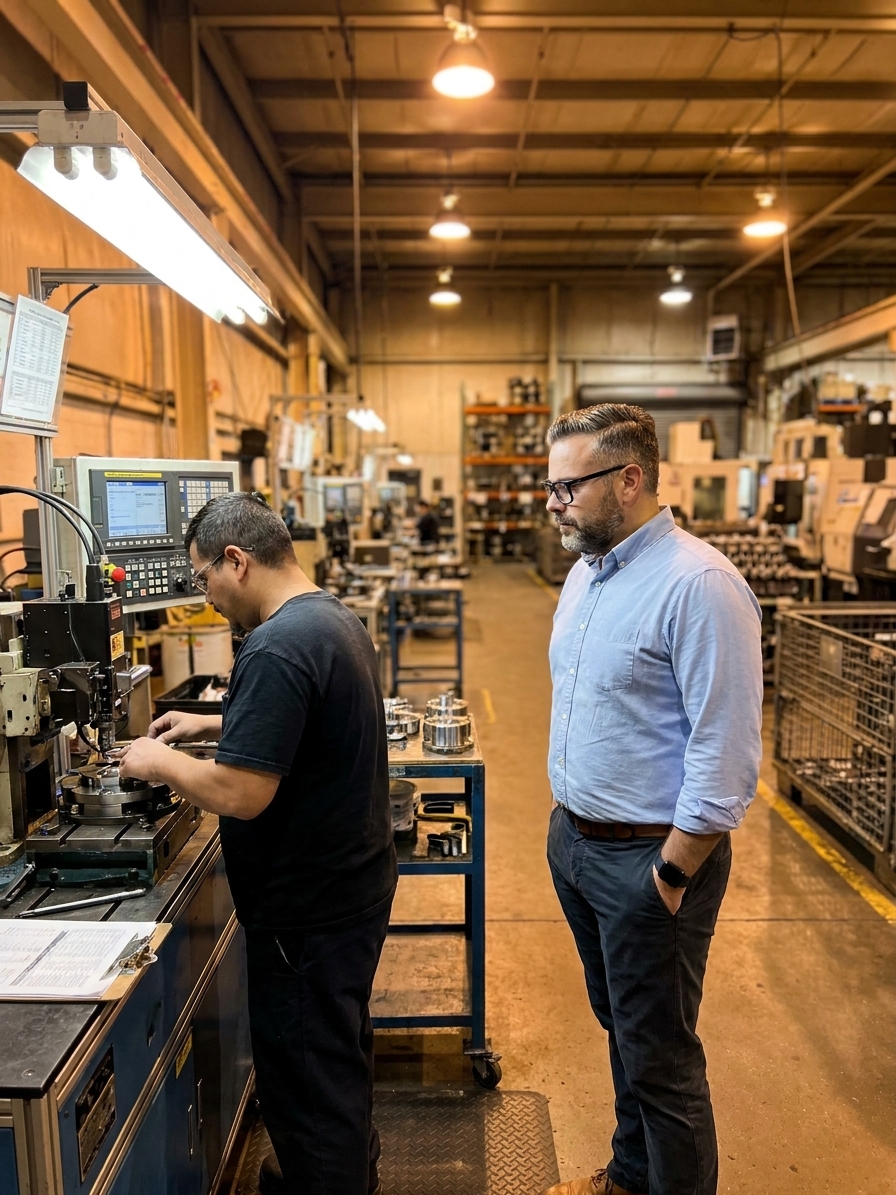
Genchi genbutsu, or go and see for yourself, is the most universally corrupted practice in lean manufacturing. Taiichi Ohno famously drew a chalk circle on the factory floor, stood a young engineer inside it, and told him to watch until he understood the waste. No dashboards, no summary reports, no filtered data through three layers of management. Just the real work, happening in real time, observed by the people responsible for improving it.
The promise of the gemba walk is that leaders leave their offices, stand where value is actually created, and see what is really happening. Not what the metrics say is happening, not what the shift report claims happened yesterday, and not what the PFMEA says should be happening. The goal is to observe what is actually occurring right now, on the shop floor, at the point of production.
In most organisations that adopt gemba walks, the practice immediately degrades. A Vice President of Operations mandates weekly walks. A route is mapped through the plant, and a checklist is distributed covering 5S standards, PPE compliance, and visual management board updates. What follows is not a learning exercise. It is an audit performed outdoors, and the distinction matters because the two activities have entirely different purposes.
Audit Compliance versus Process Observation
An audit verifies compliance against a standard. A gemba walk builds understanding of the actual process. When you convert a gemba walk into a audit, you achieve the worst of both worlds. You lose the depth of a genuine IATF 16949 or VDA 6.3 audit because you are moving too fast and checking superficial items. You simultaneously forfeit the learning of a real gemba walk because your focus is on checking boxes instead of observing flow.
Every Wednesday morning, a group of eight or ten managers walks the designated route in a cluster. They spend three to five minutes at each station, glance at the work area, and check items off the list. Operators freeze up because ten managers are staring at them. After forty-five minutes, the group returns to the conference room, reviews findings, assigns action items, and files a report. No process understanding has been generated.
A checklist converts observation into verification, and those are fundamentally different cognitive activities. When you verify, you ask if the condition matches the standard. The answer is binary, and the thinking stops there. When you observe, you ask what is actually happening and why. The answer is open-ended, contextual, and leads directly to root cause analysis.
Verification closes questions. Observation opens them. A checklist is explicitly designed to close questions efficiently, which is exactly why it prevents the discoveries that gemba walks are supposed to produce. This is not an argument against standardised work or checklists for repetitive tasks. But applying a fixed checklist to an exploratory observation of a dynamic system guarantees you will measure the wrong things.
The Entourage Problem and the Hierarchical Filter
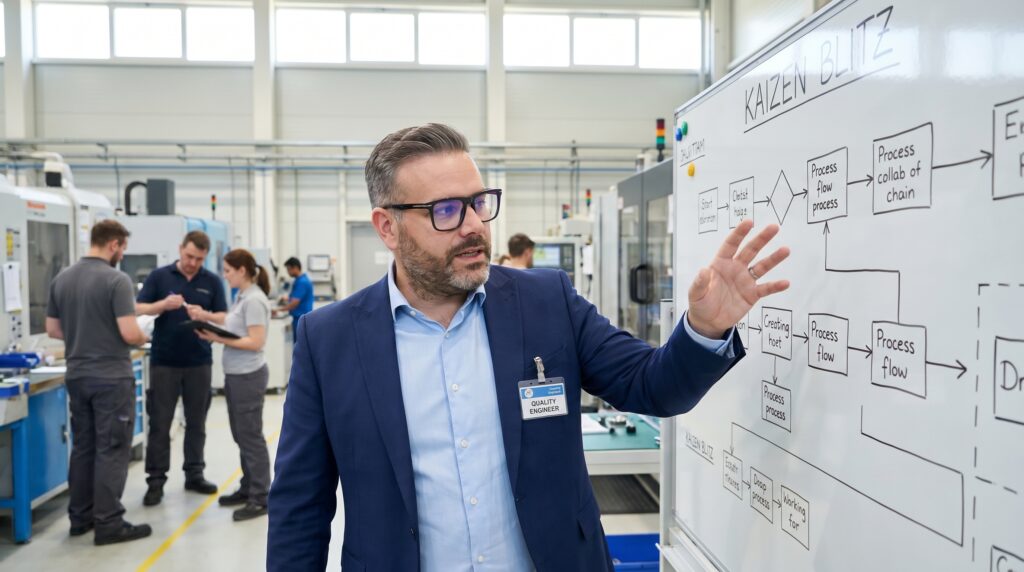
The single most common failure mode is the entourage. A gemba walk is not a group tour. Ohno sent one engineer to stand in one circle. The purpose was sustained, individual observation. That focused attention is physically impossible when you are part of a delegation of nine managers walking in formation, each trying to look smart in front of the others.
When you walk in a group, operators behave differently. They become self-conscious, follow procedures more carefully than normal, and hide the shortcuts they usually take. You see a performance, not the process. The group dynamic also shifts the cognitive mode of the participants. Instead of observing, they manage impressions by asking questions that demonstrate their knowledge and deferring to the senior person.
A real gemba walk is done alone or with one other person. Two people maximum. If a senior leader insists on joining, one person leads and one observes. The moment you have more than three people, it is a procession. The hierarchical filter also operates on multiple levels here. The VP sees what the plant manager wants them to see. The plant manager sees what the shift supervisor wants them to see. At each level, problems are minimised.
The only way to defeat this hierarchical filter is to go alone, unannounced, at different times of day. You must go to the same place repeatedly over weeks. Operators need to see that your presence on the shop floor is normal, not an event. Only when the gemba walk becomes routine will the shop floor stop performing for you and start showing you the unfiltered truth.
The Speed Trap and the Metrics Disconnect
Most corporate gemba walks last between thirty and sixty minutes and cover the entire plant. At a pace of one station every three to five minutes, you cannot observe anything meaningful. You can confirm the area looks clean. You can check that the operator is present. But you cannot observe flow.
Flow takes time to see. You need to stand in one place long enough to watch at least ten complete work cycles, ideally twenty, to see the variation. You are looking for micro-stoppages, rework, waiting, and the repositioning that operators do so smoothly it looks intentional but is actually compensation for a poorly designed workstation. Ohno's engineer stood in that chalk circle for hours, not minutes.
Many plants have adopted visual management boards and OEE dashboards at each workstation. During a gemba walk, these become a trap. Leaders walk up to the board, read the numbers, ask a question about the trend, and move on. They have engaged with a representation of the process rather than the process itself. It is the difference between reading a map and walking the terrain.
An OEE dashboard tells you nothing about the eleven micro-stoppages that happened during the shift, each invisible in the data because the system rounds down.
Metrics are a model of reality, not reality itself. They are always lagging, aggregated, and smoothed. An OEE of seventy-two percent hides the eleven forty-second micro-stoppages that happened during the shift, each invisible in the data because the system rounds down. If you stand at the machine for twenty minutes, you will see those stoppages. The gap between what the board says and what the floor shows is where the learning lives.
The Solution Reflex and Premature Closure
Engineers and managers are problem solvers, which makes the solution reflex particularly dangerous during a gemba walk. They see an operator struggling with a fixture, and they immediately propose a corrective action on the spot. The solution reflex terminates observation prematurely. The first explanation for a problem is almost never the real root cause.
The operator is struggling with the fixture. Why? Is the fixture worn? Was the part loaded incorrectly upstream? Is the clamping force drifting because maintenance has not checked it in eight months? Each explanation leads to a completely different 8D corrective action. If you jump to a solution based on five seconds of observation, you will implement a fix that addresses the symptom and leaves the root cause untouched.
When you see a problem during a gemba walk, your job is to understand it, not to solve it. Ask questions. Follow the process upstream. Talk to the operator. Gather data. Then leave, think about it, and come back with a considered response. The speed of your response is far less important than the quality of your understanding. Premature solutions teach operators that showing problems to managers only results in useless quick fixes.
The Observation Sequence
- 01Select and PositionChoose one process segment. Stand close enough to see the work, far enough to avoid disrupting the operator.
- 02Observe and MeasureWatch at least ten complete work cycles. Time them. Note variation, micro-stoppages, and ergonomic compensation.
- 03InquireAsk open-ended questions. Follow the material flow upstream to understand incoming quality and constraints.
- 04HypothesiseLeave the floor without proposing a fix. Cross-reference raw observations with process data and standard work.
- 05Return and VerifyCome back the next day to test the hypothesis against the actual conditions on the shop floor.
What a Genuine Gemba Practice Looks Like
A genuine gemba walk is unglamorous and produces no deliverable that can be filed in a quality report. You go alone. You pick one area, one workstation, or one operation, and you stay there for at least twenty minutes. You watch complete work cycles. You count, you time, and you note the variation between cycles. You look at the material flow to see where parts come from and where they go.
You ask questions, but not leading or judgmental ones. You ask the operator to walk you through what they are doing. You ask how often a specific interruption happens and what they do when a step fails. These are questions born of curiosity. You take notes on whatever surprises you, contradicts your expectations, or reveals something the OEE dashboard failed to capture.
Toyota managers did not schedule gemba walks. They lived on the shop floor. Ohno's office was on the production floor. The deepest failure mode in modern plants is treating the walk as a scheduled event rather than a daily habit. Five unannounced ten-minute walks per day at varying times are worth more than one ninety-minute scheduled walk per week. The total time is similar, but the learning is incomparable.
Scheduled Audit versus Daily Habit
The Performative Walk
- Scheduled weekly with a fixed route and management cluster
- Driven by a standardised 5S and PPE checklist
- Pre-announced, ensuring the area is cleaned and staged
- Focused on verifying what the visual boards claim is happening
The Observation Habit
- Unannounced, brief visits distributed across the day
- Driven by curiosity about process flow and cycle variation
- Routine presence that removes the pressure of performance
- Focused on finding the gap between standards and reality
Rebuilding the Practice from Scratch
If your organisation's gemba walks have devolved into performative rituals, the path back requires discipline but is not complicated. Stop scheduling formal walks. Stop distributing checklists. Stop going in groups. Stop pre-announcing visits. Pick one critical process. Go to it tomorrow, alone. Stand there for thirty minutes. Watch. Take notes on what you see, not what you expected to see.
Come back the next day and do it again. Repeat for a week. At the end of the week, you will know more about that process than anyone in your organisation who has not been doing this. You will see waste that the metrics do not capture. You will understand the physical constraints that the production meetings keep discussing without resolving. You will have questions that the standard work document cannot answer.
Some leaders walk the floor to be seen walking the floor. Others walk to solve problems in real time, gathering a team and initiating corrective actions on the spot. Both approaches are wrong. The former is a visibility exercise. The latter turns the walk into a firefighting exercise. The right reason to walk the floor is to learn and to continuously refine a mental model of how the process actually works today.
Every failure mode described here is, at its root, a mechanism for avoiding the patience required to see reality. The checklist replaces patience. The group tour replaces patience. The solution reflex replaces patience. The result is always an organisation that believes it is practicing genchi genbutsu while actually confirming what leaders already believe. Break the ritual. Go alone. Go slowly. The truth is waiting for someone patient enough to see it.