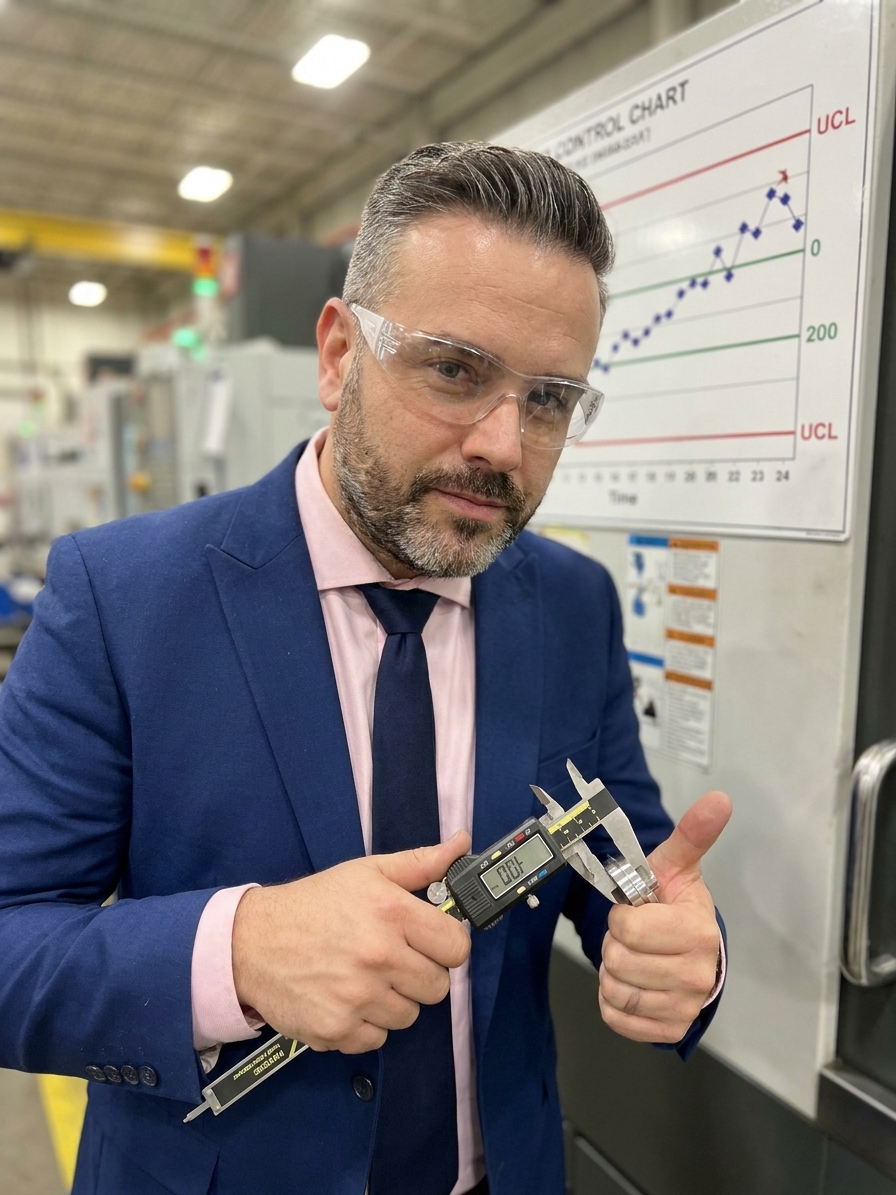
Manufacturing organisations suffer from a specific, silent failure mode that evades standard scrap reports and quality dashboards. It manifests on the shop floor, where inexperienced personnel approve first articles and wave products through with absolute certainty. These operators have executed the task a thousand times, yet they fundamentally lack understanding of the underlying engineering mechanics.
This behavioural pattern mirrors the Dunning-Kruger Effect. Individuals with limited competence drastically overestimate their abilities, while seasoned experts often hesitate because they fully comprehend the complexity of the manufacturing process. This cognitive bias is particularly dangerous in quality management because the affected individuals are constitutionally incapable of recognising their own deficit.
I have audited plants where the unshakeable conviction of a floor inspector overrode the valid, data-driven concerns of a senior quality engineer. The resulting escaped defects cost millions in warranty claims. Confidence is inherently persuasive, but in a high-volume production environment, unearned confidence is a liability that standard metrics often fail to capture.
The Persuasion of False Certainty
Overconfidence feels indistinguishable from genuine competence to the untrained observer. In a production meeting, an inspector who states a part is acceptable with absolute conviction will almost always defeat an engineer who requests further statistical analysis. Factory environments demand decisiveness, and management structures rarely reward nuanced hesitation.
This dynamic creates a backwards selection pressure. Personnel who project the most confidence, rather than the most competence, rise to positions of informal authority on the shop floor. They become the shift leads and floor coordinators who make critical disposition decisions when engineering support is unavailable.
Because these decision-makers answer with total assurance, their outputs feel correct to the rest of the team. When a flawed disposition slips through, the resulting failure is often traced back to an authoritative, confident judgement that lacked the technical depth required by the specific IATF 16949 or AS9100 control plan.
Meanwhile, your most competent staff begin to doubt their own rigorous analysis. An expert engineer, acutely aware of measurement uncertainty and process variation, will caveat their statements. Management, lacking the technical depth to distinguish between the two types of confidence, consistently sides with the loudest voice in the room.
The Measurement Paradox in Quality Control
The Dunning-Kruger Effect interacts with quality metrics to create a dangerous feedback loop. An inexperienced inspector who checks parts and approves them all generates data that looks like a massive success. A report showing zero defects and a 100% pass rate reassures management that the quality system is functioning perfectly.

However, those metrics reflect the inspector's inability to detect defects, not the actual capability of the process. The zero-defect report is merely evidence of an inspector who does not know what constitutes a nonconformance. The clean data is generated by the exact blindness that creates the organisational risk.
Conversely, your most rigorous inspector will produce alarming reports. By catching subtle deviations and borderline tolerances, they flag more issues and hold more product for review. To a manager relying purely on dashboards, the good inspector looks like a bottleneck, and the bad inspector looks like a top performer.
Organisations have fired their best inspectors and promoted their worst ones based on this paradox. The bias distorts the entire personnel evaluation system, because the metrics used to gauge performance are fundamentally contaminated by the subjectivity of the person recording the data.
Where the Bias Hides in Standard Quality Processes
This confidence gap does not distribute itself evenly. It concentrates heavily in specific quality functions where the variance between perceived and actual technical depth is hardest to measure. We see this routinely in first article inspection (FAI), where operators check the dimensions they understand and completely skip complex geometric tolerancing.
In supplier quality audits, an auditor who has memorised ISO 9001 clause numbers but lacks understanding of process capability will issue a passing grade. They will never ask for Cpk data or analyse the supplier's statistical process control (SPC) charts, believing wholeheartedly that their checklist is comprehensive.
| Quality Function | The Surface Action | The Hidden Failure |
|---|---|---|
| First Article Inspection | Measuring known dimensions and signing the report | Ignoring true position and profile tolerances they do not comprehend |
| SPC Monitoring | Plotting points within the control limits | Failing to recognise non-random patterns indicating an imminent shift |
| Corrective Action (8D) | Filing thorough, well-documented operator error reports | Missing systemic design flaws that actually caused the defect |
In calibration management, a technician may believe a gauge is accurate simply because the sticker is current, failing to grasp the concept of measurement system analysis (MSA). An operator plotting points on an SPC chart might see a point inside the control limits and conclude everything is fine, completely missing a gradual drift.
Even in corrective action, the bias is destructive. A quality manager who consistently cites 'operator error' as the root cause genuinely believes they have solved the problem. They lack the analytical depth required to conduct a true 5-Whys analysis that uncovers systemic process failures.
Structural Defences Against the Confidence Trap
Breaking this closed loop requires introducing outside variables. You cannot rely on the affected individuals to self-identify their knowledge gaps. Quality leadership must build structural defences that actively force competence checks and separate decision authority from pure confidence, regardless of how persuasive the individual might be.
Neutralising Inspector Bias
- 01Blind TestingInsert known-defective master parts into the daily inspection stream without prior warning.
- 02Diagnostic CaptureIdentify which operators pass the defects to map specific visual and functional blind spots.
- 03Calibrated FeedbackShow the operator the specific defect they missed and explain why it engineeringly matters.
- 04Process RevisionUpdate the visual inspection standard and mandate cross-functional peer review for critical parts.
Blind testing is the most effective diagnostic tool. By seeding known-defective parts into the inspection stream, you force a confrontation with reality. If an operator passes the defective part, they can no longer rationalise their competence. This exercise must be positioned as a system diagnostic, not a punitive measure.
Mandatory peer review also mitigates individual blind spots. When cross-functional teams review disposition decisions, the variation in their expertise fills the gaps. Inspector A may miss a specific type of burr or finish defect that Inspector B catches immediately, and vice versa.
Rebuilding the Authority of Expertise
Training without immediate, specific feedback is just vocabulary memorisation. When you teach a new MSA or APQP concept, you must follow it with applied exercises: 'You passed this part, here is the defect you missed, and here is why it violates the customer specification.' Concrete feedback closes the competence gap.
The most dangerous person in your quality organisation is the one who knows a little and is certain they know enough.
Management must actively separate decision authority from confidence. The person who speaks first and loudest in a containment meeting should not be the person making the final call. Decisions regarding product disposition must rest with the individual possessing the deepest relevant engineering expertise, regardless of their delivery speed.
This shift requires a deliberate cultural change driven from the top. When the quality director openly states, 'I do not know the root cause yet; we need to run a Design of Experiments,' it grants the entire team permission to be analytical. It replaces the pressure for immediate answers with the expectation of rigorous verification.
The Mirror Test for Quality Leadership
If you read this analysis and immediately picture a specific colleague, you are falling into the trap yourself. The Dunning-Kruger Effect does not exclusively affect operators and junior inspectors. It affects quality managers, engineering directors, and consultants who have spent years relying on the same mental models without having their assumptions challenged.
A quality leader with two decades of experience may possess a deep toolbox of standardised approaches but hold a remarkably shallow understanding of a specific plant's current variables. The relevant question is not whether you possess this bias. You do. The question is whether your quality system is designed to surface it and correct for it.
Every recall traces back to an inspection that passed when it should have failed. Every field failure originates from a decision made with more certainty than the underlying data supported. Every quality crisis that appears to emerge from nowhere actually brewed for months, invisible to the people closest to the process.
Genuine humility, the awareness that your inspection might have missed a critical failure mode, is the most vital attribute a quality professional can cultivate. It is also the rarest. Audit your organisation for unearned confidence, and then have the courage to audit yourself.