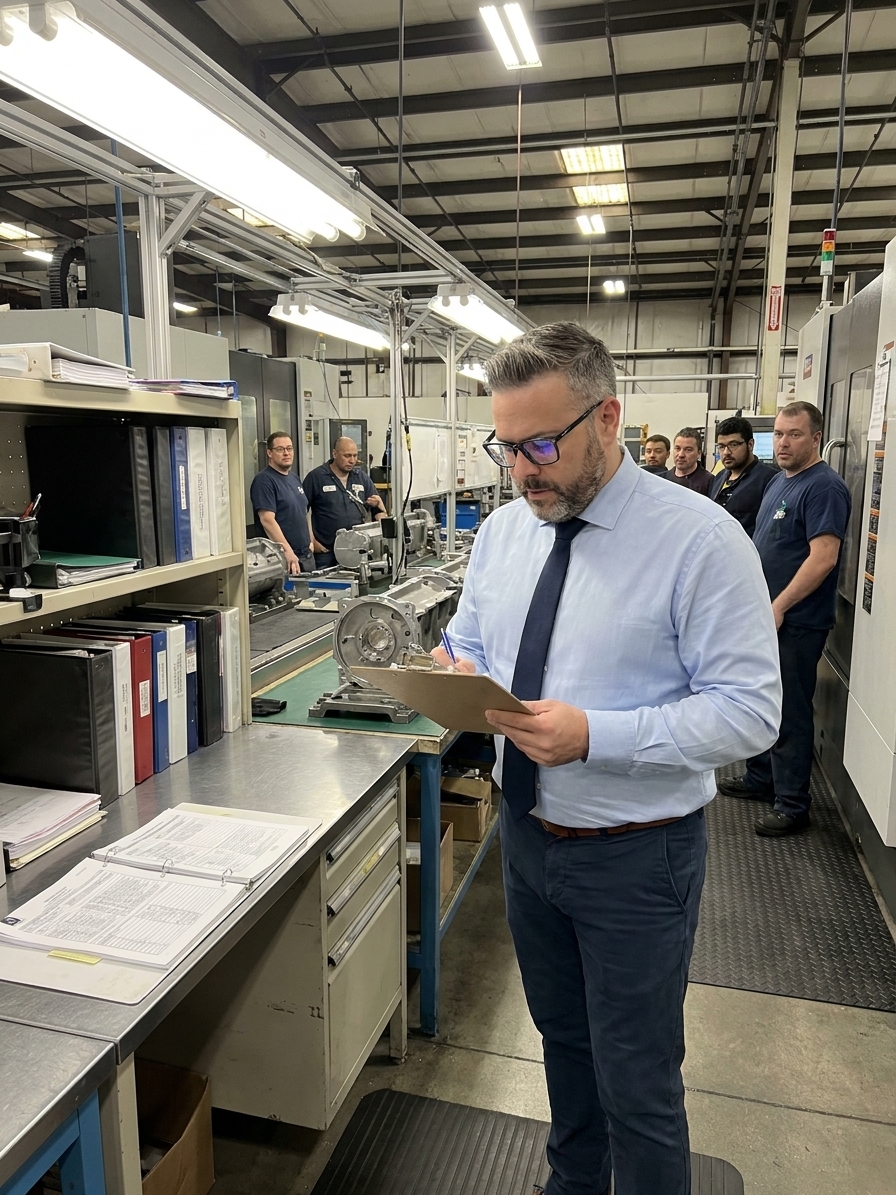
The biannual internal audit consumes thousands of labor hours across automotive, aerospace, and medical device plants. Documents are polished, nonconformances are quietly resolved before anyone official sees them, and the shop floor gets a level of attention it has not received since the previous cycle. The auditors arrive, and for three to five days, everyone performs the version of the quality management system that exists in the procedures manual, not the version that exists on the production floor.
The audit concludes. The report lists a handful of minor nonconformances, a few observations, and a corrective action request or two. Management reviews the findings, assigns owners, sets deadlines, and closes the items. The IATF 16949 or AS9100 certificate gets renewed. And within a week, the organization reverts to exactly what it was doing before the auditors showed up.
This ritual is not a failure of auditing as a discipline. It is a failure of organizational design. The internal audit was never meant to be a compliance checkpoint. It was meant to be a structured learning mechanism designed to discover where the quality system breaks. Somewhere along the way, passing the audit became confused with having good quality, and the tool designed to reveal problems became the tool designed to hide them.
How the Audit Becomes a Performance
The transformation from diagnostic tool to theatre does not happen overnight. It happens through a series of rational-seeming management decisions that individually make sense and collectively destroy the value of the audit entirely. The first shift is motivational. When audit results are tied to performance evaluations or management bonuses, the audit stops being a diagnostic and starts being a threat.
If a plant manager's bonus depends on a clean audit, they will ensure the audit is clean. They will achieve this not by fixing systemic problems, but by managing the appearance of problems. The more sophisticated the incentive structure, the more sophisticated the concealment. This is not a character flaw. It is a predictable human response to the system in which people operate.
The second shift is preparational. The very existence of an audit-readiness campaign is an admission that what the plant does every day and what it shows the auditor are different things. The preparation period temporarily closes the gap between documented process and actual process, not by changing the actual process, but by staging the documented one. Document control suddenly rejects records they previously accepted, and calibration stickers get checked.
The final shift is relational. When auditors are perceived as adversaries, the dynamic changes from collaboration to concealment. Auditee teams learn to answer the exact question asked and nothing more. They guide auditors toward areas of strength and away from weakness. This is strategic self-preservation in a system that actively punishes transparency.

The True Cost of Audit Theatre
The financial cost of audit theatre is staggering when you actually calculate it. Consider a mid-sized manufacturing plant with 300 employees preparing for a three-day internal audit. The audit team logs roughly 200 labor hours for preparation, execution, and reporting. Auditees across department heads, line supervisors, and document controllers log another 300 hours. Preparation easily consumes 500 additional labor hours of gathering records and rehearsing answers.
At standard loaded labor rates, a single audit cycle costs tens of thousands of dollars. But this direct cost is the small number. The indirect cost is the cost of problems not found, improvements not made, and risks not mitigated. Every nonconformance hidden during the audit is a defect waiting to escape to a customer. Every process deviation papered over is a variation source degrading your Cpk.
Every corrective action closed without actually fixing the root cause is a problem that will return, usually during a peak production run or an external surveillance audit. The cultural cost is even more damaging. When the audit becomes theatre, it teaches the organization a corrosive lesson: that the quality system is a paperwork exercise. Operators learn that quality is the quality department's problem during audit season.
The Audit Preparation Cost Burden
Diagnostic Indicators of a Broken Audit Program
If you are uncertain whether your internal audit program has crossed the line from diagnostic to performance, look for specific operational indicators. Audit preparation being visible to the entire plant is the first warning sign. If supervisors suddenly enforce procedures they have ignored for months when the audit approaches, the system is not in its normal state. A genuine diagnostic requires no special preparation.
Audit findings that are consistently minor should trigger immediate suspicion. If internal audits routinely find only a handful of minor nonconformances while customer complaints, scrap rates, and warranty data tell a different story, the audits are not finding what matters. A quality system that produces significant customer-facing problems has significant internal problems.
Corrective actions closed quickly and quietly almost always indicate symptom treatment rather than root cause elimination. Real root cause analysis takes time. A corrective action closed in 48 hours almost certainly means someone wrote a procedural update, retrained operators on the update, and checked the box. The underlying PFMEA failure mode remains unchanged.
The most damning indicator is recurring findings. If audit reports cite the same nonconformances cycle after cycle, the 8D corrective action process is broken. The organization is identifying the problem, writing a correction, closing the finding, and letting the problem recur because the systemic cause was never addressed.
Theatre Culture vs. Learning Culture
Theatre culture
- Findings are closely held and sanitized
- Corrective actions closed in 48 hours
- Auditees give minimal answers to protect themselves
- Same nonconformances recur every cycle
Learning culture
- Findings shared across all departments
- Root cause analysis drives real change
- Auditees actively surface process risks
- Systemic causes eliminated permanently
What a Real Audit Actually Looks Like
A genuine internal audit starts with a question, not a checklist. The question is not whether the plant is compliant with its procedures. That is the lowest possible bar for a quality system. The question is whether the quality system actually produces quality outcomes. The first inquiry leads you to verify that documents exist. The second leads you to examine whether the procedures themselves are correct and whether following them produces the required results.
I have audited plants that scheduled department-by-department, which systematically misses where quality problems actually live. Quality problems live in processes, and processes cross departmental boundaries. A real audit traces a work order from receipt through production to delivery. It follows the process across whatever departments it touches and discovers the handoff problems, communication gaps, and ownership ambiguities that departmental audits miss.
A real audit spends time where the risk is, not where the documentation is. If the audit team spends three hours reviewing the document control procedure and thirty minutes observing a critical-to-quality process on the floor, the audit is checking the wrong things. The audit itself must be risk-based, allocating time and attention proportional to the significance of what could go wrong.
A finding that confirms what everyone already knew adds little value. A finding that reveals an unknown risk is worth the entire cost of the audit.
Rebuilding the Audit as a Learning System
Transforming audit theatre into genuine learning requires structural changes, not just attitude adjustments. The incentive system must change first. As long as audit results are tied to performance evaluations or bonuses, the audit will be gamed. Disconnect audit findings from individual performance metrics entirely. The purpose of the audit is to find problems. Punishing people for problems found guarantees that problems will be hidden.
Choose auditors who understand the process, not just the ISO 19011 standard. Independence does not mean ignorance. An auditor who knows the standard but not the process will check paperwork and miss process failures. An auditor who knows the process can ask the questions that reveal whether the process is actually controlled. Use cross-plant auditors, cross-shift auditors, or auditors from different but related process areas.
Audit the audit. Periodically review the program itself to determine whether findings are leading to improvements. Are the same problems recurring? Is the audit finding significant issues or just paperwork gaps? If the audit program is not generating value, fix the program before you fix anything else. The audit is the quality system's diagnostic tool.
Share findings broadly and openly across the organization. Other departments face similar risks and can learn from problems found elsewhere. Connect audit findings to the rest of the quality system. Findings should feed directly into the CAPA system, the management review process, the training program, and strategic planning. The audit report is not a confession. It is a lesson plan.
The Audit You Actually Need
The measure of a good audit is not the number of findings, the severity rating, or the speed of corrective action closure. The measure of a good audit is whether the organization learned something it did not know before the audit started, and whether that learning led to a change that reduced risk or improved outcomes.
If audits produce no surprises, they are either looking at the wrong things or looking at the right things in the wrong way. If audits produce the same findings year after year, the corrective action process is failing. If audits are regarded as an inconvenience to be endured rather than an opportunity to be leveraged, the audit culture needs as much attention as the audit methodology.
The quality audit was designed to be the organization's most powerful learning tool. The same effort, time, and resources that currently produce audit theatre can produce genuine learning. The choice is not between auditing and not auditing. The choice is between an audit that tells you what you need to hear and an audit that tells you what you want to hear. Only one of them is worth the investment.