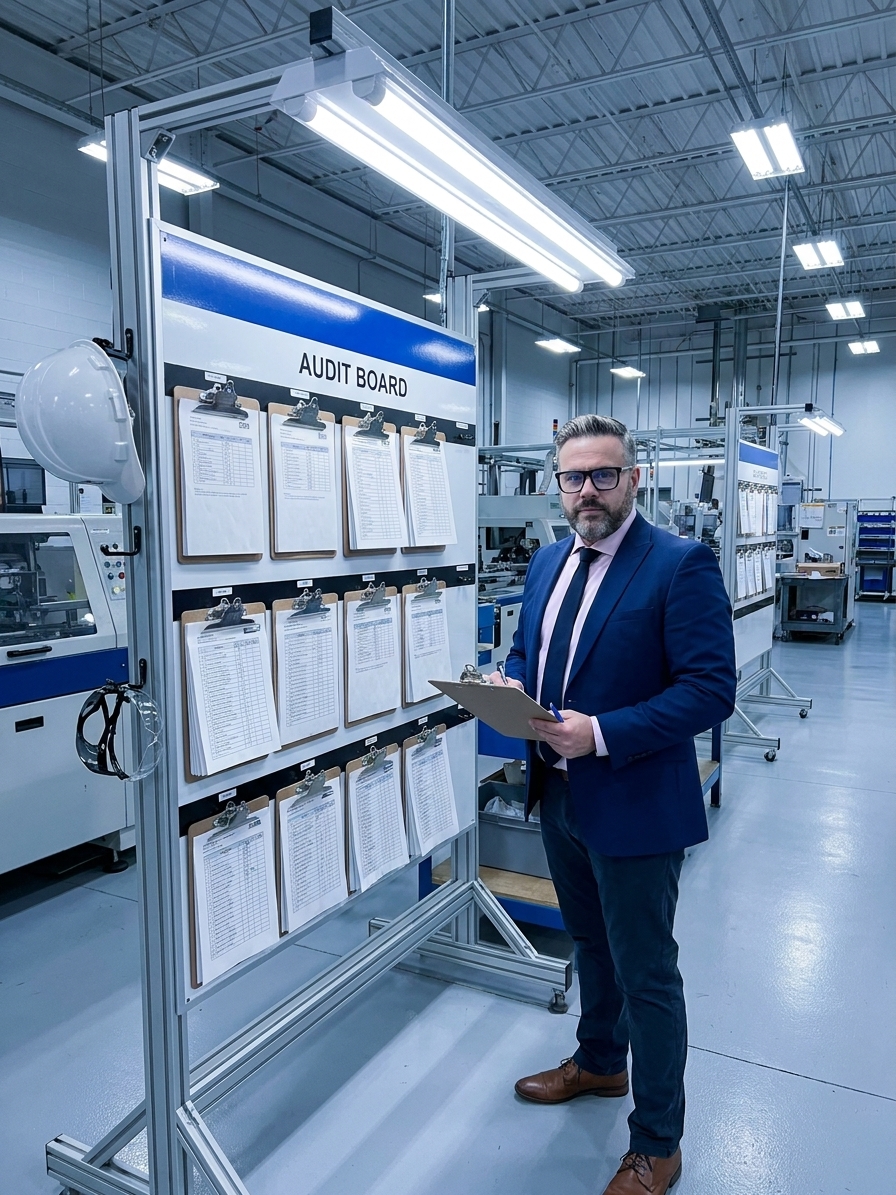
Layered Process Audits (LPAs) were designed to provide redundancy. Instead of a single quality auditor visiting the line once a quarter, verification becomes continuous. Operators check stations every shift, team leaders verify daily, supervisors audit weekly, and plant managers review monthly. If process drift threatens the customer, it should be caught three or four times by different organizational levels before it leaves the building.
The theory is sound. In plants that implement LPAs with genuine intent, process discipline improves and deviations are caught early. But in most manufacturing environments, the system degrades into compliance theatre. The forms are completed because IATF 16949 and automotive OEM requirements demand them. They are filed. And nobody learns a single thing from them.
Walk into a typical plant and you will find a board near the production line with pinned audit forms containing 15 to 25 checklist items. The operator forms ask if work instructions are present. The supervisor forms ask similar questions with slightly more scope. The plant manager's form is usually blank, or it bears a signature from three months ago. The system exists on paper, but the oversight it was built to deliver is entirely absent.
How the Layers Collapse
The collapse of an LPA system is gradual. It happens through a thousand small compromises that seem reasonable under production pressure. The operator has thirty seconds before the line starts. They have twenty items to check, and the team leader is demanding production output. The operator ticks all the boxes. Not maliciously, but because the system was designed by someone who has never stood at that station at 6:00 AM with a conveyor waiting to move.
The team leader is covering for absent operators, managing a material shortage, and fielding questions about yesterday's output. Their daily audit gets done in ninety seconds. It consists of a quick walk past the station, a glance at the work instruction, and a check in the OK column for every item. The supervisor's deeper weekly audit gets filled out in the office, from memory, between phone calls about a customer complaint.
By the time the audit reaches the top layer, the breakdown is total. The plant manager's monthly audit is supposed to demonstrate executive commitment through fresh eyes and direct operator engagement. In reality, it is delegated to a quality engineer who fills it out and routes it for signature. The plant manager signs it without reading it. They often sign three months' worth at once.
The Layer Collapse Sequence
- 01Layer 1: OperatorThirty seconds before line start. Twenty items to check. Cycle time pressure forces a blind tick.
- 02Layer 2: Team LeaderCovering absences and material shortages. Audit becomes a ninety-second walk-past.
- 03Layer 3: SupervisorSix lines to oversee. Form completed in the office from memory between meetings.
- 04Layer 4: Plant ManagerDelegated to a quality engineer. Signed in batches without reading the findings.
The Findings That Never Surface
The most damning symptom of a failed LPA system is that the findings never change. Pull twelve months of records from any plant and you will see the same five or six nonconformances repeated every week. Work instruction not current revision. Operator not wearing safety glasses. Container labeling incorrect. Calibration sticker expired. The corrective action is always identical: retrained operator, updated work instruction, replaced label.
When your audits find the same problems every single week, they are not driving improvement. They are documenting decay. You have built an expensive historian's office dedicated to recording your own dysfunction in twelve monthly installments.
The escalation path is equally broken. If an operator finds a problem, they are supposed to write a corrective action request. But writing that request means stopping the line, calling the team leader, and filling out paperwork. The unspoken rule quickly becomes: only escalate if it is really serious. Serious gets defined downward until it means the line is actively on fire. Minor process drifts never get escalated. They get noted, tolerated, and forgotten until a customer finds the defect.

The Metric That Eats the Method
Organizations typically track LPA performance using a completion rate metric: the percentage of audits finished on schedule. This creates a predictable and damaging distortion. When the organizational goal is achieving a 100 percent LPA completion rate, the behaviour that gets rewarded is filling out forms, not finding problems.
An auditor who finds zero nonconformances has performed well by this metric. An auditor who finds fifteen issues has created work for everyone who must now respond to those findings. The completion rate stays at 98 percent. The finding rate drops to near zero. Everyone feels good about the numbers while the system rots. A Layered Process Audit system that never finds nonconformances is a dead system. It means your auditors have stopped looking.
Stop tracking completion rate as your primary success indicator. Start tracking what fraction of identified nonconformances are new rather than repeats. Track what percentage of those get closed within the target timeframe. If your data shows most findings are repeats and closures take longer than target, your LPA system is an expensive way to document your inability to fix problems.
If your audits find the same problems every week, they are not driving improvement. They are documenting decay.
Audit Theatre and the Digital Distraction
When an automotive OEM audits your plant, they want to see completed forms, escalation records, and corrective action closures. Plants prepare for this by backfilling records. They strategically find a few nonconformances to make the system look credible. They stage the boards, brief the operators, and walk the customer through a performance. The customer auditor ticks the box confirming the LPA system is effective.
In recent years, plants have attempted to fix these broken systems by digitizing them. They deploy tablets, cloud-based dashboards, and real-time analytics. But technology cannot fix a broken process. An iPad with a digital checklist is just a more expensive checkbox. If operators are still ticking boxes without looking, digitizing the form merely digitizes your dysfunction.
Investing in digital LPA tools is often a form of action substitution. Buying software feels like progress. Implementing a dashboard is easier than having the difficult conversation about why your audit system produces no learning. The investment masks the real problem: the underlying behaviours have not changed.
The Finding Paradox
What the dashboard shows
- 98% LPA completion rate
- Zero nonconformances found
- All forms filed on time
- Clean Tier 1 customer audit
What is actually happening
- Operators ticking boxes blindly
- Repeat findings ignored for months
- Escalation defined as line fires only
- Process drift compounding into escapes
What a Functional LPA Looks Like
I have seen Layered Process Audits work, and the plants that succeed share specific characteristics. Their audits are risk-prioritized, not random. Instead of auditing every station against a generic checklist, they focus on high-risk processes. They target new processes, recently modified lines, and operations running at the edge of their Cpk limits. Audit frequency and depth scale with actual risk, not a one-size-fits-all schedule.
Findings are acted on, not just recorded. Every nonconformance has an owner, a due date, and a verification step. Repeat findings trigger a different type of action. If the same problem appears three audits in a row, it is no longer an operator behaviour issue. It is a systemic issue requiring engineering intervention, not another retraining memo.
The layers must add different value. The operator verifies station setup. The team leader verifies process adherence and first-piece quality. The supervisor verifies the effectiveness of the lower layers and hunts for systemic patterns. The plant manager focuses on culture: do operators feel empowered to stop the line? Do team leaders have the resources to fix problems? Each layer asks a different question.
Breaking the Cycle and Rebuilding the Layers
Stop auditing everything equally. You do not have the resources to verify every process daily. Concentrate your audit effort where risk is highest. Use your PFMEA, your capability data, and your escape history to dictate the schedule. Audit the processes most likely to generate defects, not the ones most convenient to walk past.
Change the questions continuously. If your checklist has not changed in two years, it is wrong. Your processes and risks have evolved, and your checklist must reflect current reality. If a question has been answered OK for six consecutive months without a finding, either retire it or investigate why you are not learning anything from it. Make the checklist a living document.
Make escalation change the type of intervention. A repeat finding at the same station should not generate the same corrective action. It should trigger an engineering review, a process redesign, or a control plan update. If your escalation rule is simply to inform the next level of management, you are just moving paperwork up the chain.
Get leadership on the floor for real. The plant manager's monthly audit is not a form to be signed. It is an opportunity for the most senior person in the building to ask questions no one else is asking. If your plant manager is not physically walking the floor for at least thirty minutes per month and engaging with operators, you do not have an executive audit layer. You have a signature.