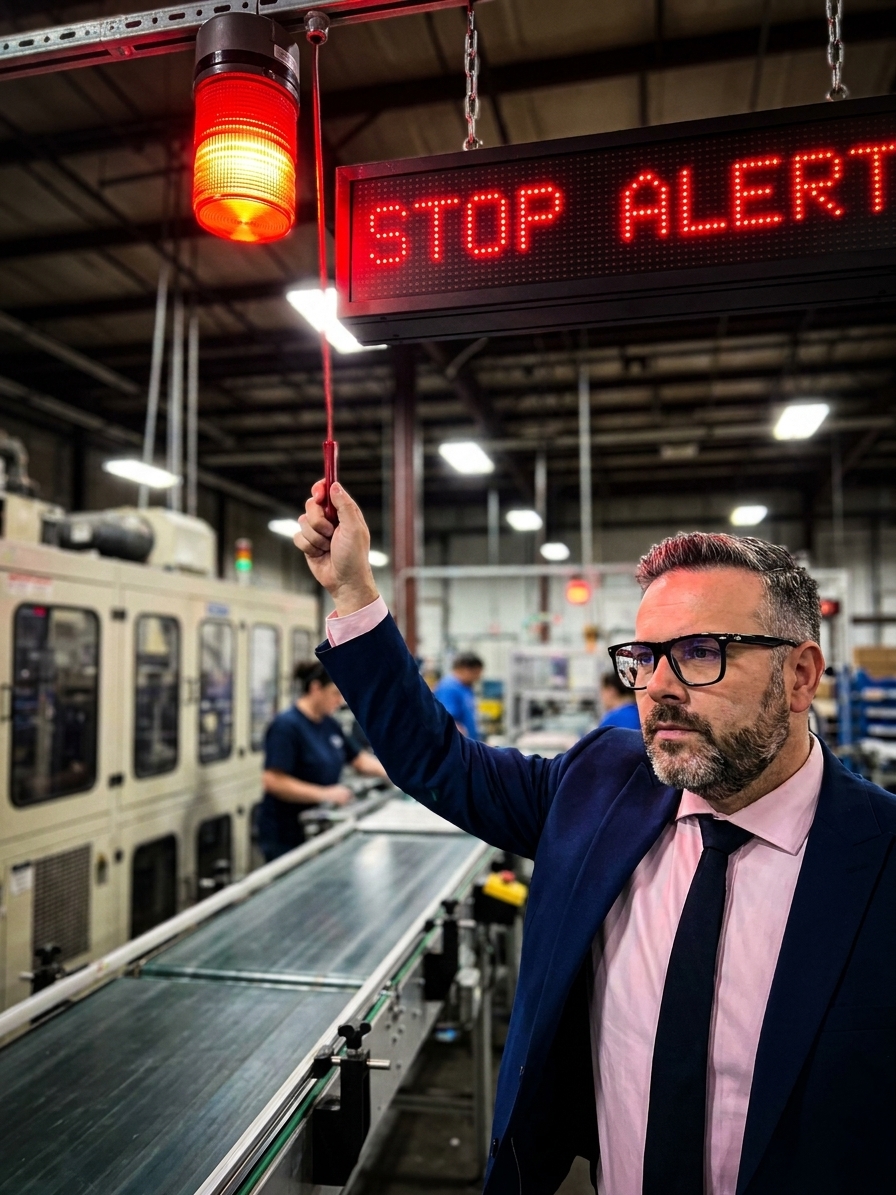
Jidoka is the second pillar of the Toyota Production System. Sakichi Toyoda invented the concept with a loom that stopped automatically when a thread broke. The machine detected its own defect and halted production. No operator needed to watch it, and no supervisor needed to sound an alarm.
That invention created a principle built on a simple premise: build quality in, do not inspect it in. When a defect occurs, stop. Fix the problem. Then restart. The machine, the process, or the operator has the authority to halt production the moment something goes wrong. Not at the end of the shift. Not at final inspection. Immediately.
Walk into most factories today and you will find the andon cord, the light, and the procedure documented in an SOP nobody opens. When the light turns red, everyone ignores it. The supervisor waves it off because the schedule cannot afford a stoppage. The principle designed to protect quality becomes the most expensive decoration in the plant.
The Four Mechanisms of Autonomation
The word is often rendered as autonomation, meaning automation with a human touch. A machine operates autonomously but has the built-in intelligence to detect abnormalities and stop itself. But jidoka extends beyond hardware. It applies to any human or mechanical process granted both the authority and the mechanism to stop when a defect is detected.
The assembly worker who spots a misaligned part pulls the cord. The welder who notices inconsistent penetration flags it. The paint booth operator who sees orange peel shuts down rather than running defective parts through the cure oven. These are all valid executions of the principle, provided the organization supports the action.
The system requires four sequential components to function. When all four operate reliably, defects are caught at the source, root causes are addressed immediately, and quality improves continuously. When any step fails, the system collapses into exactly what it was designed to prevent: a factory that produces defects and deals with them later.
The Jidoka Response Sequence
- 011. DetectA sensor triggers, a gauge reads outside spec, or an operator spots a physical deviation from standard work.
- 022. StopThe machine halts or the operator pulls the andon cord. Production ceases completely. It does not slow down.
- 033. FixA team leader responds immediately. The immediate issue is corrected to restore the process to standard.
- 044. InvestigateThe team determines root cause, updates standard work, and implements countermeasures to prevent recurrence.
The Andon That Cries Wolf
Organizations systematically undermine jidoka through specific failure modes. The most common is signal fatigue. An automotive supplier installed a comprehensive andon system with cords at every station and overhead displays. In the first month, operators pulled the cord over 800 times. The vast majority were minor issues: a bin needing refill, a question about a work instruction, a tool needing adjustment.
By the second month, supervisors delayed their response. By the third month, they stopped responding entirely. By the fourth month, operators stopped pulling the cord. In the fifth month, a critical torque specification was missed on hundreds of brake caliper housings. The defective parts flowed straight through the line because nobody triggered the alert. The system had trained everyone to ignore it.

An andon system that signals everything signals nothing. Jidoka requires clear, specific triggers for stopping. The organization must classify what constitutes a stop-worthy event versus a call-for-help event. These must be different signals with different responses, documented in the standard work.
Schedules and Response Capacity
If your production schedule does not account for jidoka stops, your jidoka system is fiction. A tier-one supplier implemented the system and stopped the line 23 times in the first week for genuine quality issues. The plant manager saw they missed their daily target by 12% and announced they needed to be more selective about stopping. That single sentence killed the initiative.
Every operator heard the message: stopping the line is bad. Hitting production numbers is what matters. Within two weeks, the andon pulls dropped to near zero. The quality problems continued, but they were caught at final inspection where rework cost ten times more. Toyota builds expected andon response time into its takt time calculations. They expect stops, plan for them, and staff for them.
Jidoka is not just a detection system; it is a response system. I visited a plant where alerts routed to a single shift supervisor covering 40 stations across two buildings. The andon light would burn red for 20 or 30 minutes while the supervisor was occupied. Operators learned that pulling the cord meant standing idle for half a shift, so they stopped pulling it.
If you cannot guarantee a rapid, competent response to every stop, you do not have autonomation. You have an expensive alarm nobody listens to. Response capacity must be designed into the organizational structure. Team leaders must be positioned, available, and trained to respond within a defined timeframe.
Treating Symptoms Instead of Root Causes
When the line stops and the supervisor arrives, what happens next determines whether jidoka delivers value. If the response is simply clearing the jam and restarting, the system acts as a fire alarm that summons firefighters to pour water on smoke while the fire burns underneath. Every stop is a root cause investigation opportunity.
A medical device manufacturer had a molding line where a specific cavity repeatedly produced short shots. The andon triggered, the technician arrived, cleared the blocked nozzle, restarted the line, and documented the event. This happened 14 times over three shifts before someone finally investigated why the nozzle kept blocking. The investigation revealed a worn feed screw causing inconsistent melt temperature.
The real fix cost $4,200 and two hours of downtime. The symptom fixes had cost 14 stoppages, approximately 9 hours of lost production, and an unknown number of defective parts that had been reworked or scrapped. If your response protocol lacks a structured root cause step, you will fix the same problem until the underlying cause destroys something expensive enough to force a real investigation.
Jidoka Response: Symptom vs. Root Cause
Fix and Restart
- Clear the jam or replace the broken tool
- Restart the line immediately
- Document the event in the shift log
- Repeat the cycle when the defect reoccurs
Investigate and Prevent
- Ask why the deviation occurred using 8D logic
- Identify the actual physical or systemic root cause
- Update PFMEA and standard work to reflect countermeasures
- Track the issue to confirm zero recurrence
The Culture That Blames the Messenger
The most insidious failure mode is cultural. When an operator pulls the andon cord and the supervisor responds with frustration—a sigh, an eye roll, a comment about being behind schedule—the operator learns that stopping the line is socially punished. No SOP or training program can overcome that learning. The operator will think twice before pulling the cord next time.
Toyota celebrates andon pulls. The company publicly recognizes operators who catch defects because every pull represents a defect that did not reach the customer. Most organizations treat andon pulls as disruptions to be minimized. The difference in mindset separates a genuine quality culture from a production culture wearing a quality costume.
If your production schedule doesn't account for jidoka stops, your jidoka system is fiction.
Your response to line stops sends a louder message than any training program. If you want people to stop the line when they see a problem, you must make it psychologically safe to do so. The moment stopping the line becomes something people are reluctant to do, your quality system has lost its primary defense against escaped defects.
The Cost Mathematics of Stopping
Consider a line running at 60 parts per hour with a first-pass yield of 95%. Three defective parts per hour are produced. If caught at the source through jidoka, the cost is the stoppage time. Assuming five minutes per stop, the line loses 15 minutes of production per hour. This is a planned, quantifiable operational cost that keeps defective units contained.
If those defects flow downstream, the economics change violently. Rework caught at final inspection costs significantly more per part. If those units escape to the customer, warranty, return, and reputational costs in automotive contexts easily reach thousands of dollars per occurrence. In aerospace or medical device manufacturing, the liability of an escaped defect dwarfs the cost of line downtime.
The Economics of Early Detection
Designing a Functional System
To build jidoka that functions as a quality system rather than theater, you must define stop conditions clearly. Create an unambiguous list of conditions that warrant a line stop: critical dimensions out of spec, safety concerns, repeated minor defects, or missing components. Separate these from call-for-help conditions that require assistance but do not require stopping.
Design response capacity into your organizational structure. Every zone needs a designated first responder who is available and physically positioned to respond within a defined time. Calculate the expected stop frequency based on historical data and ensure you have enough responders to handle simultaneous events. Build this expected stop time into your takt time calculations.
Mandate root cause investigation for every stop. This is not a 30-minute ritual; it is a structured five-minute conversation asking what happened, why, and what will prevent it. Document the findings. Track recurring issues in your lessons-learned database. When the same root cause appears three times, escalate it to a formal 8D problem-solving process.
Track andon pulls as a positive metric measuring defects caught at source. Recognize operators who pull the cord. Use IoT sensors, machine vision, and automated defect detection to give operators better information, but never use technology to bypass human judgment. A line that never stops is not a high-quality line. It is a line that has stopped noticing its own defects.