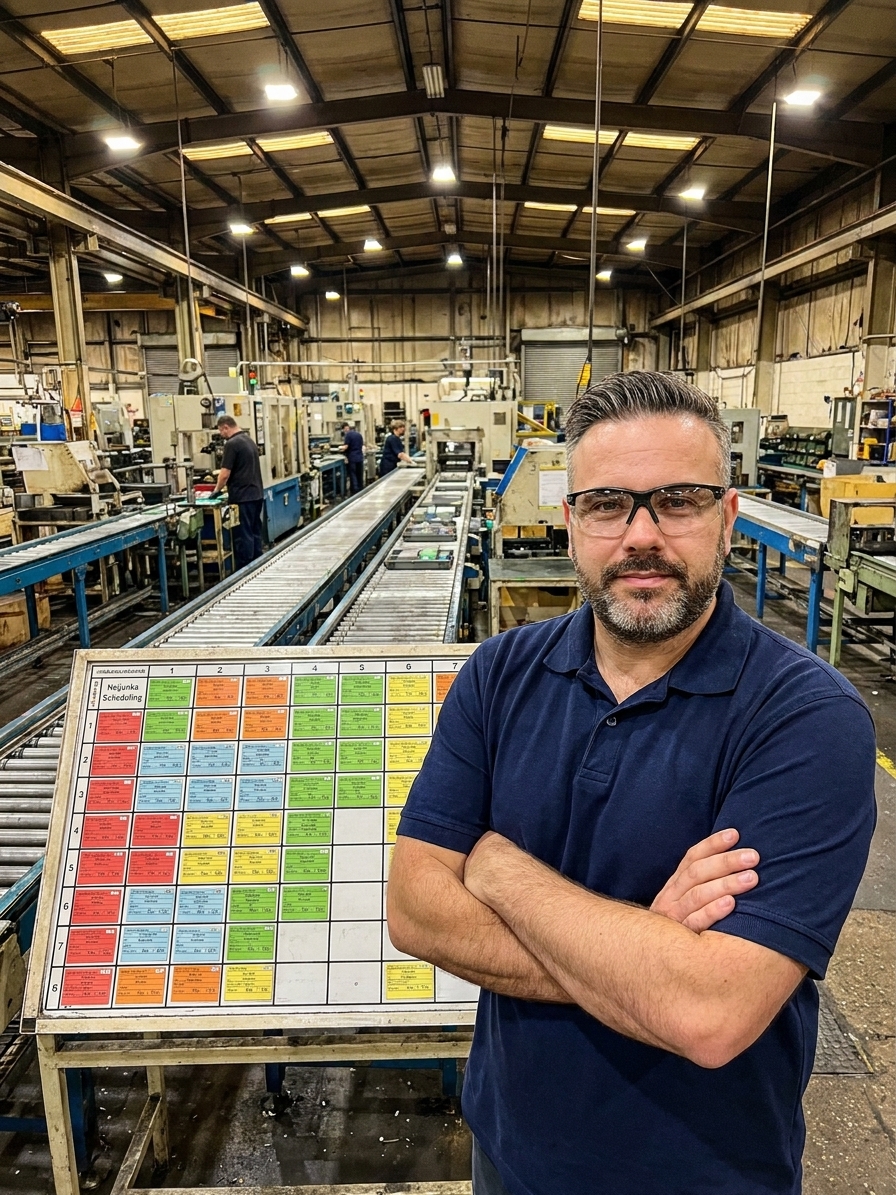
Heijunka is the practice of producing goods at a steady rate and consistent mix that matches actual customer demand. It replaces large batch runs driven by forecasts or machine utilisation targets. The objective is to create stability upstream so every preceding process can standardise work, inventory, and staffing without carrying massive safety stock.
The concept is universally understood but rarely sustained. I have audited plants where production leveling was demonstrated successfully in a pilot cell, presented to leadership during a lean assessment, and then quietly abandoned. The Heijunka box remains on the wall, but the scheduling runs entirely on MRP batch logic and expeditor phone calls.
The failure is structural. Production leveling is an organisational discipline that conflicts with standard cost accounting, departmental metrics, and legacy MRP optimisation logic. Without resolving these systemic conflicts, the scheduling tool becomes a display artefact.
The Mechanics of Production Leveling
Leveling operates across two dimensions: volume and product mix. Leveling by volume means producing a consistent total quantity per time period. Leveling by mix means producing a consistent variety of products within that period, rather than running long campaigns of a single SKU. Both dimensions must be present for the system to function.
The primary tool is the Heijunka box, a physical or digital board divided into time intervals called pitch, and rows representing product types. Kanban cards placed in each cell dictate exactly what to build during that interval. If customer demand requires 60 percent Product A, 30 percent Product B, and 10 percent Product C, the repeating pattern within each pitch might be A-A-B-C.
This is not an aesthetic exercise. When final assembly pulls at a steady, predictable rate, preceding processes stabilise. Without leveled production at the pacemaker step, pull systems degrade, inventory fluctuates, and the entire value stream oscillates between feast and famine.
Why ERP Logic Fights Leveling
Your MRP system was designed to optimise machine utilisation and minimise changeover costs. Its logic relies on economic order quantities and lot-sizing rules that actively fight against small-batch, mixed-model production. When you instruct a scheduler to run an A-B-C pattern every pitch, the ERP system flags it as inefficient.
The system reports that changeovers are too frequent, machine utilisation drops below target, and standard cost per unit increases because overhead is allocated across smaller runs. The ERP logic is not wrong within its own assumptions. It is optimising for a world where changeovers are expensive, setup times are fixed, and inventory is free.
Heijunka requires the opposite assumptions. Changeovers must be fast because you have implemented SMED. Setup times must be minimal because you have standardised them. Inventory must be recognised as expensive waste. Implementing production leveling without this foundational work installs a thermostat in a house with no insulation.
S&OP and Demand Signal Integrity
Production leveling requires a reasonably stable understanding of customer demand over a four-to-twelve-week horizon. This data comes from a functioning Sales and Operations Planning process. In most organisations, S&OP is either a spreadsheet exercise nobody follows or a weekly dispute where the loudest voice wins.
Instead of leveled schedules based on contracted volumes, demand arrives at the plant as expedited orders with two-day lead times. The scheduler, who has been burned by last-minute changes, builds massive buffer stock. This defensive batching is the exact opposite of what Heijunka intends.
Departmental Metrics vs. System Performance
Most manufacturing organisations measure and reward individual departments, not value stream performance. Production is measured on machine utilisation. Warehousing is measured on inventory turns. Sales is measured on order fulfilment. Heijunka optimises for the whole system, but it locally degrades the metrics these departments own.
Running small mixed-model batches reduces machine utilisation. Producing to takt rather than to forecast temporarily reduces output. Carrying less finished goods increases stockout risk if demand spikes. Each trade-off is correct at the system level, but each one makes a departmental dashboard look worse.
Local Optimisation vs. System Leveling
What departments protect
- Machine utilisation targets above system demand
- Minimised changeover frequency to protect output
- Large buffer stock to prevent stockouts
- Batch production driven by standard cost metrics
What Heijunka requires
- Production paced to actual customer takt time
- Frequent, standardised changeovers to enable mixed models
- Minimal inventory pulled upstream via kanban
- Small batches sequenced to smooth value stream flow
In organisations where leveling fails, people protect their dashboards rather than the system. The reward structure actively penalises the behaviour required to make Heijunka work.
Starting at the Pacemaker Process
Heijunka is not implemented across an entire factory simultaneously. It is implemented at the pacemaker process, the point in the value stream that sets the rhythm for everything downstream. This is usually final assembly or the scheduling point closest to the customer.
Upstream processes do not need Heijunka boxes. They need pull systems, such as kanban or CONWIP, that respond to the pacemaker's demand signal. The most common implementation mistake is attempting to level every workstation simultaneously, which creates complexity that dwarfs the operational benefit.
Implementing Heijunka without SMED is like installing a thermostat in a house with no insulation. The environment cannot support the tool.
Starting at the pacemaker and expanding only when upstream processes are stable is slower. It is also the only approach that survives contact with operational reality. Attempting a plant-wide rollout guarantees the system will collapse at the first demand spike.
The SMED Prerequisite
Heijunka is economically impossible when changeovers take hours. If switching from Product A to Product B requires four hours of teardown, setup, and first-article inspection, no scheduler will do it three times per shift. Three changeovers at four hours each equals twelve hours of lost production per shift. The math prohibits leveling.
Single-Minute Exchange of Die is the practical prerequisite for production leveling. You cannot level production in a meaningful way until internal setup, which requires the machine to stop, is reduced to minutes. This requires video-recording changeovers, converting internal steps to external, standardising tooling, and pre-staging fixtures.
Heijunka Implementation Sequence
- 01SMED ImplementationReduce internal setup time to under ten minutes for routine product changes.
- 02Standardised WorkCreate repeatable processes capable of producing at a predictable pace.
- 03Pull System DeploymentEstablish kanban or CONWIP signalling upstream from the pacemaker.
- 04Pacemaker LevelingImplement the Heijunka box at final assembly to set the rhythm.
- 05System ExpansionExpand the leveling pattern only when preceding processes demonstrate stability.
Running a workshop and declaring victory is not SMED. The changeover times must be genuinely under ten minutes for routine product changes before mixed-model production becomes economically viable. Without that threshold met, the ERP system's bias toward large batches is mathematically correct.
Operating the Heijunka Box Daily
In plants where Heijunka works, the box is the daily, hourly scheduling tool for the pacemaker process. The team leader pulls the next kanban at every pitch interval, hands it to the operator, and the operator builds exactly what the card specifies. The discipline is absolute.
If a card cannot be pulled due to a material shortage, quality issue, or equipment failure, the box makes the disruption immediately visible. The response is immediate because the abnormality cannot be hidden in a buffer. This visual exposure is the mechanism that forces rapid problem-solving.
In plants where Heijunka fails, the box is a concept that exists in a spreadsheet updated weekly. During audits, supervisors reference it. Between audits, production runs whatever the expeditor dictates. The box functions as a display artefact, and everyone on the floor knows it.
Managing Demand Variation
Real customer demand is lumpy. Even with a functioning S&OP process, orders fluctuate and unexpected events disrupt the plan. Plants that sustain Heijunka do not demand perfect demand stability before they begin. They establish a base pattern representing average demand and adjust incrementally.
When demand for a product spikes and the pattern cannot keep up, the response is not to abandon leveling and revert to batch production. The response is to investigate the cause, determine if the spike is temporary or structural, and adjust the pattern or capacity accordingly. Each disruption, handled systematically, makes the leveling more robust.
Stability is not the natural state of a manufacturing system. Left alone, production systems oscillate, demand amplifies upstream, and inventory accumulates. The Heijunka box is where the commitment to engineered stability becomes visible. The real work happens when a plant manager enforces the pattern instead of authorising a batch to appease a metric.