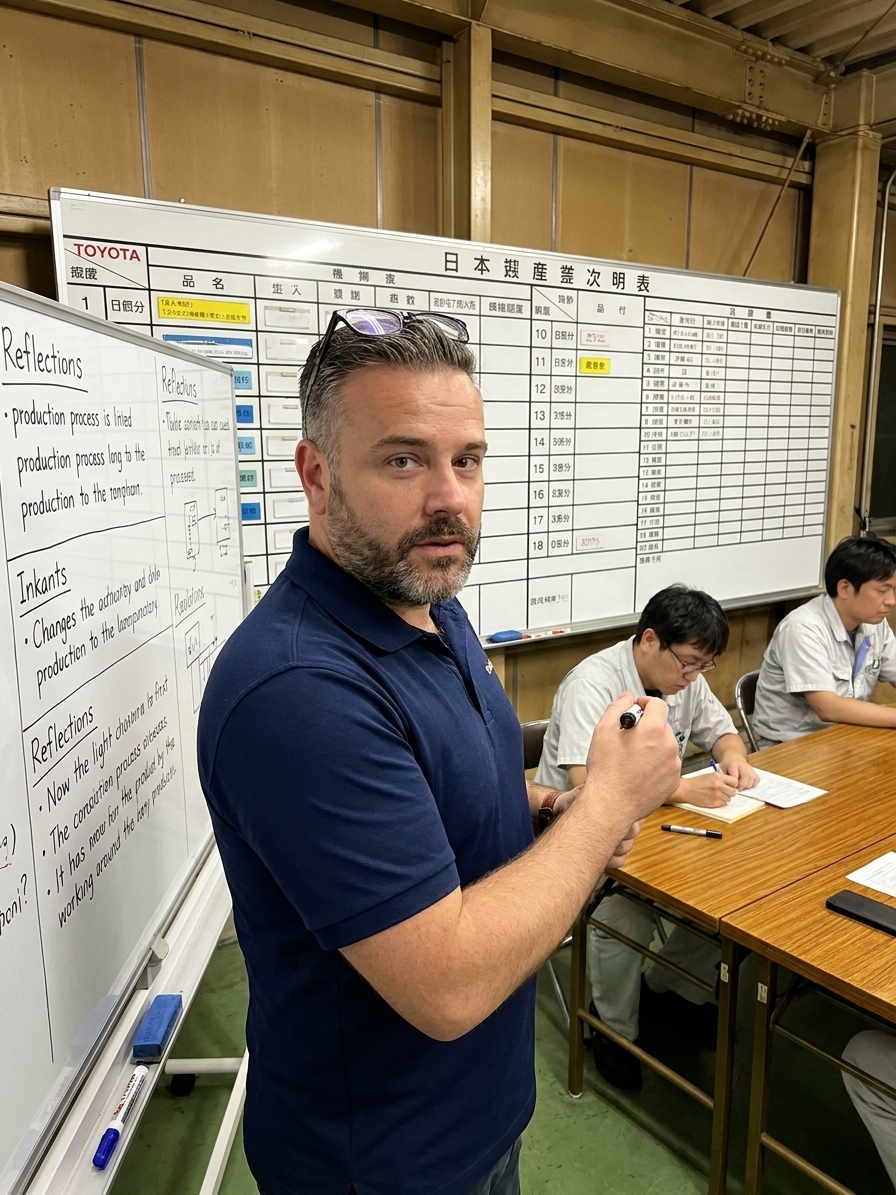
Hansei translates directly as self-reflection, but treating it as a Japanese synonym for a lessons-learned meeting is where most Western implementations fail. In a Toyota production environment, hansei happens after a successful launch. The team leader does not celebrate the achieved targets. They stand up, identify the gap between the planned standard and the actual reality, and commit to specific countermeasures.
This practice rejects the binary view that success and failure are opposites. In the hansei framework, every outcome contains failure. Not catastrophic failure, but the measurable gap between what you delivered and what was theoretically possible. Finding that gap, naming it, and systematically closing it is the engine of kaizen.
During my transition of ISO 9001 systems at WITTE Automotive, I watched well-intentioned Western teams turn reflection into a defensive exercise. They learned to apologize for missing targets rather than analyzing the process capability that caused the miss. When reflection becomes a liability shield, the practice dies. The team optimizes for the performance management system you have, not the idealized culture you describe in your quality manual.
The Operational Mechanism of Hansei
At Toyota, hansei is not a post-mortem reserved for project completion. It is embedded in the daily workflow. Daily hansei takes two or three minutes at the end of a shift. The team briefly states what went well, what deviated from the standard, and what they will adjust tomorrow. The power is not in any single observation, but in the compounding effect of hundreds of micro-adjustments over a year.
Project hansei occurs at major milestones and follows a more structured format. The team reviews the entire project plan against actual performance data. They are not looking for someone to blame. They are mapping the exact points where reality diverged from intention. The output is a specific, actionable commitment to prevent that gap in the next cycle.
Strategic hansei occurs during Hoshin Kanri, or policy deployment reviews. Executive teams evaluate whether their strategic assumptions held true and whether deployment was effective. This is where organizational learning actually happens. If leadership gets defensive at this level, the entire continuous improvement culture below them freezes. Leaders must identify their own miscalculations before anyone else does.
The Hansei Reflection Cycle
- 01Define the standardEstablish the planned outcome, process capability target (e.g. Cpk 1.33), or project specification.
- 02Measure the realityCapture actual performance data, OEE figures, and deviation logs without filtering.
- 03Identify the gapAnalyze the precise delta between the standard and the reality, focusing on process, not personnel.
- 04Commit to countermeasureAgree on a specific, actionable change to the process or standard work instruction.
- 05Verify in next cycleOpen the next reflection session by confirming whether the countermeasure closed the gap.
Apology Theatre and the Blame Transformation
The most common failure mode begins when a manager introduces reflection without modelling it. They ask the team what went wrong this week. Someone offers an honest observation that implicates a management decision. The manager reacts defensively. The team registers this response. By the third week, the reflections are entirely performative. People offer sanitized statements like 'We should collaborate more' because those statements are safe.
In organizations with rigid individual accountability, hansei rapidly mutates into a blame allocation mechanism. Reflections shift from 'We' to 'I'. People begin submitting legalistic explanations designed to provide cover rather than insight. This destroys the psychological safety required for honest analysis. If your performance management system punishes people for admitting mistakes, no reflection framework will survive contact with reality.
Genuine hansei normalizes the existence of failure, which actually strengthens safety. When the most senior person in the room routinely identifies their own shortcomings without punishment, honesty becomes safe. But this only works if the organizational response to acknowledged failure is consistently developmental. The focus must remain on the system. If you fix the person, the same failure recurs with a different operator. If you fix the system, the failure is prevented.

The Documentation Trap
Many quality departments try to formalize hansei by creating a mandatory reflection form. Teams must document what went well, what failed, and what will change. The forms are collected, filed, and reviewed by auditors. Statistics are compiled into dashboards. This feels like progress. It is the opposite of progress.
The act of writing a formal document for an external audience changes the nature of reflection. People begin writing for the quality team and the auditors rather than for themselves. The language becomes abstract and sanitized to survive scrutiny. You end up with statements about enhancing cross-functional synergy through stakeholder engagement. Nobody knows what that means. Nobody acts on it. But the file is complete for the next IATF 16949 audit.
At Toyota, daily hansei is mostly verbal. The learning lives in the team's collective memory and in the specific commitments people make to each other on the shop floor. Documentation exists for project-level and strategic-level reflection, but it is a byproduct of genuine thinking. When I built the greenfield QA/QC department at SNOP, I enforced rigorous documentation for nonconformances, but kept daily reflection informal. You cannot mandate honesty on a form.
Negative-Only Reflection and Inaction
Because hansei emphasizes the gap between intention and reality, some implementations focus exclusively on failures. Positive outcomes are ignored. Strengths are never identified. The reflection becomes a relentless inventory of inadequacy. This is exhausting and counterproductive. A team that only hears about its failures will eventually stop trying to improve.
Genuine hansei acknowledges both what worked and what did not. The emphasis on gaps is not a rejection of success. It is a refusal to be satisfied with it. The tone must be uncompromising but constructive. If the practice feels like a punishment, engagement drops to zero. The discomfort of acknowledging you could have done better is the point, but that discomfort must serve growth, not shame.
A reflection that does not produce a commitment to act is not hansei; it is just thinking out loud.
The cruelest failure mode is the reflection without action. The team meets. They identify real gaps in their PFMEA or their control plan. They generate genuine insights. Then the meeting ends. Everyone returns to their standard work. The commitments to check fixtures before each shift or involve maintenance earlier in the changeover process are forgotten within a day. At the next meeting, the same gaps are identified. The cycle repeats without end.
Building a Hansei Practice That Survives Contact with the Floor
To introduce hansei, start with yourself. Before asking your team to reflect, spend two weeks doing it publicly. At the end of each day, in front of your shift leaders, name one specific thing you would do differently tomorrow. Do not perform. Actually mean it. If you cannot model vulnerability, your team will not offer it to you.
Keep the reflection short and frequent. Daily sessions should take three minutes. Project sessions should take thirty minutes. If you make it long and formal, people will spend their time preparing for the meeting instead of doing the work. The power is in the habit, not the depth of any single session.
Performative vs. Operational Reflection
What teams do
- Fill out mandatory forms for the quality department
- Assign blame to individuals who missed the specification
- Generate generic lessons about communication and teamwork
- Ignore previous commitments and start the discussion from zero
What works
- Conduct brief, verbal reviews directly at the gemba
- Analyze the process that allowed the failure to occur
- Define specific countermeasures against the standard work
- Open by verifying whether the last countermeasure closed the gap
Closing the Loop on Every Commitment
The single most important practice is closing the loop. Start every reflection session by reviewing the commitments from the previous session. Were they acted on? Did they work? If not, what prevented the action? This discipline does more to make hansei real than any other factor. It creates the expectation that analysis leads to process change, and it surfaces the organizational barriers that prevent change from happening.
At a major aerospace manufacturer, I introduced Routing Verification KPIs that cut internal lead time by 97%. That result was not achieved by a single mandate. It was achieved by daily reflection on the gap between the planned routing and the actual cycle time, followed by immediate countermeasures. We identified the bottleneck, committed to a fix, verified the result the next day, and repeated the cycle until the lead time disappeared.
Hansei requires you to accept that your current process performance is always insufficient. It requires you to create safety around admitting mistakes, which means resisting the impulse to punish honest analysis. It requires the discipline to close the loop between reflection and action even when the initial enthusiasm has faded. When you build this discipline, weekly improvements compound into measurable competitive advantage over a year.
The teams that succeed with hansei are not the ones with the best forms or the most rigorous audit trails. They are the ones where the leader went first, where honesty was met with curiosity instead of judgment, and where every reflection ended with a commitment that someone actually kept. That is the practice. Not a meeting, not a form, but a habit of honest self-examination that becomes your most powerful continuous improvement engine.