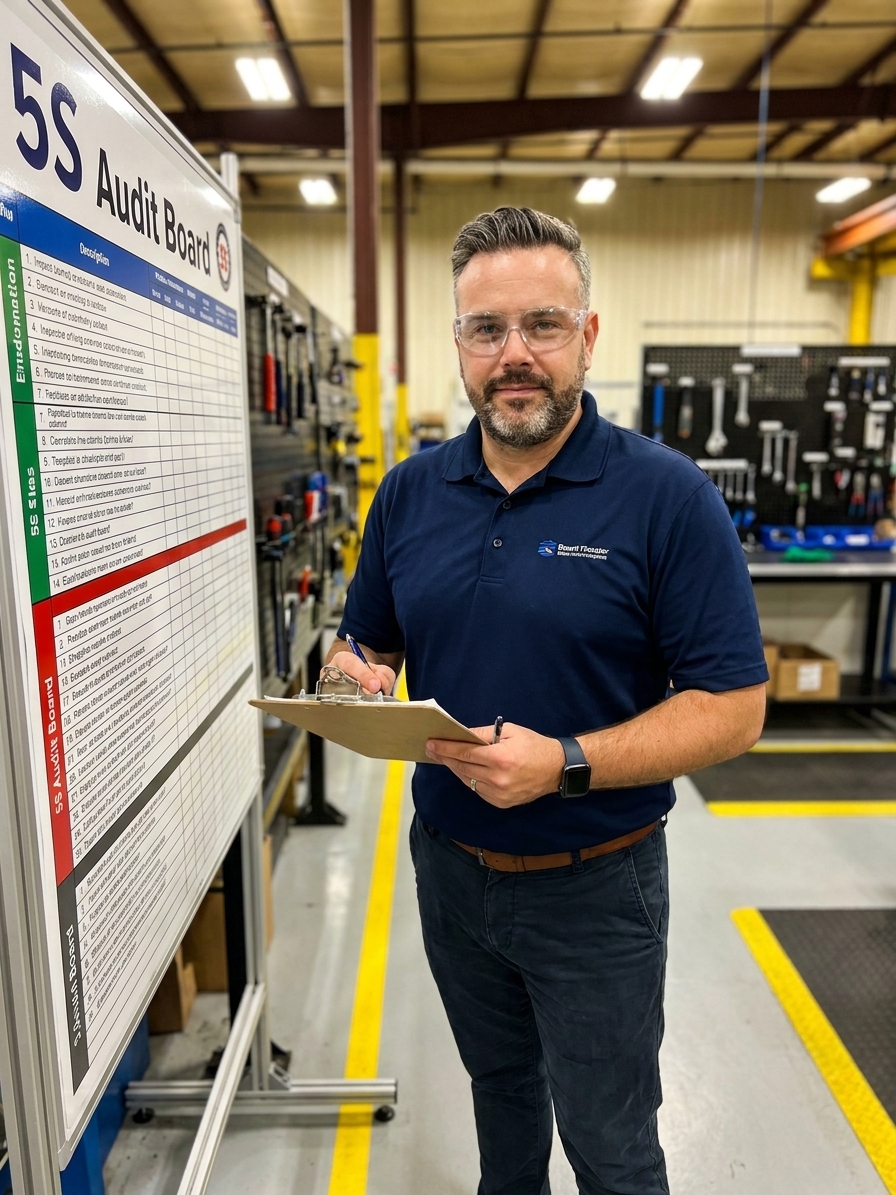
5S is arguably the most widely implemented lean tool in the world, and simultaneously the most cynically dismissed. Walk into most manufacturing facilities and you will find the remnants of a failed deployment: laminated posters fading on the walls, shadow boards missing half their tools, and operators who view the framework as a monthly housekeeping chore rather than a core quality function.
The framework was never designed as a cleaning programme. Hiroyuki Hirano formalised the five pillars at Toyota to create the visual, physical, and psychological conditions necessary for lean manufacturing. The objective was a factory floor where abnormalities are instantly visible, where missing tools immediately signal a process deviation, and where the physical environment itself reinforces operational discipline.
What most organisations implement is a hollow shell of the methodology. They adopt the terminology without understanding the operational mechanisms. The transformation 5S was designed to drive never materialises, and the management team moves on to the next initiative without realising the quality system they just compromised.
Sort: Eliminating the Source of Clutter
The first pillar, Seiri, requires making brutal decisions about necessity. It means walking a workspace and challenging every item: does this serve a purpose right now, for the work being performed here today? Not someday. Not just in case. If the item does not serve an active function, it must be removed.
The standard mechanism is the red-tag system. Ambiguous items are tagged, moved to a controlled holding area, and evaluated after a set period. If nobody claims them, they are scrapped or relocated. The principle is straightforward: unnecessary items create physical clutter, clutter hides process deviations, hidden deviations become defects, and defects become cost.
Most facilities complete Sort once during an initial launch event and never repeat it. The workspace that was pristine in week one gradually accumulates obsolete tooling, excess material, and mystery components. Nobody re-sorts because the action is treated as a project rather than a daily habit. The connection between physical clutter and escape quality remains entirely unrecognised by the people working in the space.
The deeper failure happens when supervisors who do not understand the floor drive the sorting decisions. They either dispose of necessary tooling or ignore actual waste. The operators watch, shrug, and wait for the event to pass. They have seen this cycle before, and they know the discipline will not hold.
Set in Order: Engineering Visual Transparency
If Sort eliminates the unnecessary, Seiton engineers the remaining workspace. The objective is an environment where any operator can locate any tool, fixture, or document within thirty seconds without searching. This is achieved through shadow boards, labelled locations, and colour-coded zones. The correct placement must be entirely self-evident.
The underlying mechanism is visual management. A workspace where everything has a designated location is a workspace where missing items are instantly noticed. If a torque wrench is absent from its outlined profile, everyone walking past can see it. The absence itself becomes actionable data. This is the real power of Seiton: visual transparency, not superficial tidiness.
Organisations routinely fail here by treating Set in Order as an aesthetic exercise. They purchase label makers and coloured tape, spend a week outlining tools, and then abandon the effort when production pressure returns. Materials pile up in aisles. The shadow boards remain on the walls as monuments to a brief enthusiasm for lean, displaying the silhouettes of tools that have not been seen in months.
When Seiton functions properly, a disordered workspace signals an immediate problem: a material flow breakdown, inadequate staffing, or an uncontrolled process change. When it is abandoned, disorder becomes the baseline normal, and the early warning system that could have isolated problems at the source goes entirely silent.
The Set in Order Mechanism
What teams typically do
- Purchase shadow boards and coloured tape for a launch event
- Outline tools that vanish within three weeks of deployment
- Treat visual management as an aesthetic improvement
- Accept piled materials and blocked aisles as normal production reality
What actually drives quality
- Engineer visual transparency so missing items trigger immediate alerts
- Ensure any operator can locate any tool within thirty seconds
- Treat a disorderly workstation as a symptom of a hidden process deviation
- Use clear designated locations to expose material flow breakdowns instantly
Shine: Equipment Inspection Through Cleaning
This is where the methodology gets most badly corrupted. Seiso is not housekeeping. It is inspection through cleaning. At Toyota, the act of wiping down a machine is simultaneously the act of assessing its condition. The operator is feeling for unusual vibration, looking for micro-leaks, and checking for loose fasteners. Cleaning is the mechanism; equipment condition assessment is the purpose.
This dual function is why Shine must be assigned to the operators who run the equipment, never to a contracted janitorial crew. The standard is specific and documented. It is not a vague instruction to clean the area. It is a defined checklist: wipe the machine bed, verify hydraulic fluid levels, inspect cable routing for abrasion, report any abnormal noise. The cleaning and the inspection are inseparable.
In failed deployments, organisations assign cleaning to a janitorial crew that lacks equipment knowledge. Alternatively, they give operators five minutes at the end of a shift and no checklist. The cleaning becomes a perfunctory sweep. The inspection component, which was the entire operational point, disappears completely from the workflow.
The consequence is severe. Hydraulic leaks, hairline cracks, and failing bearings go unnoticed until they trigger unplanned downtime. Predictive maintenance opportunities are missed entirely because nobody is physically close enough to the machinery to observe the developing trends. Operators remain detached from the equipment they run, preventing the development of critical process knowledge.
Standardize: Embedding Expectations in the Floor
The first three pillars are discrete actions. Seiketsu is the system that makes those actions repeatable. It requires creating clear, documented expectations for how the first three pillars are executed in each area: who performs the task, when, how often, and to what exact standard. This is where the methodology scales across a facility.
Standardisation means embedding expectations directly into the workplace environment. Colour-coded floor markings, standardised container sizes, posted process sheets, and visual cues at each workstation. The standard is not a PDF locked in a quality manual. It is visible, immediate, and physically embedded in the workspace. Anyone walking through should instantly see whether the standard is being met.
Organisations fail Standardize by treating it as a documentation exercise. They write detailed procedures, bind them in notebooks, and file them on an office shelf. The workplace itself remains unchanged. The standard exists on paper and nowhere else, which means it functionally exists nowhere. The gap between the documented system and the physical reality becomes a standing joke on the factory floor.
The verification test is simple. I have audited plants where a brand-new operator can walk into a workstation and immediately understand the expected state without being told. That is successful standardisation. If the visual cues are absent or ignored, the standardisation has failed, regardless of what the ISO 9001 or IATF 16949 documentation claims.
Sustain: The Management System Problem
Shitsuke is where every deployment lives or dies. Sustaining discipline over time is universally acknowledged as the hardest pillar. It requires three elements: leadership commitment, quantitative measurement, and accountability. Management must treat 5S as a non-negotiable operational standard. Compliance must be measured through regular audits with scored criteria. Results must carry consequences, both recognition and correction.
In most facilities, leadership launches the programme with a speech, then moves on to the next initiative when the novelty fades. Audits are conducted sporadically, scored generously to avoid conflict, and filed without follow-up. There are no consequences for non-compliance and no recognition for excellence. Workers learn within weeks that the programme is entirely optional. Optional programmes in manufacturing always degrade into background noise.
Discipline is not created by posters or slogans. It is created by clear expectations, regular measurement, and consistent enforcement by leadership.
The fundamental error is treating Sustain as a communication problem. Management prints more posters, designs more slogans, and sends more email reminders. Sustain is actually a management system problem. It fails because leadership treats it as a monthly checklist rather than a core operational metric that demands the same scrutiny as OEE or Cpk.
When audits do happen, they rarely drive corrective action. A 5S audit should function like a layered process audit in IATF 16949 environments. It should identify specific deviations, assign 8D corrective actions, and track closure. Instead, the audits are typically a box-ticking exercise that supervisors complete in five minutes to satisfy a KPI that nobody reviews.
The Diagnostic Cost and the Revival Path
The cost of a superficial 5S implementation is not merely the wasted hours of the launch event. It is the opportunity cost of every defect the system would have prevented. A functioning programme surfaces equipment issues before they escalate into breakdowns, reduces changeover times by ensuring tool accessibility, eliminates defects caused by misplaced materials, and prevents the safety incidents that inevitably stem from cluttered workspaces.
A failed programme delivers none of these benefits while consuming organisational credibility. The deeper damage is cultural. I have seen operators live through multiple launch cycles, each announced with fanfare and abandoned within months. They become permanently resistant to any improvement initiative. The tool that was supposed to build foundational discipline instead destroys trust in leadership's commitment to change.
Reviving a dead 5S programme requires starting with a single pilot area, not a plant-wide rollout. Choose a zone with a supportive supervisor and visible operational problems. Implement all five pillars properly: sort aggressively, engineer visual transparency, integrate inspection into daily cleaning, embed standards into the physical workspace, and audit weekly with honest, scored criteria that drive immediate corrective actions.
Targeted Pilot Deployment
- 01Select pilot zoneChoose a single area with an engaged supervisor and measurable problems like high changeover times or recurring defects.
- 02Execute five pillarsSort aggressively, design visual organisation, and integrate equipment inspection into the daily cleaning checklist.
- 03Enforce weekly auditsConduct audits with strict, quantified scoring. Tie deviations directly to corrective action requests and track closure.
- 04Measure operational dataTrack equipment downtime, defect rates, and changeover times over a ninety-day period to establish statistical relevance.
- 05Expand based on evidenceUse the verified data from the pilot zone to build the business case for expanding to the next workstation.
Run the pilot for ninety days. Measure the results rigorously: track equipment downtime, first-pass yield, changeover times, and safety incidents. If the numbers show genuine improvement, use that quantitative data to justify the capital and time required for expansion. If they do not, determine the operational failure before attempting to scale.
The ultimate test of 5S is whether the system has changed how people work on the floor. Are operators actively detecting equipment wear before it causes a breakdown? Is the workplace designed to make the correct state obvious and the incorrect state immediately visible? Has the discipline of maintaining order become an ingrained habit rather than a management mandate?
Toyota has practiced this framework continuously for over seventy years. They understand that the discipline embedded in 5S is the exact same discipline required to make IATF 16949, VDA 6.3, and Six Sigma function properly. It is the operational foundation everything else stands on. When that foundation is structurally solid, the entire quality system benefits. When it crumbles, everything built on top of it eventually follows.