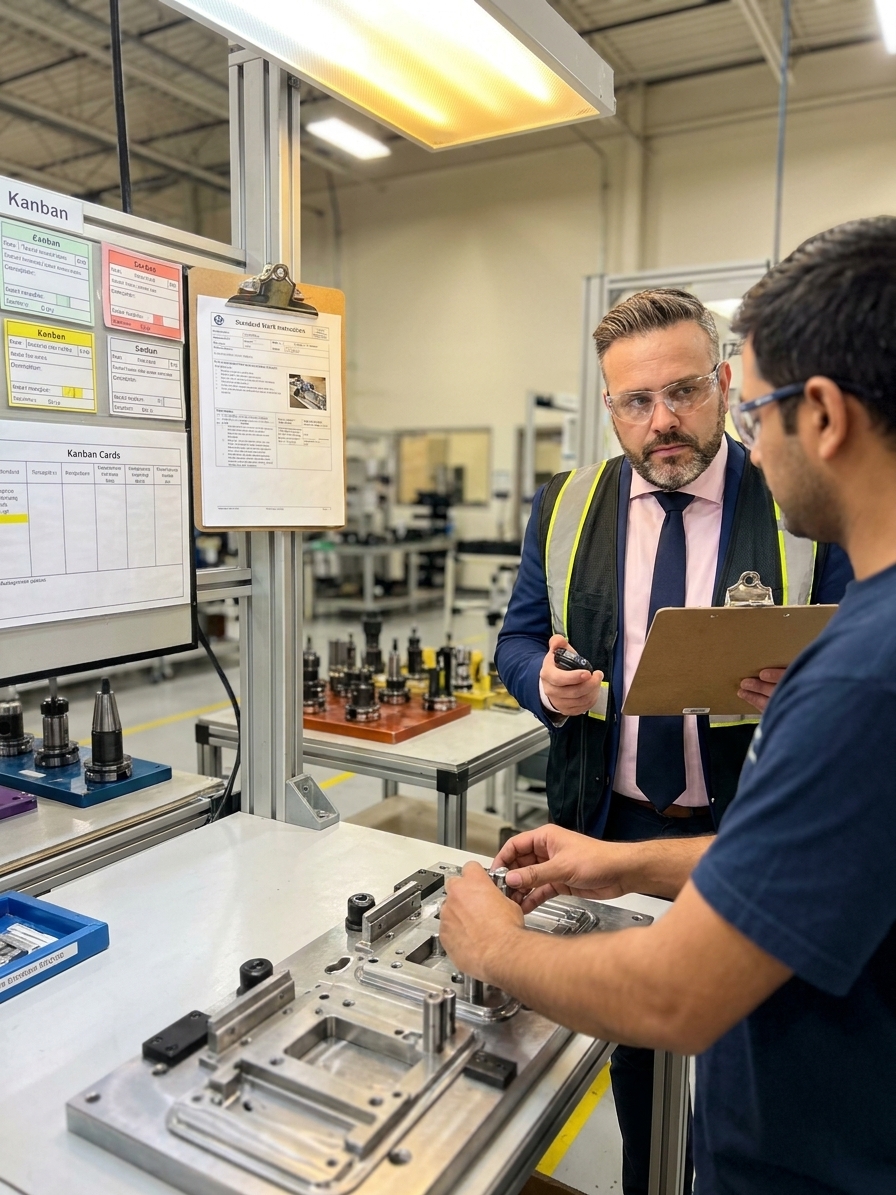
Walk into any facility, ask a machine operator where their standard work document lives, and watch their face. The vague gesture toward a shelf, followed by silence about when they last opened it, explains exactly why your defect rates refuse to drop. Standard Work is supposed to be the baseline for manufacturing consistency. It is the documented, observed, and agreed-upon best method for performing a task.
Every Lean certification and operational excellence program begins with the same premise: write down the work, follow the work, improve the work. Yet in factory after factory, the standard work binder sits collecting dust. Operators execute the job their own way, supervisors sign off on compliance they never verified, and engineers wonder why Cpk indices swing wildly from shift to shift.
I have audited plants where the documented standard had not been updated in three years. The operators had developed entirely different methods to cope with tooling wear and material variations. The documented process was obsolete, the actual process was uncontrolled, and the quality system was simply generating paperwork. Standard Work must be a practice, not an artefact.
The Three Components Most Plants Ignore
Proper Standard Work rests on three distinct components: the work sequence, the cycle time, and the standard in-process inventory. Together, these define what the operator does, the rhythm at which they do it, and the buffer that keeps the process flowing. When any one of these is missing, the standard is incomplete and cannot function as a baseline for improvement.
Work sequence means the specific order of operations. Not general instructions like assemble the part, but granular motions: pick up the housing with the left hand, insert the bearing using the press fixture, and verify seating with the go/no-go gauge. Every motion matters because every motion consumes time and creates an opportunity for error. Vague sequences guarantee inconsistent outputs.
Cycle time is the observed, measured time it takes a qualified operator to complete the sequence following the standard. This is not an engineered standard from a time study conducted years ago. It is the actual time, measured at the gemba with current tools and materials. Standard in-process inventory then defines the minimum work-in-progress needed to maintain flow without accumulating hidden defects.
The Predictable Failure Mode of Documentation
The failure pattern for Standard Work is predictable and almost always starts with good intentions. A quality manager launches a documentation initiative. Engineering writes procedures, uses templates, includes photographs, and secures manager sign-offs. Binders are printed, distributed, and a compliance audit schedule is established. The team celebrates the newly institutionalised discipline.
Then operational reality takes over. An operator discovers a faster sequence that avoids a tooling crash, but the standard stays unchanged because the update process demands multiple signatures. A new supplier ships parts with altered dimensions, forcing operators to adapt their technique silently. A senior operator retires, and their replacement learns a tribal variation of the process.

When the auditor eventually arrives, they note a discrepancy between the binder and the floor. The corrective action is to retrain the operator on the standard. But the standard is fundamentally wrong. Retraining people on an obsolete document does not create consistency. It generates resentment and guarantees the workaround continues undetected.
Treating the Standard as a Hypothesis
The core issue is that most organisations treat standard work as a deliverable. In reality, standard work is an ongoing practice of observing work, comparing it to the standard, identifying gaps, and closing them. The document is merely the artefact of that practice. When the focus shifts entirely to maintaining the document, the practice dies.
Organisations that succeed with Standard Work share common characteristics. Standards are reviewed and updated monthly, not annually. Operators propose changes based on their daily reality, rather than engineers writing standards in isolation. Standards are posted as single pages at the point of use, and leaders observe work against the standard regularly. Improvement is directly linked to documentation.
| Operational Characteristic | Sustaining Standard Work | Failing Standard Work |
|---|---|---|
| Revision cadence | Reviewed and updated monthly at the gemba | Annual reviews driven by external audit calendars |
| Operator ownership | Operators propose and validate changes | Engineers dictate standards from offices |
| Visual management | Single-page standards posted at point of use | Detailed binders stored in supervisor cabinets |
| Leadership behaviour | Leaders watch work and compare to standard | Leaders review yield metrics in conference rooms |
Notice what is absent from the sustaining column: software platforms, external consultants, or expensive technology. The organisations that maintain living standard work do so through leadership habits and shop-floor presence, not through IT investment. The system works because leaders verify it with their own eyes.
Closing the Observation Gap
How much time do your supervisors and engineers spend watching actual work compared to reviewing data about the work? In most organisations, the ratio is catastrophically skewed toward data review. Managers sit in meetings looking at dashboards, scanning statistical process control charts, and debating scrap trends. They are managing the lagging indicators.
Meanwhile, an operator on the floor has developed a workaround for a chronic tooling issue that introduces a subtle but consistent source of variation. The dashboard shows the resulting yield drop. The workaround causing it remains invisible from the conference room. Data tells you a problem exists. Observation tells you why.
Data tells you a problem exists. Direct observation tells you why.
The role of a team leader must include regular observation of standardized work to verify compliance and identify improvement opportunities. This is coaching, not surveillance. When a leader sees a deviation, asking why the operator does it differently reveals crucial intelligence. The answer might expose a training gap, a broken process, or an improvement that should be incorporated into the standard.
Enforcing Discipline Without Killing Innovation
Standard work is about establishing a shared baseline that makes variation visible. Organisations that swing too far toward punitive rigidity create a different but equally damaging dysfunction. When operators are punished for deviating from the standard, they stop innovating. Worse, they stop reporting problems, because reporting a problem implies the standard failed to prevent it.
The result is surface compliance. Everyone appears to follow the standard while nobody actually does. The Cpk targets look stable until a massive defect escapes. The healthy alternative treats the standard as a hypothesis. It is the current best understanding of the right way to do the work. When reality contradicts the hypothesis, you investigate, learn, and revise.
Operators must feel empowered to flag issues and propose improvements. Engineers must treat the shop floor as a laboratory rather than a compliance zone. If an operator's proposed change is an improvement, it becomes the new standard. If it fails, the engineer explains why. Both outcomes build a culture of active engagement.
A Framework for Rebuilding Standard Work
If your documentation has degraded into shelf art, do not launch a facility-wide overhaul. Pick one critical production line. Go to the gemba with a stopwatch and a blank sheet of paper. Watch the work, time the steps, and record the actual sequence being used today. Draft the new standard with the operators, not for them.
The people doing the work daily know which step is hardest and where defects appear. Document the process on a single page. If the standard work sheet cannot fit on one page posted at the workstation, it is too complex. Photos, key parameters, and step sequences are sufficient. The detailed reference material stays in the controlled manual.
Rebuilding a Living Standard
- 01Observe and DocumentTime the current process at the machine and record the real sequence.
- 02Simplify and PostCondense the method to a single visual page positioned at the point of use.
- 03Audit via ObservationLeaders watch the work and compare execution directly to the posted standard.
- 04Revise RapidlyImplement operator-proposed improvements within days, not quarters.
Build a mandatory observation cadence. Assign leaders at every level to spend scheduled, protected time at the process watching work against the standard. Create a fast revision process. When an operator proposes a change, engineering must evaluate it within a week. Link these standards directly to your 8D corrective action data.
When a defect appears, the first diagnostic question must be whether the standard work was followed. If yes, the standard itself is defective and needs immediate revision. If no, you must determine why the operator deviated. The answer will point directly to a mismatch between the documented process and physical reality on the floor.