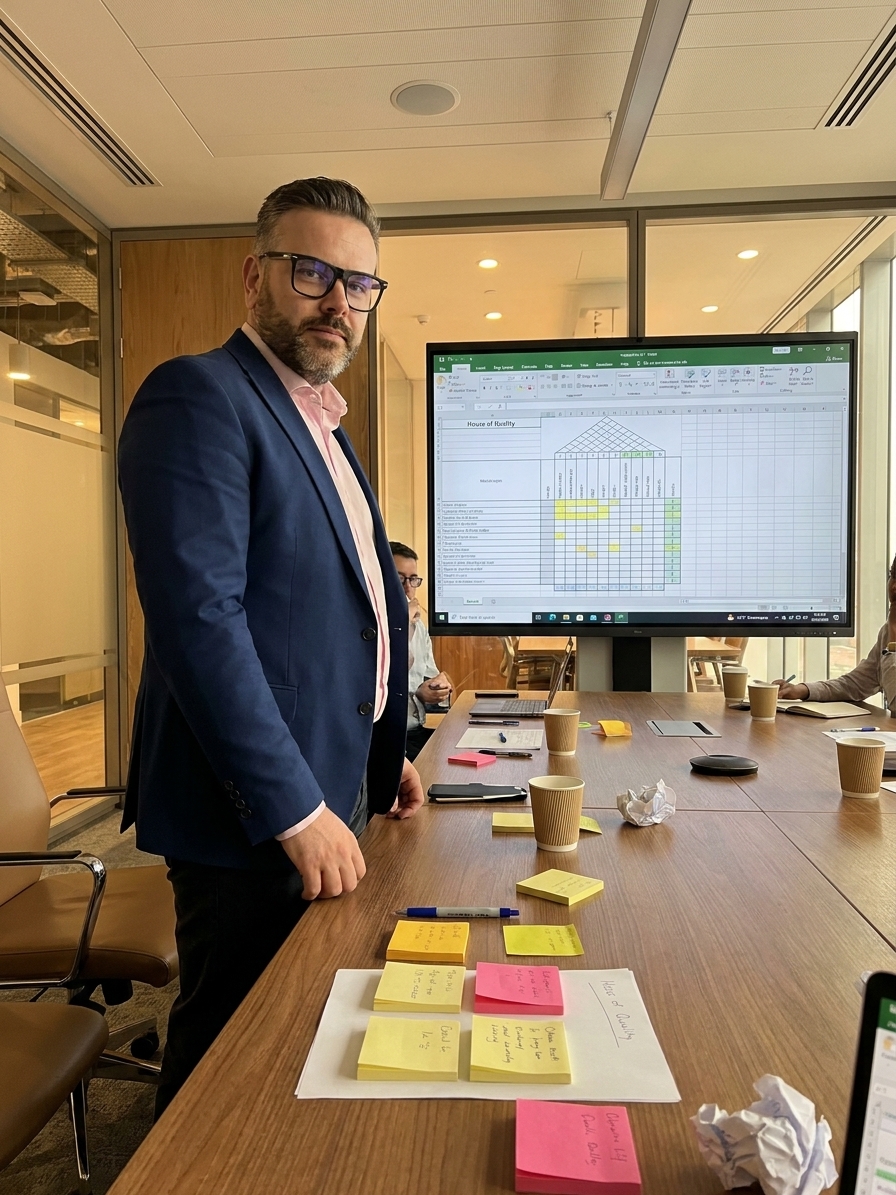
Quality Function Deployment has a reputation problem. In most organisations, it devolves into a two-day conference-room exercise that produces a partially completed spreadsheet. Someone heard about the House of Quality at a conference, a quality manager printed the template, and a cross-functional team gathered to fill the grid. By hour three, an engineer asks the question that kills the exercise: what do we actually do with this?
The result is a document that lives on a shared drive until an ISO 9001 or IATF 16949 audit requires evidence of customer focus. It gets pulled out, photographed, and filed away. The core issue is not the methodology itself. The problem is that organisations run a truncated version of the tool that looks like the real thing but generates zero engineering insight.
When executed with discipline, QFD remains one of the most effective frameworks for ensuring product specifications align with actual market demands. Developed at Mitsubishi's Kobe shipyard in the late 1960s and adopted by Toyota, the method builds a structured bridge between what customers need and what engineers must measure. It forces a team to define exactly what constitutes a good product before the design phase begins.
The Mechanics of the House of Quality
The House of Quality is the foundational matrix of QFD. The structure demands that teams list customer needs, often called the 'whats', in the rows. These must be stated in the customer's language: durable, quiet, or easy to actuate. Along the columns, engineers define the technical characteristics, or the 'hows': cycle life, decibel output, or actuation force.
The intersection of these inputs creates the relationship matrix, where the team scores how strongly each technical characteristic influences each customer need. The strength is typically rated as strong, medium, weak, or none. This forces engineers to trace a measurable parameter directly back to a specific customer desire.
Crucially, the matrix requires an importance weighting for each customer need. These weights must be derived from structured customer surveys, not internal opinion. A competitive benchmarking section maps how the current product and competitors perform against these needs, providing a baseline for target setting.

Matrix Sprawl and Scope Mismanagement
The most common failure mode is uncontrolled expansion. A matrix that begins as a manageable grid grows exponentially as every stakeholder demands representation. Because the relationship cells must be evaluated for every intersection, the effort scales multiplicatively. A session that should take two days drags on for three weeks.
By the time an oversized matrix is completed, the original assumptions are stale and the team has forgotten why specific cells were rated strongly. The fix is brutal prioritisation. If you cannot complete the matrix in a focused two-day session with five to seven people, the scope is too broad.
Split complex products into distinct subsystems and run separate QFD sessions for each. A focused House of Quality for a single door actuation mechanism is worth ten times more than a sprawling, unfinished matrix for an entire vehicle platform.
Handling Benchmarking and the Technical Correlation Roof
Competitive benchmarking is essential, but genuine testing is expensive. Teams often fill the benchmarking column with guesses based on market perception or a glance at a competitor's spec sheet. These are assumptions masquerading as data. If you cannot test competitor products objectively, mark the cells as estimated and commit to validation.
The technical correlation matrix sits at the top of the chart, forming the roof. It identifies where engineering characteristics conflict. Reducing material thickness might lower weight but drastically reduce cycle life. These trade-offs are the heart of engineering decision-making, yet this section is frequently skipped because the team is exhausted by the time they reach it.
Counterintuitively, do the roof early. Complete it immediately after the relationship matrix. The conflicts and synergies you identify will change how you approach the target values. Leaving the roof until the end guarantees the team will be too tired to evaluate critical system risks.
Executing a Focused QFD Session
- 01Define Subsystem ScopeRestrict the matrix boundaries to a specific component or sub-assembly.
- 02Input Real Customer DataFeed pre-collected, statistically valid importance weights into the rows.
- 03Complete Relationship MatrixMap the strength of engineering characteristics against customer needs.
- 04Evaluate the Roof EarlyIdentify engineering conflicts before establishing final targets.
- 05Set and Assign TargetsEstablish technical limits and assign direct ownership to specific engineers.
Integrating QFD with APQP and Agile Development
A common objection is that QFD belongs to a waterfall era and contradicts Agile development. This reflects a misunderstanding of both frameworks. Agile focuses on iterative development, while QFD ensures you are building the right product in the first place. The House of Quality identifies which technical parameters most strongly drive perceived quality.
That information must feed directly into Agile backlog prioritisation. The features mapping to high-importance customer needs with strong engineering relationships are the features you build first. Within automotive APQP frameworks, the QFD output serves as the foundational input for Design Failure Mode and Effects Analysis (DFMEA).
By linking QFD targets to DFMEA and the Production Part Approval Process (PPAP), the organisation ensures that critical characteristics are monitored and controlled throughout the manufacturing lifecycle.
A QFD matrix that acknowledges what it does not know is more useful than one that pretends to know everything.
Translating Outputs into Design Controls
The most tragic failure mode is the completed matrix that goes nowhere. A team spends three days in a room, identifies target values, and feels aligned. Then they return to their desks and proceed with the design they had already started. The QFD matrix is never referenced again.
Targets identified in the session must be entered into formal requirements documents and engineering specifications. The trade-offs identified in the roof must become standard inputs for design reviews. If no one assigns direct ownership for carrying these outputs into downstream processes, the session was a waste of resources.
Book follow-up reviews before the QFD session ends. Schedule a check at thirty, sixty, and ninety days to verify that outputs are driving design decisions. Use these checkpoints to confirm whether assumptions made during the session are holding up against engineering reality.
QFD Execution: Perception versus Discipline
What teams often do
- Use internal opinions and sales anecdotes to weight customer needs.
- Skip the technical correlation roof to save time.
- Guess competitive performance based on published marketing specifications.
- File the completed matrix in a quality folder for the next external audit.
What actually drives results
- Use statistically valid survey data, like conjoint analysis, to weight needs.
- Build the roof immediately after the relationship matrix to catch critical trade-offs.
- Buy and test competitor products using identical internal measurement systems.
- Assign specific engineers to translate targets into requirements documents.
Measuring Long-Term QFD Effectiveness
Six months after a QFD session, apply a simple diagnostic test. Ask anyone on the team to name the top three customer needs by importance weight. If they cannot answer, the session did not embed itself in the team's daily thinking. The matrix was a compliance exercise, not a functional tool.
Check whether the engineering characteristic targets changed during development. If targets shifted but the matrix was not updated, the organisation treated QFD as a static document. This indicates the team abandoned the methodology the moment real engineering constraints appeared.
Finally, assess whether any trade-offs identified in the technical correlation roof were resolved in ways that surprised the team. If no surprises emerged, the roof analysis likely lacked the rigour needed to surface hidden system conflicts. A successful QFD process produces a living framework that actively guides design, testing, and manufacturing validation.