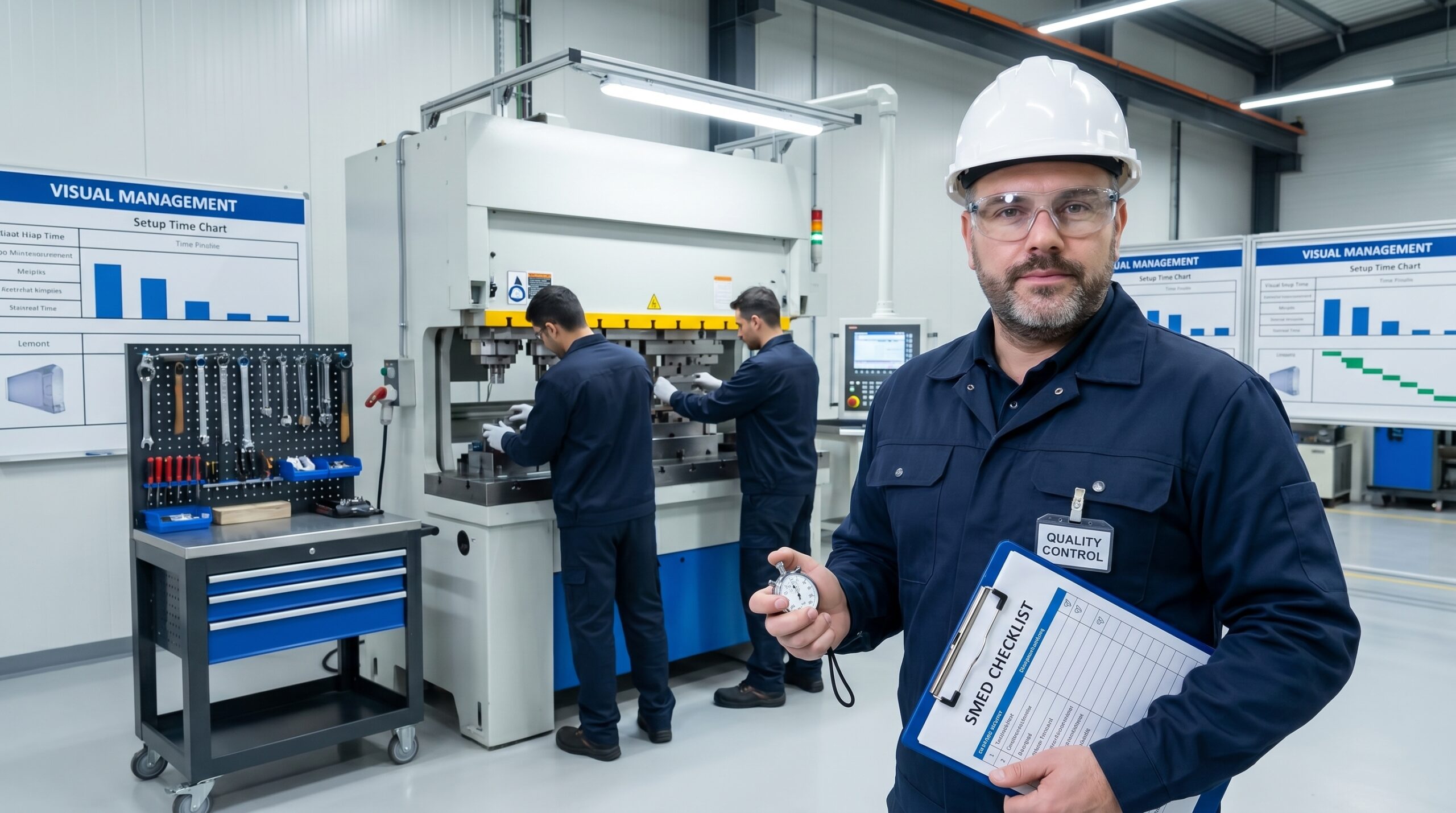
I walked into a Slovak automotive plant in November and the production manager met me at the door with a problem. Average machine setups were running two hours. They needed five changeovers per shift. Ten hours of daily capacity lost to preparation alone.
I asked him what he would say if those setups took ten minutes. He laughed. It was the same reaction Toyota engineers had before Shigeo Shingo developed Single-Minute Exchange of Dies in the 1950s and 1960s.
Three months later, that plant was running 9-minute setups. Capacity was up 23% without a single new machine. The methodology is not secret, but it requires a discipline most plants skip.
What SMED Actually Does to Setup Time
Shingo observed that most setup time was consumed by activities that did not require the machine to be stopped. Operators searched for tools, waited for foreman approval, retrieved materials from distant stores. Perhaps 10% of the elapsed setup time involved actual work on the stopped machine. The rest was pure waste.
The SMED method splits every setup activity into two categories. Internal setup requires the machine to be stopped: die removal, mounting, first-piece alignment. External setup can be performed while the machine still runs: tool preparation, material staging, documentation, gauge retrieval.
The mechanism is simple. Move every possible activity from internal to external. Then streamline what remains. Most plants never make this distinction, which is why their setups balloon to hours instead of minutes.
The SMED Impact at the Slovak Plant
Step One: Observe Without Assumptions
I have audited plants where management confidently described their setup process, then watched reality diverge completely. Assumptions are not data. You need a stopwatch, a blank sheet, and a full observation of one complete changeover from last good piece of Product A to first approved piece of Product B.
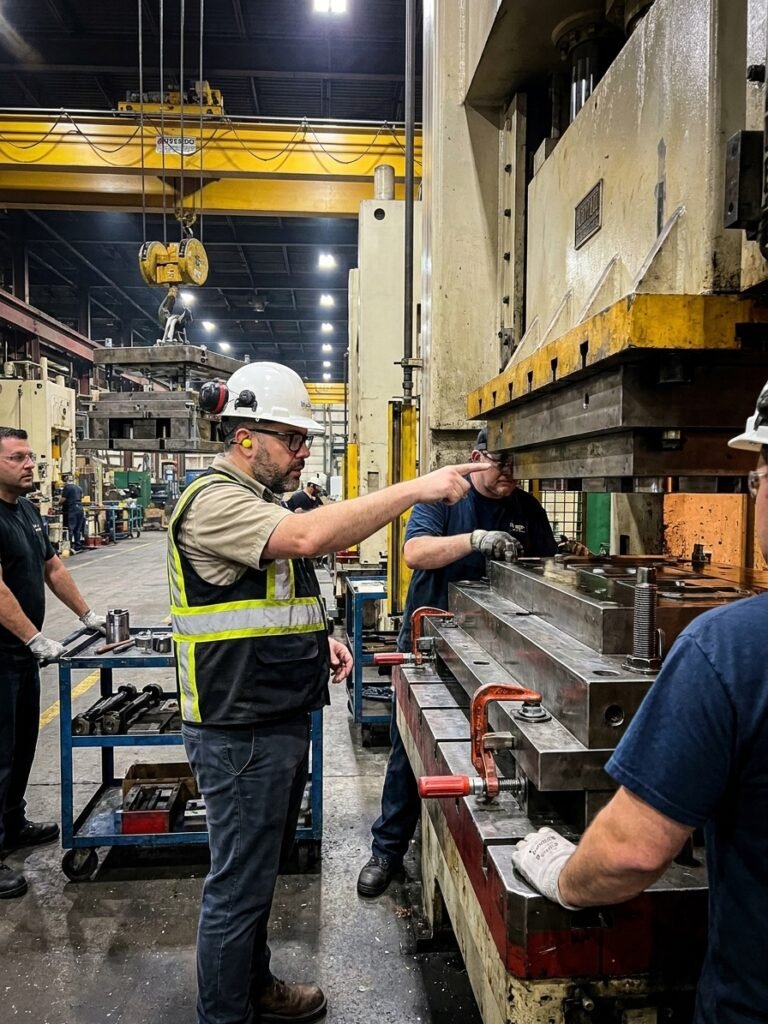
In the Slovak plant, the observed setup ran 127 minutes. We broke down every activity. Eighteen minutes spent finding tools in the store. Twelve minutes waiting for foreman approval. Nine minutes walking to fetch a gauge that should have been at the station. Twenty-three minutes on trial runs and adjustment.
Of those 127 minutes, roughly 35 were true internal work, activities that genuinely required the machine to stand still. The remaining 92 minutes were external tasks performed during downtime simply because nobody had prepared them in advance. That gap is where the gains live.
Phase One: Separate External from Internal
Sit with your team and walk through every recorded activity. Ask one question for each: must the machine be stopped to do this? If the answer is no, move it before the machine stops. Pre-staging tools, preparing material, checking gauge availability, completing documentation, pre-heating dies, all of this can happen during the current production run.
We saved 47 minutes at the Slovak plant with this step alone. Tools were placed on a labelled cart with a checklist, positioned at the machine before the last piece of the current batch ran. Material for the next job was staged. Documentation was pre-filled. The machine stopped only when the operator was ready to begin physical changeover.
This phase requires no capital investment. It requires organisation, visual management, and the discipline to treat preparation as a production task rather than an interruption to it.
Phase Two: Convert Internal to External
This is where engineering judgement enters. Shingo's instruction was direct: if it requires the machine to stop, find a way to do it without stopping. The press technician at the plant spent 12 minutes heating a die to operating temperature after mounting it. We installed a pre-heating station beside the press. The outgoing die was removed, the next die was already at temperature. Twelve minutes of internal time eliminated.
Die removal itself took 14 minutes because bolts were scored and had to be unwound one by one. We replaced them with a hydraulic quick-clamp system actuated by a single lever. Removal dropped to 2 minutes. The investment paid for itself in weeks, not months, because the time saving compounded across every changeover.
Not every internal activity can be converted, but most plants never attempt it. The default assumption is that if the machine is stopped, the activity belongs there. That assumption costs you capacity every shift.
Assumptions are not data. You cannot optimise a setup you have not observed with a stopwatch.
Phase Three: Standardise What Remains
Once external activities are separated and internal activities are minimised, standardise the remaining process. We built a visual procedure using photographs, not text. Every step documented with an image, arrows showing action points, and a time target for each. The tool cart had a checklist attached.
We designated a single setup operator, not because it required a specialist, but because repetition builds speed. The first week, changeovers took 50 minutes. The fourth week, 22 minutes. The eighth week, 14 minutes. Muscular memory applies to industrial work as much as it does to sport.
Standardisation without measurement is theatre. Track every changeover. Display the times. When the team sees the trend line dropping, the momentum sustains itself. When they see it climbing, the root cause is usually visible within two or three observations.
SMED Implementation Sequence
- 01Observe and recordTime every activity across three full changeovers. Assume nothing.
- 02Separate external workMove every non-machine-dependent task before the machine stops.
- 03Convert internal to externalEngineer out remaining stop-time activities through tooling and process redesign.
- 04Standardise the residualVisual procedures, dedicated operators, time targets per step.
Phase Four: Eliminate Setup Entirely
This is the ideal. It is not always achievable, but it should be considered during product and process design. Common clamping points across a product family mean you change an insert, not the full tooling. Modular dies allow swapping one component rather than the complete assembly. Parallel stations let one machine run while another is being set.
In one plant, we designed a product family around identical fixture geometry. Changing from one product to another required swapping an internal insert. Three minutes instead of 45. The decision was made at the design stage, not the production stage, and it changed the economics of the entire line.
Most plants will never reach full elimination. But the pursuit of it exposes opportunities that a passive acceptance of long setups will never reveal. The question worth asking during every new product introduction is: what setup does this design impose on us, and can we reduce it?
Where SMED Fails
I have seen more SMED implementations fail than succeed, and the failure modes are consistent. The most common is starting without observation. A production manager tells you they know the process. They do not. When you sit and watch, the real process looks nothing like the assumed one.
The second failure is over-investing in technology before fixing basics. Plants buy hydraulic clamps and automated tool changers while their operators are still walking to the store for gauges. Fix the organisation first. Invest in hardware only when the process is already lean and you know exactly what the constraint is.
The third failure is doing it to operators rather than with them. Engineers conduct the analysis, write the procedure, and hand it down. Operators ignore it because they were not involved. SMED is a team exercise from the first observation. The people who run the machine must own the standard.
The fourth failure is neglecting maintenance. Quick setup demands maintained equipment. A scored bolt that jams on every changeover adds minutes that standardisation cannot remove. SMED and TPM are linked disciplines. One without the other degrades within months.
How to Start Tomorrow
Pick one machine, ideally the one with the most frequent setups or the greatest impact on throughput. Observe three complete changeovers with a stopwatch. Record every activity. Label each as external or internal. Move every external activity before the machine stops. Repeat the observation.
The first cycle will deliver a 30 to 50% reduction in setup time. No investment, no consultants, no project team. Just observation, classification, and the discipline to prepare before stopping the machine. The remaining phases build on this foundation, but they are meaningless without it.
When setups take two hours, people avoid them. They pressure planners for longer runs, which inflates inventory and reduces responsiveness. When setups take five minutes, you change over without thinking about it. The plant becomes flexible by design, not by overtime.