An operator on an automotive assembly line stops work. The line stops. Twenty-three people wait. He is looking for a 13mm socket wrench. Four minutes pass before he finds it draped over a fixture two stations down the line. When questioned about the downtime, the shift supervisor shrugs. 'Tools get lost. People have to find them.' This response is standard, but it is unacceptable.
That four-minute delay is muda—pure waste. It is so deeply embedded in the daily routine that most manufacturing teams have stopped seeing it as a problem. They treat the symptom, searching frantically, rather than addressing the cause: a complete lack of visual control. This is exactly where a shadow board intervenes.
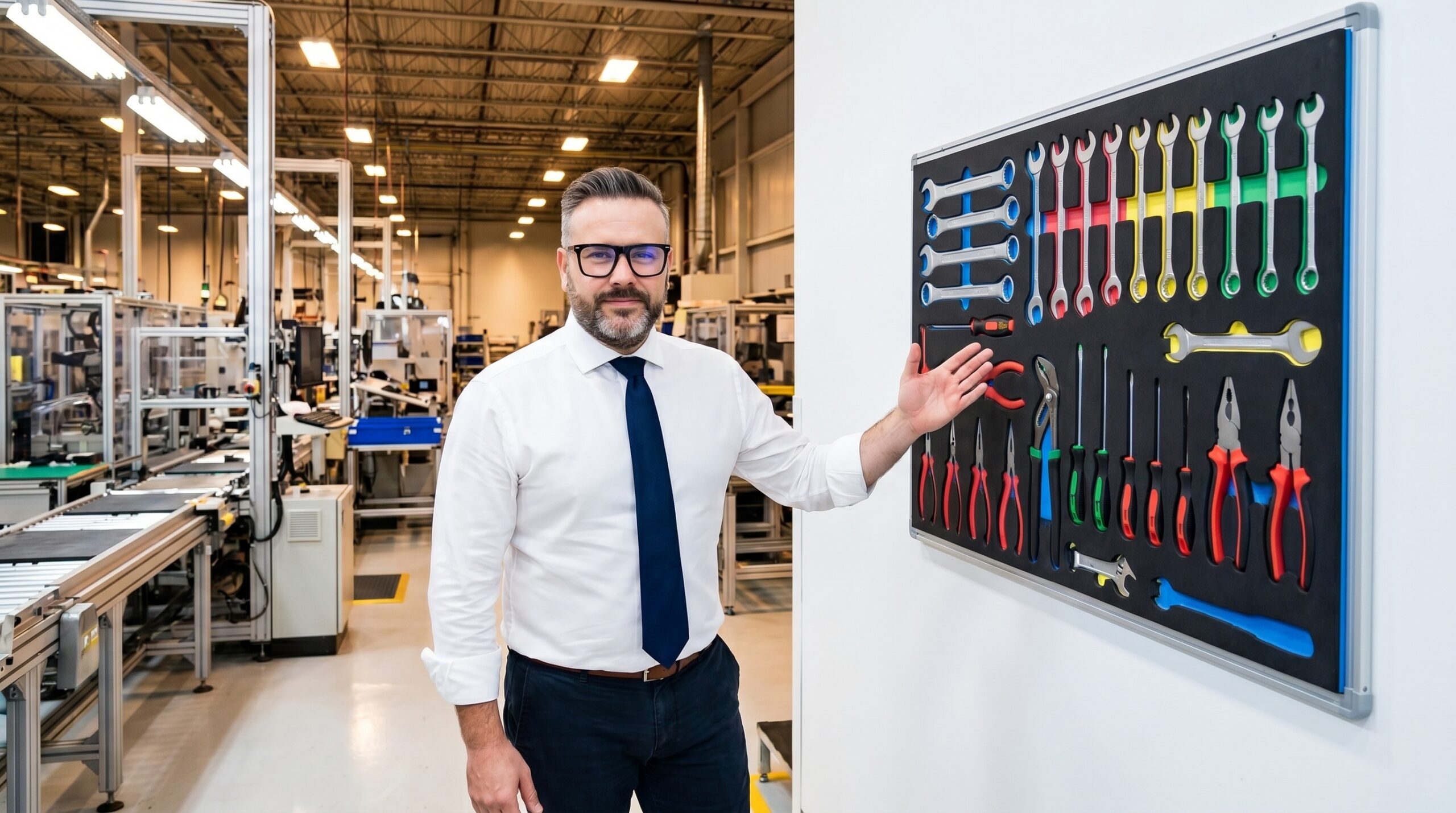
A shadow board is a physical organising system—a foam panel, metal board, or magnetic surface—where the exact outlines of required tools are cut, painted, or printed. When a tool is in use, you see a coloured silhouette. When it is missing, that silhouette immediately signals an abnormality. The Toyota Production System demands that normal states be visually obvious and abnormal states be instantly recognisable. Shadow boards are the mechanical translation of that principle.
Measuring the Hidden Cost of Disorganisation
Implementing a shadow board without first measuring your current tool-search time destroys your business case. You must quantify the waste. When I implemented visual management systems in an automotive plant in Central Slovakia, I began by tracking how long operators spent looking for equipment. I instructed the team to log their search times for three consecutive days.
The baseline data was staggering. The average search time per instance was 3.7 minutes. Operators searched for tools an average of twelve times per shift. The total time lost to searching amounted to roughly 44 minutes per shift. Projected across a single production line, this equalled approximately 280 lost hours annually. That is over seven full working weeks of completely avoidable downtime.
The financial impact becomes undeniable when you convert those hours into labour costs and lost output. 280 hours per line is a massive drain on OEE and profitability. Before designing a single foam cutout, present this baseline data to your management team. Numbers change the conversation from 'tidying up' to operational efficiency.
The Baseline Waste Metric
Building a Functional Shadow Board
Not all shadow boards succeed. I have audited plants with beautifully laser-cut, colour-coded panels that operators completely ignored. I have also seen crudely cut foam boards that teams fiercely protected and maintained. The deciding factor is never the material; it is always the level of operator engagement during the design phase.
Never design a shadow board behind a desk and impose it on the shop floor. Sit down with the operators and ask targeted questions. 'Which tools do you actually need? Which do you use every single shift? Which tools are redundant?' This final question is critical. You will routinely find that operators actively use only twelve tools out of a drawer of thirty. The rest are kept 'just in case,' and that excess inventory is precisely what creates chaos.
Location dictates effectiveness. A shadow board belongs where the tool is used, not where it looks aesthetically pleasing to a touring manager. If the operator moves along the line, mount the board on a mobile trolley. The standard must be ruthless: an operator must be able to reach and return any tool in under five seconds. If it takes longer, relocate the board.
Material Selection and Layout Standards
Selecting the right substrate depends on the working environment. In high-vibration or heavy-machinery areas, metal panels with laser-cut outlines withstand harsh conditions. For standard assembly stations, high-density foam is highly effective. The automotive industry standard is dual-layer foam: a black top layer with a bright red or yellow layer beneath.
When a tool is removed from dual-layer foam, the bright underlying colour immediately signals a missing item. This contrast eliminates any ambiguity. Beyond the silhouette, you must label every pocket. Include the tool name, size, and any relevant identification number. Do not assume every operator can instantly distinguish a 12mm wrench from a 13mm wrench in poor lighting.
Magnetic panels offer flexibility for rapidly changing tool sets, while 3D-printed organisers work well for highly specific, irregularly shaped gauges. Regardless of the material chosen, the layout must group tools by function or frequency of use. Apply the 80/20 rule: if 80% of the task requires 20% of the tools, those critical items get the most accessible, front-and-centre real estate on the board.
Integrating Visual Control into Daily Routines
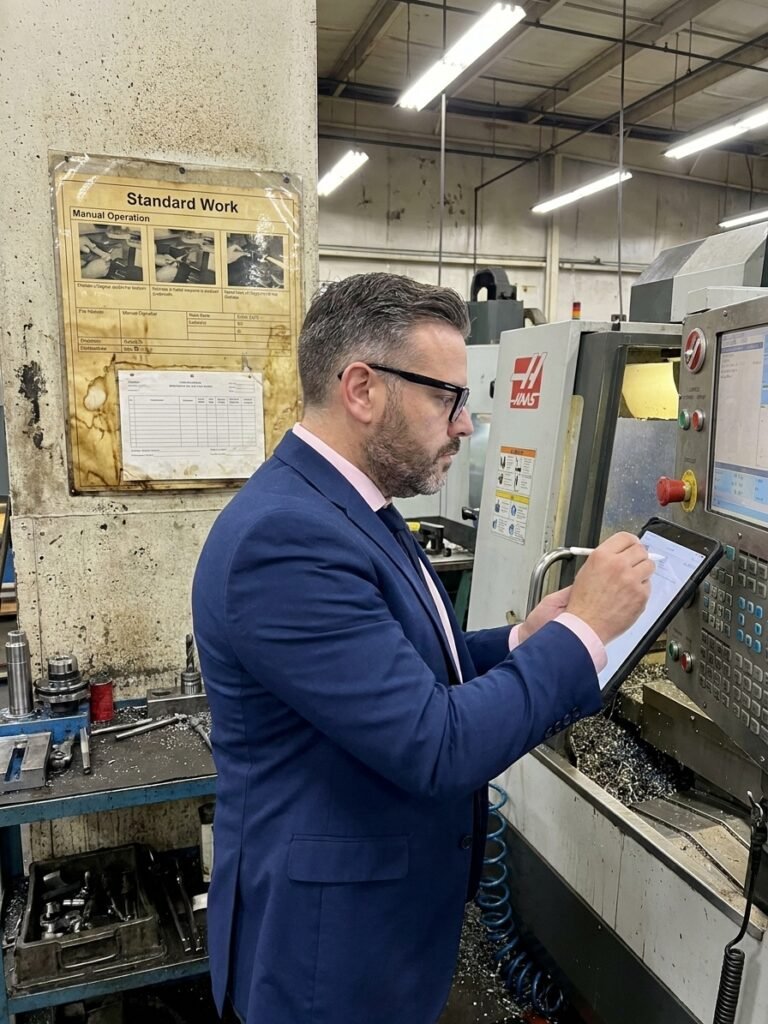
A shadow board without a governing routine is just decoration. To sustain the system, you must embed it into your daily Standard Work. Operators must verify the board at the start of the shift, ensuring all tools are present. During the shift, tools are returned to their designated pockets immediately after use—never placed temporarily on a bench or machine.
At shift handover, the outgoing operator must pass the workstation to the incoming operator with a complete shadow board. This transfers accountability cleanly. You can enforce these rules by integrating the shadow board check into your existing Layered Process Audits (LPA), SMED changeover procedures, or monthly 5S audits.
Visual control does not replace discipline; it simply makes the lack of it immediately obvious to everyone.
The combination of a shadow board and a Kamishibai board for daily audits creates a powerful management loop. The shadow board physically exposes the abnormality, and the Kamishibai board ensures leadership addresses the root cause during their scheduled gemba walks.
Measurable Impact Beyond Search Time
Returning to the Central Slovakia automotive line: one month after implementing the operator-designed shadow boards, we repeated the baseline measurement. Search time dropped to zero. The 44 minutes of daily accumulated waste was entirely recovered. But the primary operational metrics improved in ways we had not fully anticipated.
First-pass quality yield improved by 12%. The mechanism here is straightforward: when operators have immediate access to the correct tool, they stop improvising with the closest available substitute. Using a properly calibrated torque wrench instead of a worn-out nearby equivalent directly reduces defect rates and rework.
Tool damage and replacement costs dropped by 34%. When equipment has a designated, protected location, operators handle it with more respect. Cluttered workstations lead to tools being knocked onto concrete floors or buried under components. Safety incidents also decreased, as tripping hazards and loose metal debris were eliminated from the workstation.
Pre- and Post-Implementation Behaviour
Before shadow boards
- Operators improvise with incorrect tooling.
- 44 minutes per shift spent searching.
- Tools damaged from falling or improper storage.
- Cluttered work surfaces create safety hazards.
After shadow boards
- Correct tool is always within a 5-second reach.
- Zero minutes lost to searching per shift.
- Tool replacement costs drop by over a third.
- Workstation condition audited at every handover.
Scaling the Principle Across the Value Stream
The shadow board principle extends far beyond hand tools. In aerospace manufacturing, I have seen this exact methodology applied to aircraft maintenance kits, where a missing wrench triggers an immediate work stoppage until the item is recovered. In medical device assembly, shadow boards manage surgical and calibration equipment with zero tolerance for deviation.
Apply the same visual control to your spare parts inventory, safety equipment stations, and first-aid kits. If an eyewash station or critical fire extinguisher is missing or obstructed, a brightly painted floor outline instantly flags the danger. Visual management replaces human memory with a foolproof visual standard.
Industry 4.0 technologies offer digital upgrades to this analog system. RFID tags embedded in tool handles can automatically log when a tool is removed and returned. IoT sensors track usage frequency, feeding data directly into an MES. But technology cannot fix a broken culture. If operators will not return a tool to a piece of cut foam, they will not return it to an RFID dock. Start analog, build the discipline, then digitise.
The return on investment for an analog shadow board is calculated in days. A dual-layer foam board costs roughly 30 to 80 euros. Installation and layout take a few hours. Recovering 44 minutes of downtime per shift pays for the implementation in less than two days. Shadow boards work because they are simple, operator-driven, and attack the hidden waste that most teams have learned to ignore.