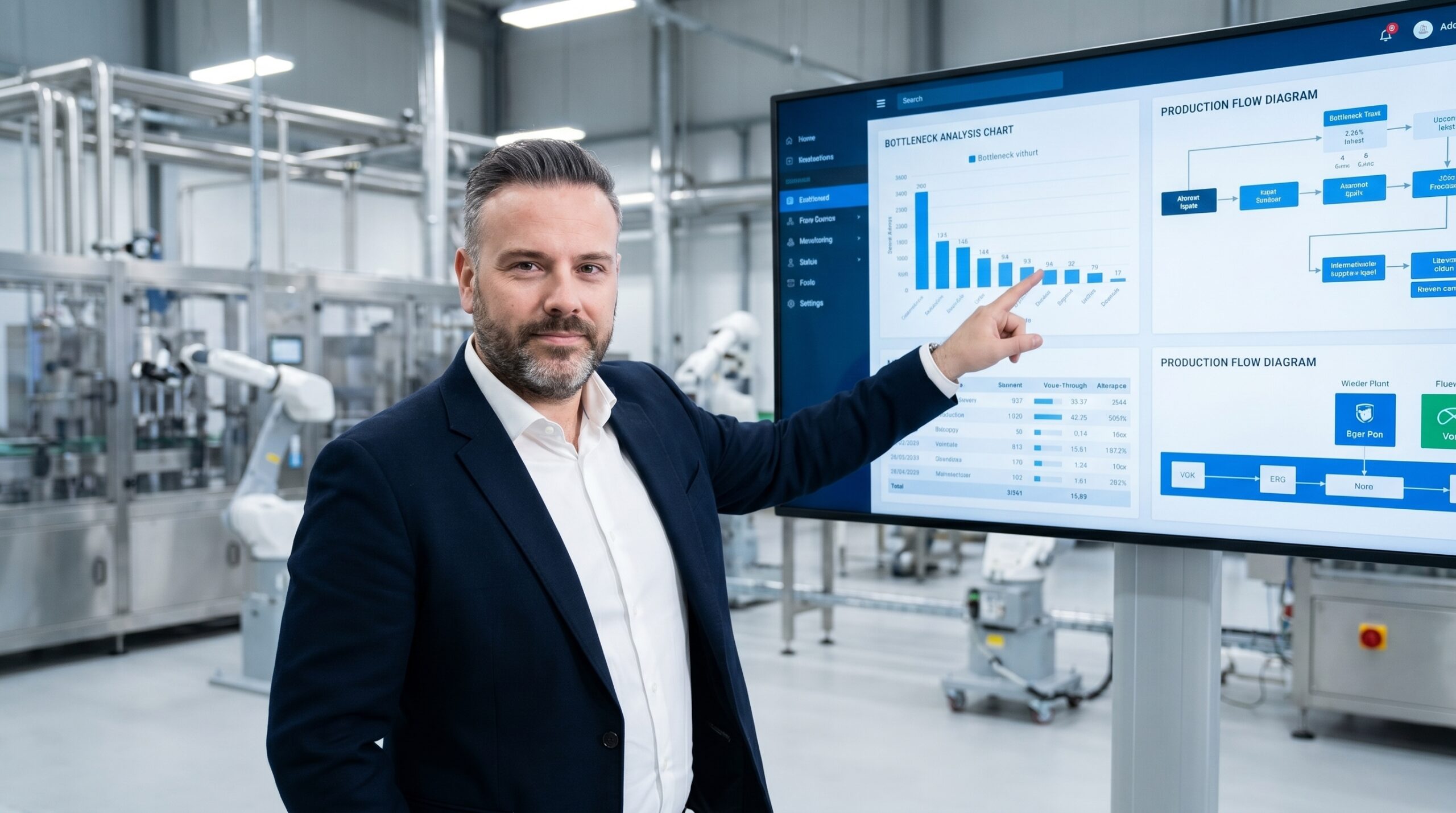
A production line rated for 480 units per shift consistently delivers 312. Material is present, operators are at their stations, and the machines are running. When a plant hits this wall, the problem is almost never effort or material availability. The problem is a constraint.
Eliyahu Goldratt formalised this in his 1984 book The Goal. The Theory of Constraints (TOC) operates on a brutal premise: the output of an entire system is dictated solely by the output of its slowest component. Improving any other part of the line only builds excess inventory.
In my experience auditing and transitioning ISO 9001 and IATF 16949 systems, I have seen plants invest heavily in automation only to watch output flatline. They automated the wrong stations. When you map the process, measure cycle times against customer takt, and focus your resources on the single bottleneck, the line balances itself.
System Throughput vs. Local Efficiencies
Local efficiency is the most destructive metric in manufacturing. Measuring and rewarding individual stations for 100% utilisation guarantees one outcome: massive work-in-process (WIP) accumulation directly in front of the constraint. The faster a non-bottleneck station runs, the worse the overall system performs.
A manufacturing line operates exactly like a physical chain. A twenty-link chain can only hold the weight its weakest link allows. If you strengthen the top five links, you gain nothing. You must identify the single operation running slower than customer takt time and subordinate the entire plant's schedule to its rhythm.
This requires a fundamental shift in management thinking. You must accept that idle time at non-constraint stations is not a failure—it is a necessary condition for system stability. When downstream stations process parts only as the constraint releases them, chaos drops, lead times shrink, and quality stabilises.
Core TOC Operating Metrics
The Five Focusing Steps
Goldratt did not just define the problem; he provided a rigid implementation process. The methodology requires absolute discipline. You cannot skip steps or try to parallel-track solutions. You start at the bottleneck and work outward.
Step one is identification. You do not find the bottleneck from a conference room. Map the value stream and measure the actual cycle time of every operation. The operation with a cycle time longer than customer takt time is your constraint. If a milling operation takes 47 seconds and takt is 36 seconds, the mill is the bottleneck.
The TOC Focusing Process
- 011. IdentifyCycle-time the entire line. Find the station exceeding customer takt.
- 022. ExploitMaximise bottleneck utilisation. Remove micro-stops and waiting.
- 033. SubordinateFeed the constraint perfectly. Downgrade priority of all other stations.
- 044. ElevateIf steps 2-3 fail, invest capital. Buy machinery or add shifts.
- 055. RepeatThe constraint has moved. Return to step one for the new bottleneck.
Step two is exploitation. Before requesting capital for a new machine, squeeze every second out of the existing constraint. Pre-stage material so the machine never waits. Assign your most experienced operator to the station. Move lunch breaks and scheduled maintenance outside of production hours. Inspection must happen at the machine.
Step three is subordination. This is where most organisations fail. The entire plant must support the bottleneck. Maintenance must prioritise the constraint above all other assets. Purchasing must guarantee material availability exactly when the constraint requires it. Quality control must inspect parts entering the constraint, not leaving it.
Protecting the Constraint with Quality
A defective part that passes through a constraint consumes unrecoverable system capacity. If your bottleneck processes 50 parts an hour, a scrap part costs the plant exactly 72 seconds of total line output—time you cannot recover by running faster elsewhere.
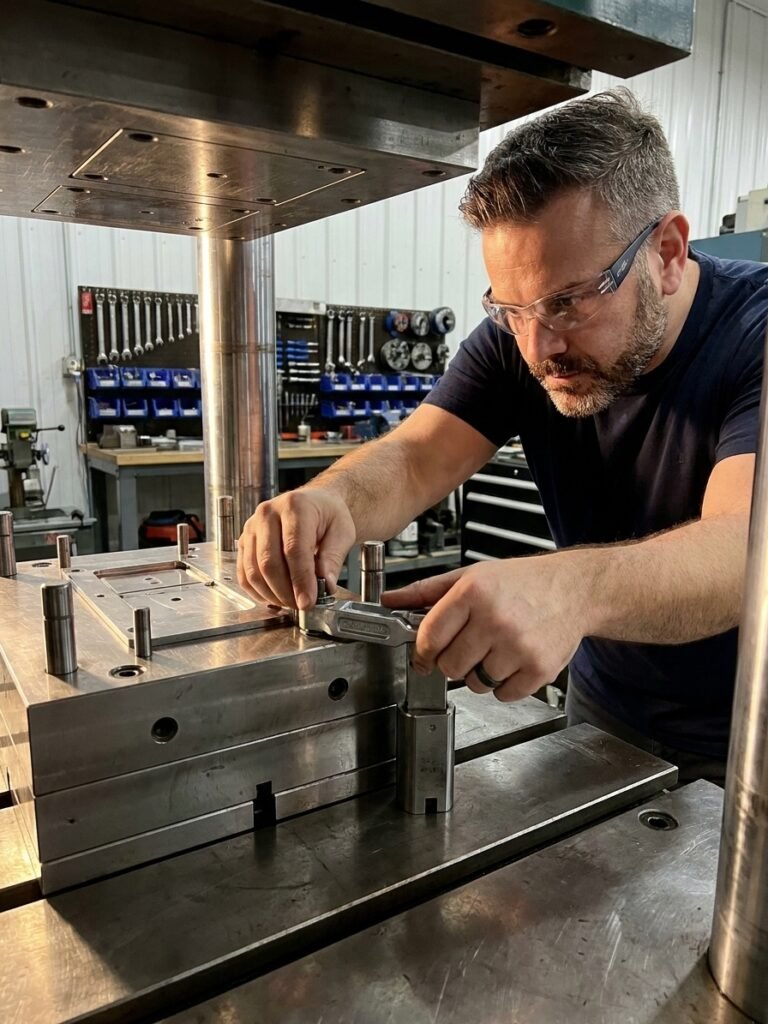
This is why TOC demands a quality gate immediately upstream of the bottleneck. Do not rely on final inspection. Verify dimensions, material certs, and surface finish before the part enters the constrained operation. This upstream gate must be defined in your PFMEA and control plan.
Furthermore, the constraint requires Total Productive Maintenance (TPM). If the bottleneck goes down, the entire plant stops generating throughput. Apply predictive maintenance, vibration analysis, and rigorous autonomous maintenance checks. Unplanned downtime at the constraint is a systemic failure that cannot be mitigated by safety stock.
Drum-Buffer-Rope: Synchronising the Flow
To operationalise these concepts, Goldratt developed the Drum-Buffer-Rope (DBR) scheduling system. DBR replaces traditional push-system MRP logic with a pull mechanism driven entirely by the physical reality of the constraint.
The Drum is the constraint itself. It sets the beat for the entire manufacturing line. Every operator works to this rhythm. The Buffer is not warehouse stock; it is a calculated time-delay of material placed strategically in front of the constraint to absorb variability upstream.
The faster a non-bottleneck station runs, the worse the overall system performs.
The Rope is the communication signal. When the constraint finishes a part, it sends a signal upstream to release raw material for exactly one new part. No more, no less. This mechanism strictly limits WIP, slashes lead times, and guarantees the bottleneck never starves.
Implementing DBR requires breaking the conventional mindset of operator utilisation. Non-constraint operators will have idle time. That idle time is not inefficiency; it is the buffer that keeps the system stable. Measure your operators by adherence to the drum's rhythm, not by individual station output.
Integrating TOC with Lean and Six Sigma
Practitioners often ask whether TOC replaces Lean or Six Sigma. It does not. It provides the targeting logic that makes them effective. Blindly applying Kaizen events across a plant yields isolated efficiencies that compound into WIP congestion.
Use TOC to identify the exact process limiting system throughput. Once identified, deploy Lean tools—SMED for changeovers, 5S for workplace organisation, and Kanban for material flow—specifically on that constraint.
Then apply Six Sigma's DMAIC framework to reduce variation at the bottleneck. A constraint operating at Cpk 1.67 with zero micro-stops will outperform a highly optimised non-constraint every time. Integrate these methodologies, focus them exclusively on the bottleneck, and system throughput rises.
Common Implementation Failures
The most frequent error is improving a non-constraint. I have audited facilities where engineers proudly presented SMED projects that cut changeover time by 80%—on a station feeding an already-starved bottleneck. The result was more inventory on the floor and zero increase in final output.
The second failure is assuming TOC is a one-time project. When you elevate a constraint—say, by adding a second milling machine—the bottleneck physically moves. It might shift to packaging, to a specific supplier, or to engineering approvals. If your management system does not immediately search for the new constraint, you fall back into chaos.
The third failure is ignoring the human element. If operators do not understand why their station is being deliberately slowed, they will resist. You must explain the chain metaphor. Train your shift leaders to explain why idle time at non-constraints is critical to the plant's financial success and the customer's delivery schedule.