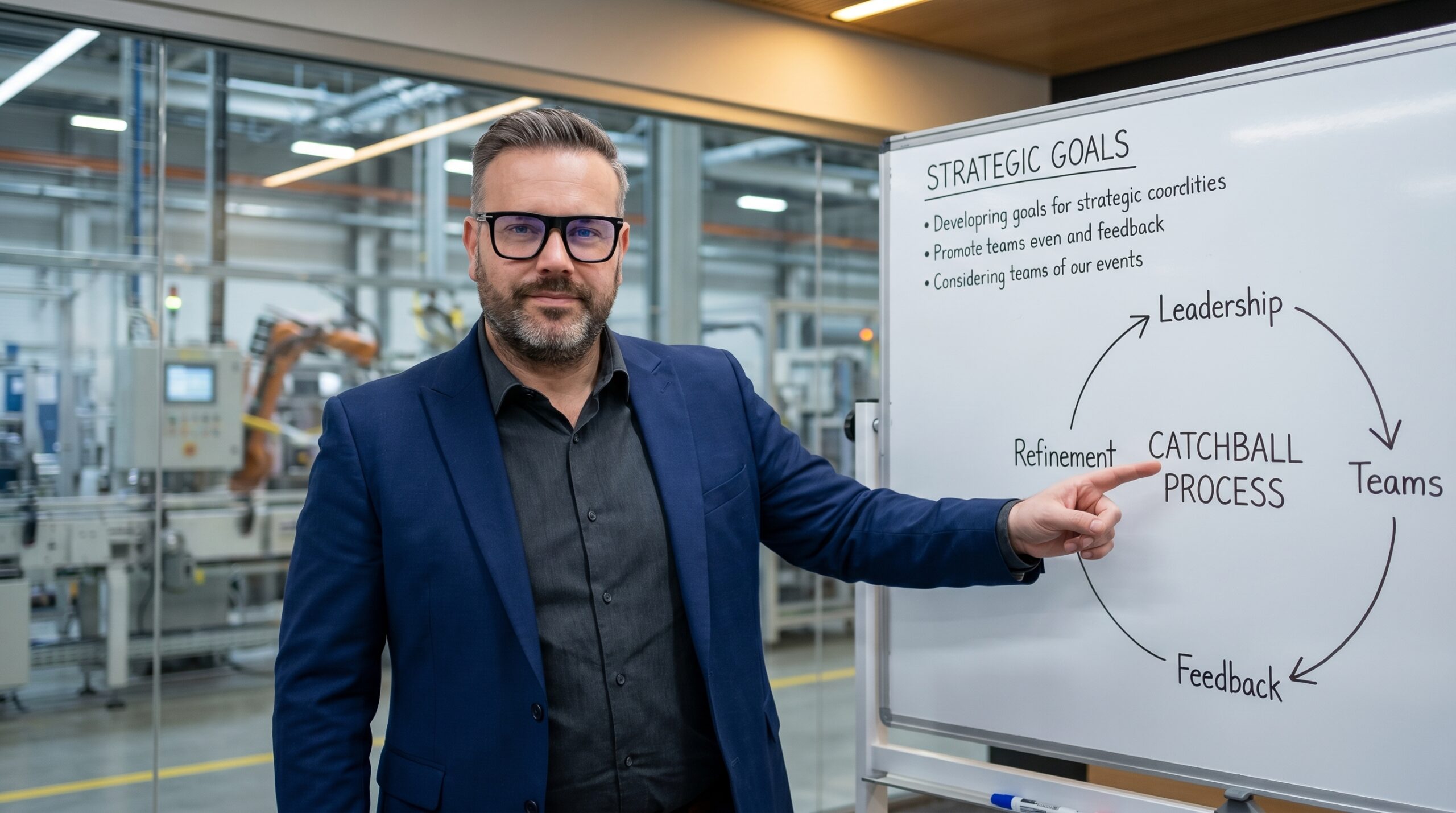
Strategic deployment fails when executive targets are simply dictated to the operational level. Leadership sets a goal to reduce scrap by 20 percent, pushes the number down through the hierarchy, and wonders why the shift supervisors cannot deliver. The gap between boardroom strategy and shop-floor execution is rarely a problem of effort. It is a problem of mechanism.
Hoshin Kanri—often called policy deployment—solves this through a structured negotiation process called catchball. Named after the simple act of throwing a ball back and forth, catchball requires that every strategic objective is debated, refined, and resourced at the organisational level responsible for executing it. The goal is not consensus. It is alignment through friction.
I have audited plants where the leadership team could quote their IATF 16949 business plan targets perfectly, but the line operators had no idea what the top three quality KPIs were. That is a failure of deployment, not a failure of the standard. Catchball closes that specific gap.
How the Catchball Mechanism Works
Catchball operates through a vertical cycle of proposals and counter-proposals. Executive management defines the strategic imperative. Middle management evaluates the feasibility and proposes the tactical approach. Shop-floor leadership defines the operational tasks and the resources required to execute them.
At each handover, the receiving level has the right to push back. If a target is physically impossible given current process capability—say, a Cpk of 1.67 on a legacy stamping line—the receiving team must return the "ball" with data. The executive level then either authorises the capital investment required to upgrade the line, or adjusts the strategic target. This forces data into the strategic conversation.
The Catchball Deployment Cycle
- 01Top-down: Strategic TargetExecutive leadership defines the strategic imperative, e.g. reduce cost of poor quality by 15%.
- 02Bottom-up: Tactical ProposalQuality and operations managers assess feasibility and propose specific process improvement initiatives.
- 03Top-down: Resource AllocationLeadership reviews the tactical plan and authorises budget, headcount, or equipment changes.
- 04Bottom-up: Execution PlanShift leaders and process engineers define the daily operational tasks and commit to the KPI.
The alternative is the cascade model, where targets are simply pushed down the organisational chart. Cascade deployment assumes that the strategy is perfect and the execution is the only variable. Catchball assumes the opposite: the initial strategy is incomplete until it has been stress-tested by the people who run the process.
X-Matrix Alignment

The primary tool for structuring this negotiation is the Hoshin X-Matrix. It is a single-page document that forces the user to connect long-term breaks throughs to annual targets, specific improvement initiatives, and the owners responsible for execution. The matrix is completed at each organisational tier.
The top-level X-Matrix breaks down the three-to-five-year strategic vision into annual objectives. The departmental X-Matrix translates those annual objectives into specific tactical projects. The shop-floor tier translates those projects into daily management standards and process controls.
Integration with Quality Standards
Both ISO 9001 and IATF 16949 require organisations to deploy their quality policy and objectives across relevant functions and levels. Catchball is the operational method that satisfies this requirement. It provides the auditable evidence that objectives have been communicated, understood, and resourced, rather than merely posted on a notice board.
In my experience transitioning quality management systems at automotive and aerospace suppliers, the most common audit nonconformance in clause 6.2 (Quality Objectives and Planning) is the inability of operational personnel to explain how their daily work connects to the company targets. Catchball makes this connection explicit.
When an IATF 16949 auditor asks a line leader about their contribution to the scrap reduction target, the catchball process ensures that leader has already debated the target, agreed to the measurement, and defined the specific process parameter they are responsible for controlling.
Strategy that is not argued at the shop floor is just a wish list. Catchball turns the wish list into a work instruction.
Common Failure Modes
Catchball fails when middle management acts as a simple relay rather than a translator. If the quality manager receives the executive target and simply forwards it to the shift supervisors without context, the process is broken. Middle management must add the tactical detail: which specific process, which defect mode, which measurement system.
Dictated Targets vs. Catchball Deployment
Cascade Deployment
- Targets pushed down with no feedback loop.
- Middle management acts as a postman.
- Shop floor receives a number without context.
- Failure results in blame, not process review.
Catchball Deployment
- Targets are negotiated based on process data.
- Middle management translates strategy into tactics.
- Shop floor defines the daily execution plan.
- Gaps trigger investment or target revision.
The second failure mode is the absence of data. Pushback without data is just complaining. If a production supervisor rejects a scrap reduction target, they must present the current OEE, the specific failure modes from the PFMEA, and the historical data from the control plan. The catchball negotiation must be an engineering discussion, not an emotional one.
Implementing the Process
Start with one strategic objective. Do not attempt to deploy the entire business plan through catchball in the first quarter. Choose a high-impact target—such as reducing customer PPM or improving first-pass yield—and run the vertical negotiation cycle for that single objective.
Train middle management first. They are the critical link. If they cannot facilitate the negotiation between leadership and the shop floor, the process collapses into a traditional top-down mandate. Middle managers must understand how to use the X-Matrix, how to challenge a target constructively, and how to translate a strategic goal into a tactical project plan.
Finally, standardise the review. Catchball is not a single event; it is a recurring cycle. Establish a monthly review where the deployed targets are checked against actual performance. If the tactical plan is not delivering the expected result, the ball goes back into play. The strategy is revised, or the execution plan is changed.