
I have walked into plants with flawless ISO 9001 documentation mounted on the lobby wall and production areas that functioned like uncontrolled garages. The procedures were perfectly formatted. The reality on the shop floor was entirely different.
Inspection records were filled out retrospectively at the end of the shift. Operators could not identify their critical-to-quality dimensions. Management genuinely believed the certificate on the wall guaranteed product conformity. It did not.
Quality is not a document. Quality is behaviour. Implementing standards like ISO 9001, IATF 16949, or AS9100 requires changing how hundreds of people approach their daily work. John Kotter's eight-step framework for organisational change provides the exact mechanism to achieve this in a manufacturing environment.
Establishing Urgency on the Shop Floor
The primary reason quality transformations fail is a lack of urgency. People must understand that the current state is unsustainable, not eventually, but immediately. In quality management, this means translating abstract metrics into immediate operational consequences.
Consider a standard quality review meeting. The Quality Manager presents a defect rate of 2,500 PPM. To an operator on the line, this number is abstract. But when you translate that metric into 75 defective parts shipped to the customer every month, the dynamic changes. Explain that one of those parts could fail during a family's braking manoeuvre. Suddenly, the PPM chart represents tangible risk and personal responsibility.
You build urgency with real business data, not industry averages. Bring in an angry customer to explain the operational disruption a defective delivery causes. Calculate the actual Cost of Poor Quality in lost profit. Show exactly where your competitors outperform you. Without this visceral understanding of the current reality, no quality initiative will gain traction.
Translating Defect Data into Urgency
Building a Guiding Coalition of Operators
A single Quality Director cannot change a plant. The Quality Department alone cannot force compliance. You need a credible, cross-functional coalition to drive the transformation and carry the message to the floor.
The common mistake is building a coalition entirely out of managers. You need positional power, but authority without trust is useless. Your coalition must include the informal leaders on the shop floor. You need the experienced operators that junior workers approach when they have a problem. These are the respected individuals who hold no formal title but hold immense sway over daily operations.
A functional change coalition requires production leadership to authorize line stoppages. It needs shift leaders who witness daily reality. It requires an HR representative to align training and reward systems. It demands key operators who will champion the new standard among their peers, plus a quality engineer to provide technical support.
Forming and Communicating a Strategic Vision
Without a clear vision, a quality initiative degrades into a series of disconnected, uncoordinated projects. A vision answers a specific question: what kind of manufacturing operation will we be in two years? Achieving ISO 9001 certification is a project milestone, not a vision.
A functional vision for a manufacturing plant sounds like this: every employee knows what quality means, understands why it matters, and has the authority to prevent defects rather than merely detect them. The strategy is the bridge between that vision and daily reality.
Phased Implementation of the Quality Vision
- 011. Awareness (Months 1-3)Gemba walks, data sharing, and fundamental process training across the plant.
- 022. Pilot (Months 4-6)Intensive focus on one line or process, targeting one critical metric.
- 033. Scaling (Months 7-12)Expanding validated improvements to the remaining production lines.
- 044. Anchoring (Year 2)Integrating quality KPIs into formal performance and compensation reviews.
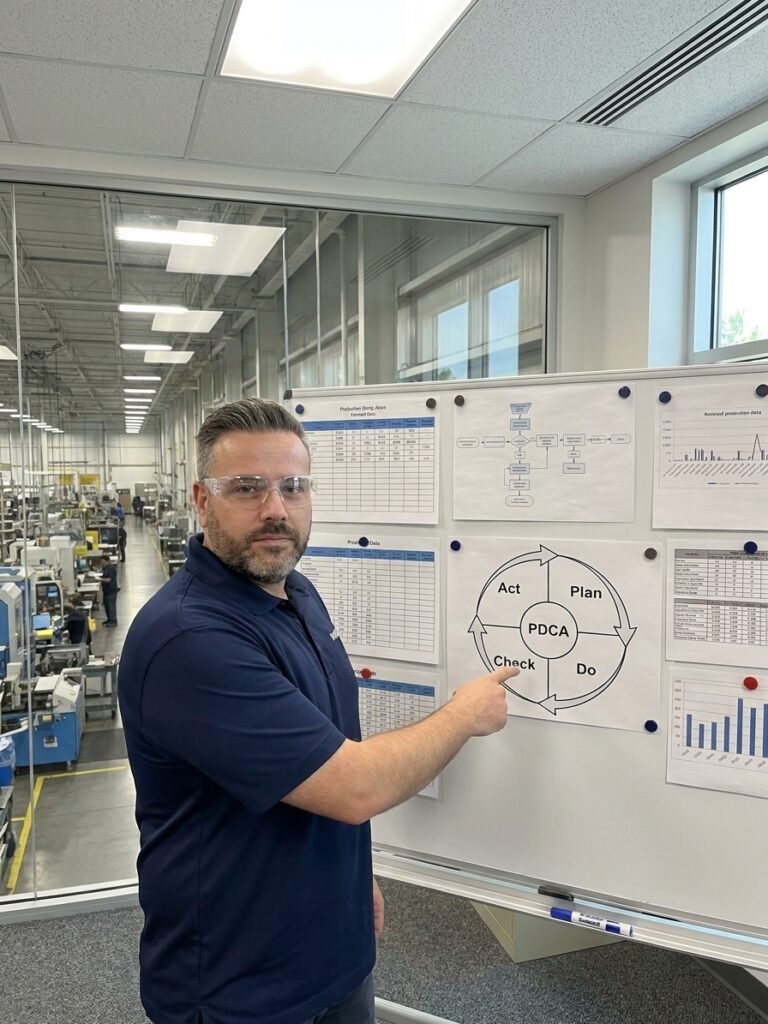
Communication must be relentless and bidirectional. It requires daily shift briefings, visual management boards on the shop floor, and leadership by example. When a Plant Director stops the line to address a quality deviation, that action communicates the new standard far more effectively than any internal memo.
In one facility, we introduced daily five-minute 'Quality at the Coffee Machine' stand-ups. A team member shared a brief story about a defect they caused, or a process they improved. Within three months, operators were proactively bringing process improvement suggestions to engineering. The communication channel had been successfully opened.
Enabling Action by Removing Systemic Barriers
This is where most quality transformations stall. The vision is clear, the communication is strong, but when an operator attempts to change a process, they hit a wall. These barriers are rarely intentional; they are built into legacy systems.
Give me the authority to stop the line, or give me the tools to do it right. Quality cannot survive a bureaucratic compromise.
Barriers take many forms. The IT system might prevent operators from updating a critical parameter. The change-control process might require four signatures to alter a work instruction. Often, production volume targets directly conflict with quality objectives. The most common barrier I see during Gemba walks is outdated equipment specifications.
In one automotive plant, our coalition attempted to scale a successful pilot after the initial victory. Management told us to pause and let it settle. Within six months, the pilot line had reverted to old habits because the surrounding lines operated under different rules. Sustaining acceleration means pushing immediately into the next area before the initial momentum dies.
Generating Short-Term Wins and Sustaining Momentum
Human patience for organisational change is strictly limited. Without visible, unambiguous short-term wins, people will conclude the new quality initiative is just another management fad. Kotter stresses that early wins must be directly tied to the change effort.
A short-term win in quality is concrete. It is a pilot line achieving a Cpk of 1.33 or higher. It is the first calendar month without a specific customer complaint. It is an operator submitting a suggestion that reduces scrap by 30 percent, saving the plant a measurable amount of money every week.
How you celebrate these wins dictates the culture. A financial bonus is appreciated, but public recognition builds culture. It happens when the Plant Director walks to the line, shakes the operator's hand, and acknowledges their specific contribution in front of their peers. That moment changes behaviour more than any presentation slide.
Instituting Change in the Corporate Culture
Change is not real until it becomes embedded in the culture. Culture is the set of behaviours that occur when management is entirely absent. It is also the slowest thing to change in any organisation.
To anchor quality in the culture, the new behaviours must be visible in performance evaluations. If you promote someone who ignores quality procedures to maximise output, the entire plant will notice. Your promotion and reward systems must align with your quality vision. Onboarding for new hires must reflect the new reality from day one.
The ultimate test of a quality culture is simple. When a manager leaves the area, and an operator has the opportunity to take a shortcut that saves time but degrades quality, do they take it? If they refuse, not out of fear of punishment, but because they believe doing the job correctly is the right way to work, the transformation is complete.
Kotter's framework succeeds where traditional quality implementations fail because it respects the human element. ISO 9001 and IATF 16949 define the system requirements: the documentation, the records, and the process maps. These are necessary foundations. But a system without engaged operators is a parked car with a full tank of fuel. It goes nowhere.
When you align the standard with human behaviour, your documentation stops being a bureaucratic shield. It becomes an accurate reflection of how your plant actually operates.