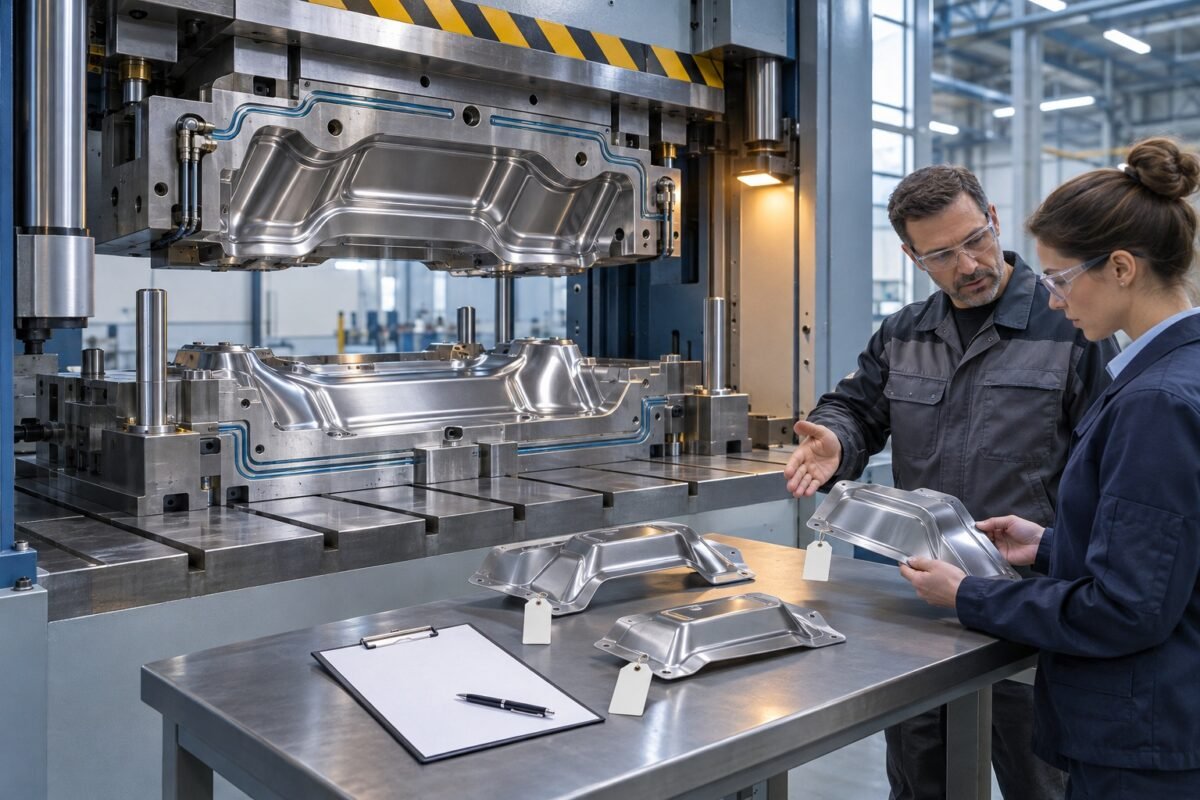
Across two decades in automotive and aerospace quality, I have sat through hundreds of tooling buy-offs, and I can tell you the truth that rarely gets spoken aloud: by the time a tool arrives at your plant for validation, most of your quality outcome has already been decided. A stamping die with an unbalanced draw bead condition will produce wrinkles at a rate you cannot inspect your way out of. An injection mould with marginal cooling channel placement will give you dimensional drift that no amount of downstream sorting will contain.
The buy-off is your last real point of leverage. Once you sign, the toolmaker's commercial obligation narrows to whatever you wrote into the acceptance criteria — and if those criteria were vague, or if you accepted a tool with promises of later correction, you have bought a defect generator with a maintenance contract. Post-buy-off changes are slow, contested and expensive. The toolmaker argues the part met print. Your production people argue the tool is unstable. Neither argument lowers your scrap rate.
The worst situation is the one this article addresses directly: accepting a tool that can never be capable. Not under-performing, not immature — fundamentally incapable, because of design decisions baked into hardened steel or a cast mould base. Recognising that condition before signature is the difference between a negotiation and a decade of containment.
What Trial Runs Must Actually Prove
A meaningful buy-off trial is not a demonstration that good parts can be made. Of course good parts can be made — a skilled setter with careful material selection and generous cycle time can coax presentable parts out of almost any tool. The trial must prove the tool produces conforming parts under production conditions, repeatedly, across the natural variation you will see in daily manufacture.
That means running at production cycle time, with production-intent material from more than one lot if you can get it, with the operators who will actually run the job, and with process parameters set where production intends to run them — not the sweet spot hand-tuned for the trial. Insist on a sustained run, long enough to see thermal equilibrium in moulds and die sets. A mould that measures fine on shot twenty and drifts by shot five hundred has told you something the first hour concealed.
Sample continuously through the run rather than collecting parts only at the start. Capture parts after any intended adjustment, after tool changes or cleaning cycles, and at the end. What you are looking for is not just the mean but the behaviour: is the dimension stable, is it wandering with a pattern, does it step when the tool cools or heats? A run chart of key characteristics across the trial tells you more than a stack of final inspection reports ever will.
Demonstration trial versus validation trial
What teams do
- Run at hand-tuned parameters in the sweet spot
- Single material lot, often the toolmaker's best stock
- Sample only at the start of the run
- Judge on final inspection reports
What works
- Production cycle time, production parameters
- Multiple production-intent material lots
- Continuous sampling plus parts after adjustments
- Run charts of key characteristics over the full run
Capability Evidence at Buy-Off: Read It Critically
Capability studies at buy-off deserve scepticism, not because suppliers are dishonest but because the conditions are unreal. Sample sizes are small. Material lots are cherry-picked. The press or machine used is often the toolmaker's best, not the tired production press the tool will live on. Short-term capability computed from thirty consecutive parts tells you about common-cause variation within a narrow window; it tells you almost nothing about shift-to-shift, lot-to-lot behaviour.
What to look for instead is the pattern of variation within the study itself. If every key dimension sits in the same half of the tolerance band, the tool is telling you it aims there — and that aim point is now your process centre, whether it suits you or not. If certain dimensions hug a tolerance limit and the toolmaker's response is "it's within spec", that is the sound of future nonconformance. Central tendency matters as much as spread, because tools wear in predictable directions and you need margin in the direction of wear.
Ask the toolmaker to run the study at parameter extremes — faster cycle, cooler barrel, higher tonnage if relevant — deliberately. A tool whose dimensions move dramatically with small parameter shifts is fragile. You will spend its whole life fighting drift. Capability demonstrated only at one cosy operating point is capability you cannot rely on.
Thresholds that matter at acceptance
Reading the Trial Parts: Failure Modes That Predict a Lifetime of Scrap
Certain trial findings are not blemishes; they are diagnoses. In stamping, look closely at thinning in draw corners. Measure material thickness on sectioned parts if the geometry is critical. Excessive thinning at buy-off means the die will split parts once material hardness varies or coating friction changes — a failure you will meet in production with no recourse, because the die geometry that caused it is hardened and ground.
In injection moulding, examine weld lines and gate blush on pigmented and textured surfaces. Check for flash at parting lines under higher clamp pressure. Voids in thick sections reveal poor packing strategy or gate placement that cannot be fixed without re-engineering. In die casting, porosity distribution on sectioned parts near bosses and thick-to-thin transitions predicts leak scrap for the tool's entire life.
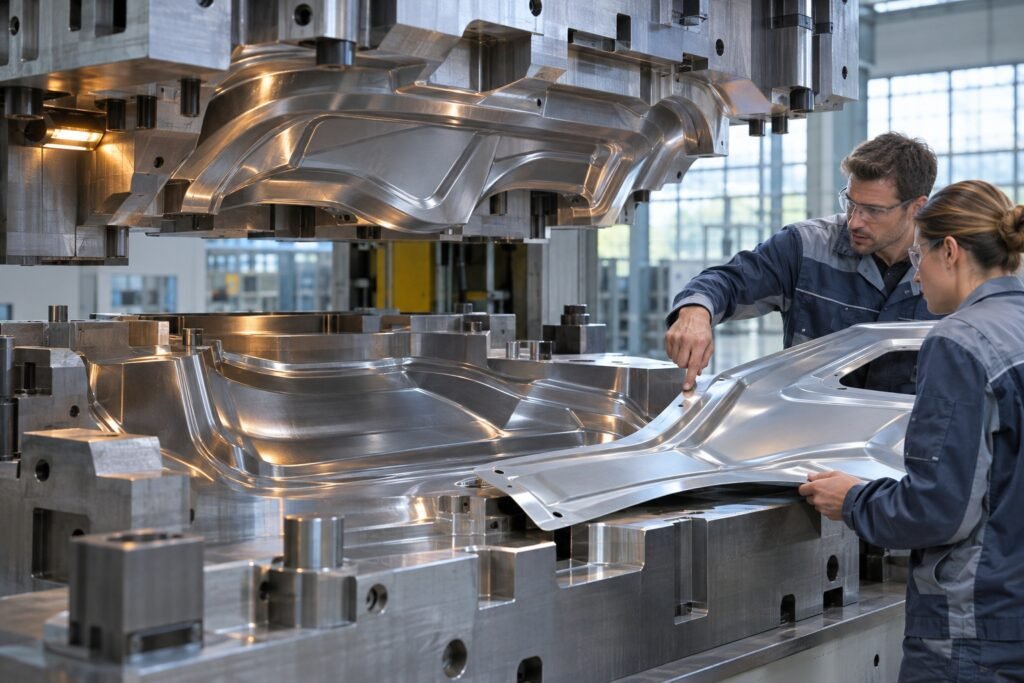
Surface defects on the tool itself matter as much as part defects. Inspect the tooling surfaces directly — polish levels, texture depth, vent channels, cooling line condition via flow checks. Photograph everything and record die IDs and cavity numbers on retained samples, because post-buy-off disputes dissolve into "which cavity, which day?" arguments you cannot win without traceable retained parts from the acceptance run.
The Trap of Conditional Acceptance
Here is the pattern I have seen destroy quality programmes: the trial reveals marginal results, the launch date is pressing, and someone proposes conditional acceptance with a punch list of corrections the toolmaker promises to complete after production starts. Everyone nods. The tool ships. The corrections become change orders, the change orders become negotiations, the negotiations become permanent containment.
Conditional acceptance can work for genuinely minor items — a polish touch-up, a missing sensor bracket, cosmetic work on non-functional surfaces. It cannot work for anything that changes the tool's forming, filling or cooling behaviour. Grinding a draw bead is not a minor correction. Moving a gate is not a minor correction. Adding cooling channels to a hardened mould base is often impossible. If the fix requires removing steel in a way that alters material flow, the honest position is rejection, not deferral.
When you do accept with conditions, write the acceptance so that capability must be re-demonstrated after the correction, with the same rigour as the original trial, and tie final payment to it. Payment is the only leverage that survives signature. Vague punch lists with no financial teeth get closed on paper and never in steel.
Post-Buy-Off Changes: What Is Realistic and What Is Fantasy
Steel changes are possible but bounded. Adding steel — shims, inserts, re-machining a detail larger — is generally feasible. Removing steel in a controlled way is also possible, but every weld-up and re-cut carries distortion risk, and a tool that has been welded repeatedly becomes metallurgically unpredictable. Texture and polish corrections are routine. Structural changes — new cooling circuits, relocated gating, revised slide mechanics — approach re-tooling in cost and often exceed the original tool price argument.
The other constraint is commercial. Once accepted, the tool is yours, and every change runs through a quotation, a lead time and a debate over who pays. I have watched a known split condition on a draw die take months to resolve while production sorted parts daily, and the sorting cost alone exceeded the correction quote several times over — but the correction needed a shutdown nobody wanted to authorise.
So the discipline is this: catalogue at buy-off every change you might ever want, estimate its feasibility with the toolmaker while you still hold leverage, and force the structural ones into the pre-signature window. After signature you are not a customer with a claim; you are an owner with a maintenance problem.
Vague punch lists with no financial teeth get closed on paper and never in steel.
Building the Trial Criteria Before the Tool Exists
The final word is about sequence. Trial criteria written the week before the trial are worthless, because the tool is already built. Acceptance criteria — dimensional report format, sample quantities, run length, permitted adjustment attempts, which press or machine, what material lots — belong in the purchase order and the tooling specification, agreed before steel is cut.
Require toolmakers to submit a dimensional and functional validation plan as part of the tooling quotation package. Their plan tells you how seriously they take their own work. A toolmaker who proposes running the trial on your production press, with your material, before you ask, is a toolmaker who expects to pass. One who resists those conditions is telling you something too.
Involve the people who will live with the tool. Process engineers, maintenance, die setters — walk the tool with them at the toolmaker's facility during build, not just at trial. They will spot cooling point locations that cannot be plumbed, clamp conditions that will not suit your press, sensor positions that will be destroyed in the first week. Every one of those caught early is a correction made cheaply at the toolmaker's cost, instead of a permanently compromised tool wearing your name on the asset register.
A buy-off sequence that holds leverage
- 01Write acceptance criteria into the PORun length, sample plan, press, material lots and report format, agreed before design release.
- 02Review the toolmaker's validation planTheir proposed trial conditions reveal their confidence before you commit.
- 03Walk the tool during buildProcess, maintenance and setters catch unbuildable details at the toolmaker's cost.
- 04Run the production-condition trialSustained run, multiple lots, continuous sampling, parameter extremes tested.
- 05Accept, condition or rejectConditions carry re-demonstrated capability and payment linkage; flow-altering fixes mean rejection.