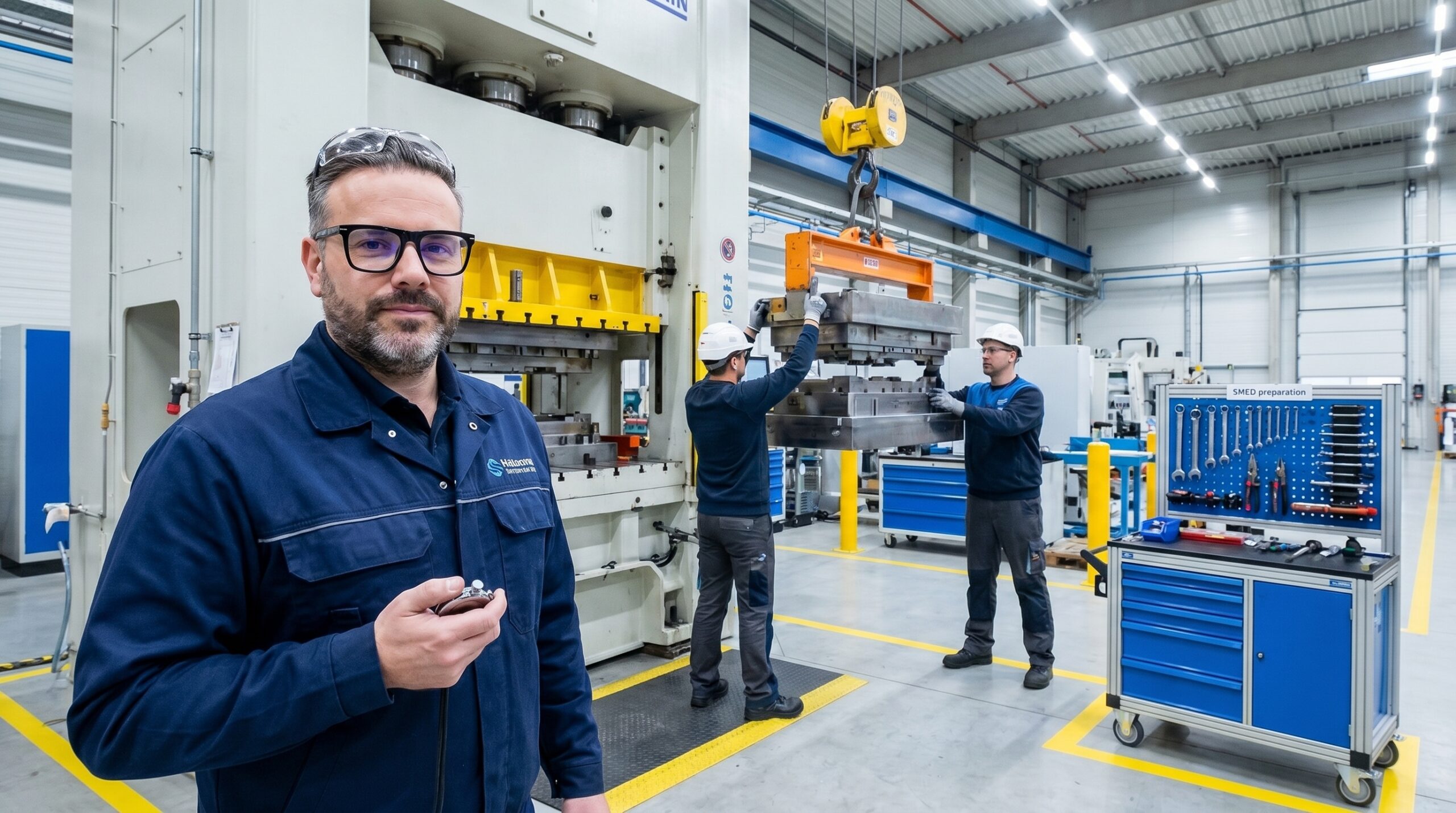
Single-Minute Exchange of Dies (SMED) is the most misunderstood productivity lever in mainstream manufacturing. Engineers assume it requires quick-clamp hydraulics or new tooling. It does not. The methodology, developed by Shigeo Shingo in the 1950s and 1960s, rests on a simpler premise: the majority of activities performed during a changeover can be done while the machine is still running.
I have audited plants where the same press, running the same mould type, had changeover times ranging from nine minutes to four hours and twenty minutes. The difference was never the equipment. The nine-minute plant had simply separated internal from external setup work. The four-hour plant was preparing the next mould, gathering tools, and pre-heating platens while the press sat idle.
That gap is not a curiosity. At four changes per week, 4.5 hours per change translates to over 900 hours of lost production time annually. This is capacity that vanishes not because the machine breaks down, but because nobody has systematically questioned the sequence of the work. SMED provides that systematic challenge.
The Internal vs. External Distinction
The core mechanism of SMED is the classification of every setup task into two categories. Internal operations are those that can only be performed when the machine is stopped: unboling the active mould, removing it, inserting the new one, and calibrating position. These activities directly dictate the duration of downtime.
External operations are everything that can be done while the machine is still producing the current batch. Retrieving the next mould from storage, pre-checking temperature probes, assembling required tooling, and preparing documentation all belong here. Shingo's measurements across numerous facilities revealed a consistent finding: 60 to 70 percent of all changeover tasks are external.
The implication is severe. In most plants, two-thirds of machine downtime during changeover is unnecessary. Teams are performing external work with the machine stopped because no formal distinction was ever drawn between what must happen offline and what must happen at the press. Closing this gap is the first and fastest intervention.
Phase 0 and Phase 1: Baseline and Separate
Before changing anything, the current state must be measured. This means standing at the machine with a stopwatch and recording the entire changeover on video. Operators routinely estimate changeover time at "about two hours." The video reveals the reality: twenty minutes searching for the tool-cabinet key, repeated trips to the crib, and unnecessary movement patterns that are invisible to the people performing them.
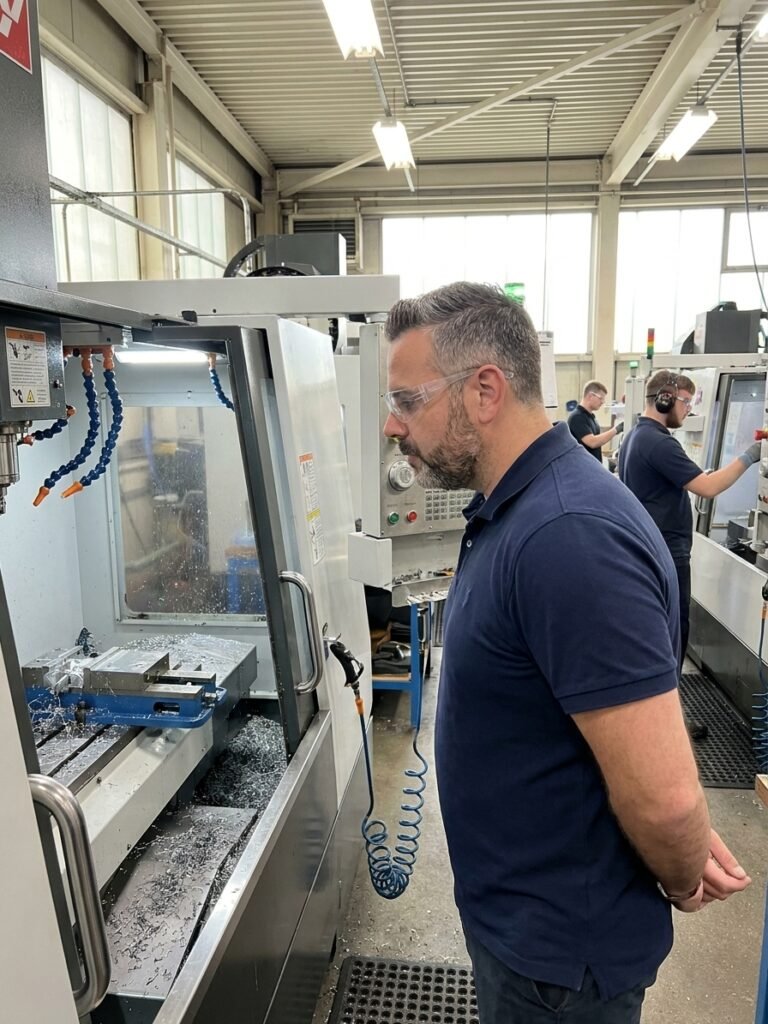
Phase 1 is the fastest win in the methodology and requires zero capital investment. By logistically moving external tasks to the running period of the previous batch, you can reduce changeover time by 30 to 50 percent in days. In one press shop I worked with, a 140-minute mould change dropped to 78 minutes simply by adding a preparation table beside the press.
The operator had been spending 45 minutes of stopped-press time retrieving the new mould, checking thermal sensors, and staging heating platens. Once that work was repositioned to the final hour of the preceding production run, the mould arrived at the press pre-heated and ready. No new technology was purchased; the external work was simply shifted.
Phase 2 and Phase 3: Convert and Streamline
Phase 2 asks a harder question: which remaining internal tasks can be converted to external? Pre-heating moulds at an external station rather than inside the press eliminates 20-30 minutes of soak time. Pre-loading machine parameters into the controller during the prior run means the new programme is ready the moment the previous batch ends.
Standardising fasteners is another high-impact conversion. I have audited plants using seven different bolt types across different moulds on the same press line. Consolidating to a single bolt size with a quick-release mechanism reduced clamping time by 60 percent. On one injection moulding project, converting internal operations to external cut changeover from 78 minutes to 34 minutes.
Phase 3 targets what remains: the genuinely internal operations that cannot be moved. Here the focus shifts to elimination and acceleration. Precision locating pins and dial indicators remove the need for trial-and-error positioning cycles. Hydraulic or pneumatic clamping systems replace manual bolting — eight M20 bolts at three turns each becomes a single hydraulic lever engaged in two seconds.
The Four-Phase SMED Implementation Sequence
- 01Phase 0: BaselineVideo the entire changeover. Map every step, its duration, and who performs it.
- 02Phase 1: SeparateMove all external tasks to the running period. Typical gain: 30-50% with zero spend.
- 03Phase 2: ConvertShift remaining internal tasks externally via pre-heating, pre-loading parameters, and standardising fasteners.
- 04Phase 3: StreamlineAccelerate what remains with quick-clamp systems, parallel operations, and precision locating.
Phase 4: Standardisation and Sustaining
Without standardisation, every gain achieved in Phases 1 through 3 evaporates within three months. I have seen this pattern repeat across plants that celebrated sub-15-minute changeovers in week one, only to drift back to 90 minutes by the second quarter. The mechanism of failure is always the same: no visual standard, no measurement, no accountability.
A one-page visual standard must be posted at the machine, not filed in a manager's office. It photographs each step, defines time limits, and assigns responsibility. A pre-changeover checklist must be signed by the operator before the machine is permitted to stop. Every changeover is measured, the time recorded, and the trend tracked. When cycle time starts to creep upward, the response is immediate.
SMED without standardisation is weight loss without a lifestyle change — the rebound is guaranteed.
The Financial Case and Operational Gains
The financial mathematics of SMED are straightforward. One plant I worked with ran six mould changes per week at an average of 185 minutes each. At a machine-hour rate of €120, they were losing €111,000 annually in changeover time alone. After full SMED implementation across all four phases, the average changeover dropped to 11 minutes. Annual changeover cost fell to €6,600 — a saving of over €104,000 with no new equipment purchased.
Beyond direct savings, SMED unlocks three structural advantages. Shorter changeovers make smaller batch sizes economically viable, which reduces finished-goods inventory and the quality risk associated with long runs. When a defect surfaces, it affects fewer parts. Production scheduling gains flexibility to absorb order changes without derailing the weekly plan.
| Metric | Pre-SMED | Post-SMED |
|---|---|---|
| Average changeover | 185 min | 11 min |
| Weekly changeover time | 18.5 hrs | 1.1 hrs |
| Annual lost capacity | 925 hrs | 55 hrs |
| Annual cost at €120/hr | €111,000 | €6,600 |
Common Implementation Failures
The most frequent objection is the paradox of time: teams claim they cannot afford to stop production to study changeovers. The response is to start with a single machine — the one with the highest changeover frequency. Two days of analysis and one day of Phase 1 implementation produces measurable proof within a week.
The second failure is more insidious. Teams skip Phase 1 entirely and jump directly to quick-clamp hardware and pre-heating stations. They accelerate the internal operations but continue performing external tasks with the machine stopped. The result is an expensive system that still wastes the cheapest 30-50 percent of available savings.
The third failure is the absence of standardisation. As discussed in Phase 4, without a visual standard posted at the machine and a measurement system that tracks every changeover, the methodology degrades. Operators revert to old habits, preparation steps slip back into the stopped-press window, and within weeks the gains are gone.
Why Skipping Phase 1 Destroys ROI
Skipping to hardware
- Buys hydraulic clamps and pre-heat stations first
- Continues external prep with machine stopped
- Wastes the cheapest 30-50% of savings
- High spend, marginal return
Methodological sequence
- Separates external tasks before any spend
- Captures immediate 30-50% time reduction
- Targets hardware spend at genuinely internal tasks
- Low spend, compounding return