
Monday morning, 6:00 AM. Line 3 is silent. Machines sit idle while operators wait for material. The production manager paces the hall, phone pressed to his ear, trying to locate missing stampings from the press shop. This scenario repeats itself weekly across automotive and aerospace plants. Monday and Tuesday run flat-out to clear massive batch orders. Wednesday brings a priority shift. Thursday is consumed by a key customer's emergency.
By Friday, the team pushes for overtime to recover the lost time. The result is violent oscillation. Monday morning starts with empty buffers and stationary lines. By Tuesday evening, finished goods overflow into the aisles. Wednesday forces a schedule reset. The factory breathes in violent gasps rather than a steady rhythm.
I have audited dozens of plants caught in this cycle. The problem is rarely the competence of the operators, planners, or department managers. The failure lies in the scheduling system itself. The solution requires dismantling batch logic and replacing it with Heijunka — the Japanese principle of production levelling.
Volume Levelling vs. Product Mix Levelling
Heijunka is frequently translated as production levelling, but most manufacturers implement only half the concept. They focus on volume. If total weekly demand is 3,000 units, they push to build 600 units every day. This volume levelling smooths the overall capacity load but ignores the disruption caused by product changeovers.
True levelling requires attacking both volume and product mix. A plant running 600 identical blue parts on Monday, 600 red parts on Tuesday, and 600 green parts on Wednesday has levelled volume but destroyed flow. The downstream process receives a flood of blue parts, followed by a drought, followed by a flood of red. This triggers massive WIP accumulation and frozen capital.
Product mix levelling forces the line to mirror actual consumption rates. Instead of running large batches of individual variants, the schedule interleaves them in small, repeating sequences. If daily demand requires 300 blue, 200 red, and 100 green units, the ratio is 3:2:1. The line builds to this ratio sequentially, pulling small quantities of each variant throughout the shift.
Batch Scheduling vs. Heijunka Mix Levelling
Batch production logic
- Massive WIP accumulation between processes
- Extended lead times for non-priority variants
- Downstream stations starved or flooded daily
- Quality defects hidden inside large batches
Levelled mix logic
- Steady, predictable flow of all variants
- Shorter lead times across the portfolio
- Downstream demand met in real-time
- Defects caught immediately in small batches
Establishing the Daily Production Ratio
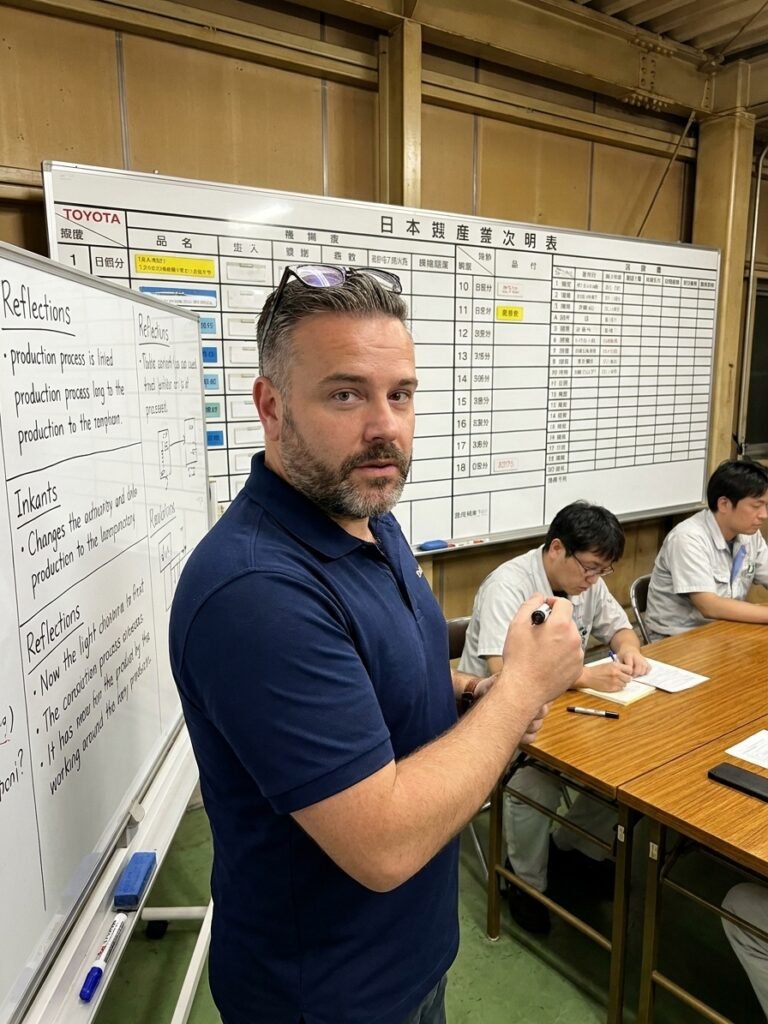
Transitioning to levelled production begins on the shop floor, not in a conference room. In one facility, we gathered the team at the gemba and plotted the last six weeks of customer orders by day and variant. The planners realised they had only ever reacted to incoming demand spikes. Nobody had calculated the average daily consumption for each product type.
Once we established the daily averages, we extracted the takt time for each variant. Product A required 120 units per day (4 minutes per unit), Product B required 80 units (6 minutes per unit), and Product C required 40 units (12 minutes per unit). This yielded a daily volume of 240 units and a demand ratio of 3:2:1.
Instead of running all of Product A until midday, we established a repeating six-unit pattern: A-A-B-A-B-C. This pattern became the heartbeat of the line. The sequence repeated continuously, ensuring that every 24 minutes, the line produced the exact mix the customer consumed daily.
The Heijunka Box as a Visual Control
A Heijunka box is a physical matrix of rows and columns that forces this rhythm onto the shop floor. Each row represents a product variant. Each column represents a fixed time interval, typically 20 minutes. Operators pull coloured Kanban cards from the boxes to know exactly what to build next.
When a process builds ahead of schedule, the box physically empties. When a process falls behind, cards accumulate. This visual control instantly exposes bottlenecks without requiring a digital dashboard or a supervisory interrogation. The limit of the physical boxes enforces the limit of WIP allowed on the floor.
The changeover realities of the equipment dictate the size of the intervals. If a changeover takes an hour, you cannot schedule a 20-minute interval. The implementation team must systematically apply SMED (Single-Minute Exchange of Die) to reduce internal setup time before the Heijunka box can function properly.
The Three Levels of Production Levelling
Levelling is not a single switch you flip. It requires progression through three distinct phases. The first phase is month-leveling. Sales teams often batch orders at the end of a quarter to hit targets, causing severe manufacturing whiplash. Month-leveling forces an agreement between sales and production to release orders in uniform weekly buckets.
The second phase is day-leveling. The planning team translates the uniform weekly volume into a specific daily mix. Instead of building large batches of each variant sequentially, the system sequences them into the small, repeating patterns. This phase immediately shrinks WIP and insulates the factory from daily customer order fluctuations.
The Maturity Scale of Heijunka Implementation
- Level 3: Cycle LevellingSequencing product variants by takt time within each shift.
- Level 2: Day LevellingInterleaving small batches of variants to mirror daily demand.
- Level 1: Month LevellingSmoothing sales order releases into uniform weekly buckets.
The third phase is cycle-leveling, the most advanced application. At this stage, the system levels production down to individual operator cycles. Standard work and takt time are rigidly enforced. The operator builds the exact sequence of variants repeatedly throughout the shift, creating a perfectly balanced flow that eliminates overproduction completely.
Eliminating Muri and Mura to Expose Muda
Large batch manufacturing directly creates Mura (unevenness) and Muri (overburden). Running a line at maximum capacity on Monday to clear a backlog overloads equipment and exhausts operators. Standing idle on Wednesday wastes fixed costs. Heijunka attacks both by forcing a steady, predictable tempo across the entire week.
Most shop-floor waste is not a root cause; it is a symptom of an uneven production schedule.
When you eliminate unevenness, the seven wastes (Muda) shrink naturally. You no longer need forklift drivers to move mountains of WIP out of the way. You stop paying premium freight to expedite delayed shipments. Quality defects are caught within a 20-unit batch instead of a 1,000-unit batch, dramatically reducing scrap costs and rework hours.
The mathematical impact on lead time is severe. If your batch size is 1,000 units and daily demand is 200 units, a part spends roughly five days waiting in queue. When Heijunka reduces that batch size to 200 units, queue time drops to a single day. This acceleration provides the ultimate competitive advantage: the ability to absorb customer design changes without scrapping obsolete inventory.
Overcoming Setup Constraints
The most frequent objection to running small, interleaved batches is changeover time. If switching between Product A and Product B requires 60 minutes, a 20-minute production interval is impossible. Plants use this reality as an excuse to maintain large batch runs, but the actual solution is aggressive SMED implementation.
In the line 3 implementation, we applied SMED to isolate internal and external setup tasks. We standardised clamping mechanisms, pre-staged tooling, and converted stop adjustments to quick-release mechanisms. Changeover time dropped from 45 minutes to 12 minutes. This reduction was the prerequisite that made the 20-minute Heijunka intervals viable.
Software and advanced APS (Advanced Planning and Scheduling) systems can automate Heijunka logic, but they cannot fix a lack of mechanical readiness. If the planning software generates an optimised sequence but the operators lack the proper tooling to execute the changeover safely, the schedule collapses within the first hour of the shift.
Start with a physical board, Kanban cards, and manual data collection. Master the rhythm manually. Once the operators trust the sequence and the SMED processes are proven stable, transition the logic into the digital MES. The software must model the physical reality of the floor, not an idealised version of it.