
I have audited plants that boasted the most sophisticated Quality Management Systems in their region. Control plans were meticulously updated. KPI dashboards glowed green. The board reviewed daily reports and felt confident in the system.
Yet customer complaints kept rising and scrap rates fluctuated unpredictably. The operators on the line looked at the quality engineers with exhausted eyes. The message was clear: the documentation looked flawless, but the shop floor operated in an entirely different reality.
That quality engineer was me earlier in my career. It took months of failure to realise that my charts only reflected what the system was designed to capture, completely missing what was actually happening. The gap between those two worlds is where every defect is born.
Defining the Gemba Walk
Gemba (現場) is a Japanese term meaning "the actual place." In manufacturing, it is the production line. In healthcare, it is the operating theatre. A Gemba Walk is a deliberate, structured visit to this location with a specific intent: to observe, learn, and understand the actual work flow.
This requires a fundamental shift in mindset from the start. A Gemba Walk is not an audit. It is not an inspection to catch non-conformances, nor is it a hunt for someone to blame during an 8D investigation. It is the disciplined act of verifying that your documented standard work matches the reality your operators face every day.
The concept originates from the Toyota Production System. Taiichi Ohno famously forced engineers to stand at the shop floor and map the value stream in real time. He stood with them, pointed at waste, and applied the Five Whys methodology until the root cause of the process failure was exposed.
The mandate is straightforward. If you want to understand a process, go to where it operates. You will not find the truth in a database query or a monthly summary report. You will find it where the operator stands, solving problems your QMS has not even registered yet.
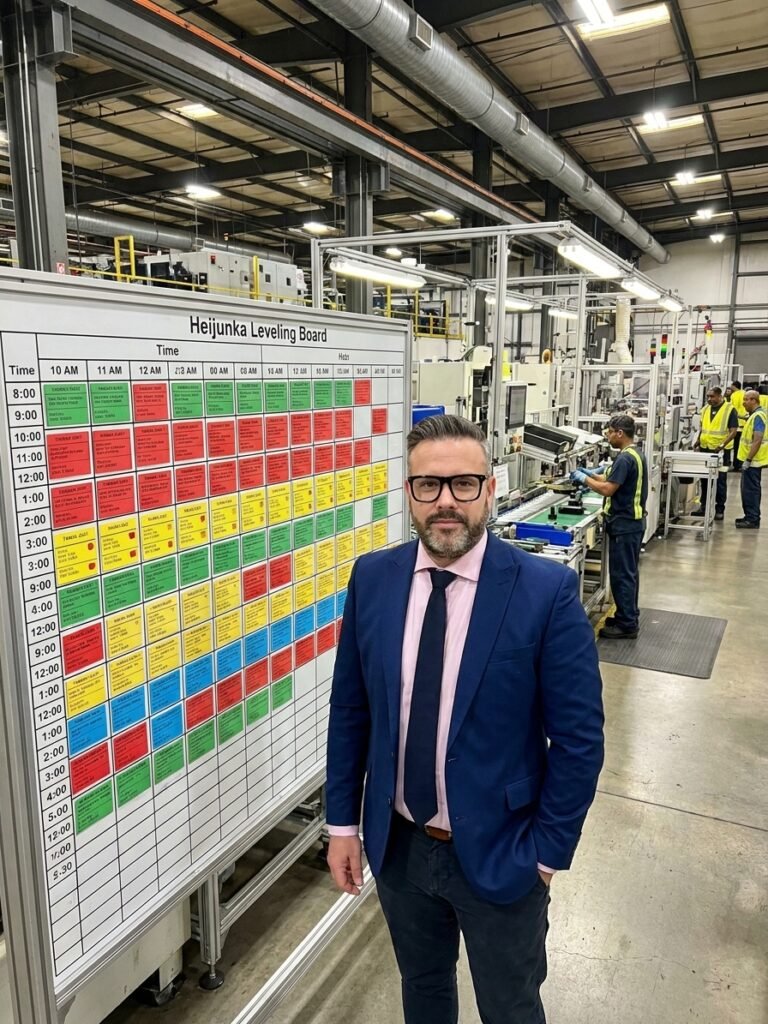
Structuring the Observation
Not every trip to the shop floor qualifies as a Gemba Walk. If you visit the line just to check on production status, it is a casual tour. A productive Gemba Walk demands a rigorous three-phase structure to ensure the visit yields actionable intelligence.
Phase one is preparation. Before stepping onto the floor, you must define your objective. Identify the specific process or bottleneck you need to observe, determine what data you are validating, and prepare open-ended questions for the operators. Approaching the line without a plan is industrial tourism.
Never go to the Gemba with a predetermined solution. If you already know what needs to be fixed, you do not need an observation walk; you need an implementation plan. The Gemba is for discovering the actual conditions, not for enforcing directives from an engineering office.
Execution on the Factory Floor
Phase two is the observation itself. When you arrive at the process, your priority is to see the work through the eyes of the people who perform it. Maintain strict silence for the first ten minutes. Quiet observation reveals far more about flow, ergonomics, and bottlenecks than reading an hour of production reports.
Ask questions rather than giving instructions. Inquire: "Can you show me how you execute this setup?" or "What would make this specific operation easier?" Your goal is to uncover unrecorded variation and invisible waste. Look for unnecessary transport, waiting times, and processes where the actual practice deviates from the PFMEA.
Respect is a functional requirement, not just a courtesy. If you march onto the floor with an entourage of auditors carrying clipboards, the operators will retreat and hide deviations. Approach the process alone or in a pair, ask for their expertise, and they will reveal the hidden realities of the production line.
Phase Three: Processing and Action
Phase three occurs immediately after you leave the floor. Without structured documentation and subsequent action, the walk is a waste of time. Human memory is inaccurate, so write down your observations before returning to your desk.
Distil your notes into two or three critical findings. Assign clear responsibilities and deadlines for corrective actions. Most importantly, close the loop with the operators. Tell them what you saw and what steps will be taken. If you vanish without providing feedback, they will never trust your presence again.
The Three-Phase Gemba Method
- 01Prepare and DefineIdentify the specific process and the exact data points you need to verify.
- 02Observe and InquireWatch the actual work, ask open-ended questions, and identify unrecorded waste.
- 03Document and AssignRecord findings immediately and allocate corrective tasks with strict deadlines.
- 04Close the LoopProvide transparent feedback to the operators who facilitated the walk.
Categorising the Types of Walks
Different operational challenges require different approaches to the Gemba. A leadership walk brings senior management to the floor to understand the culture and verify safety and 5S compliance. This builds visibility and reinforces the priority of shop floor reality over boardroom metrics.
A problem-solving walk is highly targeted. You go directly to where a specific defect occurred. The objective is to reconstruct the event, compare the physical evidence against the control plan, and drive a Root Cause Analysis using facts gathered directly from the source.
Process observation walks focus on a single workstation over an extended period. This is highly effective when validating a new line or implementing a significant engineering change. It forces a direct comparison between documented standard work and the actual physical reality of the production cycle.
Finally, coaching walks focus on developing team leaders. A manager accompanies a shift supervisor to observe a process together. The manager does not solve the problems; instead, they coach the supervisor on how to identify waste and formulate the right questions to drive continuous improvement.
Digital tools show you what happened. The Gemba Walk shows you why.
Common Failures in Application
I have seen attempts at Gemba Walks that caused more damage than if they had never happened. The most destructive failure mode is treating the walk as a hunt for a scapegoat. If you ask who is responsible for a mess, you are not observing the process. You are policing it, and operators will naturally hide future non-conformances.
Arriving with a rigid solution is equally damaging. When an engineer dictates a fix on the spot without understanding the operational constraints, they undermine the entire purpose of the walk. The most effective countermeasures are developed by the people who execute the process daily.
Bringing an entourage of suited managers transforms a learning exercise into a disruptive spectacle. A crowd of eight observers guarantees modified behaviour. The ideal number of participants is two or three. This minimises disruption and encourages genuine dialogue with the operators at the machine.
Ignoring immediate safety concerns invalidates the entire methodology. If an operator is bypassing a safety guard or wearing their PPE incorrectly, addressing that specific risk becomes the absolute priority. Everything else stops until the unsafe condition is resolved.
The Intersection of Gemba and Industry 4.0
The rise of Industry 4.0, IoT sensors, and digital twins has led some to argue that the physical Gemba Walk is obsolete. This is a fundamental misreading of what data actually provides. Digital tools are exceptional at highlighting anomalies, but they cannot explain the human context behind them.
An IoT datastream will immediately flag that a hydraulic press is experiencing abnormal vibration. What it will not show is that a maintenance technician removed an anchoring bolt three months ago because the machine was scheduled to be moved, a plan that was later cancelled without updating the maintenance records.
Your SCADA system might show a furnace temperature fluctuating outside control limits. It will not reveal that the night shift operator manually overrides the automatic calibration because the thermocouple drifts during the first hour of production, a workaround they never documented in the shift log.
Digital systems and physical observation must work in tandem. Use your real-time data and SPC charts to identify exactly where the variation is occurring. Then, deploy a Gemba Walk to stand at that precise location and understand the physical, unrecorded reasons why it is happening.
Measuring Gemba Impact
Executing Your First Walk
Select one specific process step for your initial observation. Do not attempt to evaluate an entire assembly line. Focus on a defined action, such as how operators verify the first piece of a new production run, or how they execute a specific machine changeover.
Prepare a short list of targeted questions. Ask the operator how they know the part is conforming, where they record non-conformances, and what single change would make their workstation more ergonomic. Limit your time at the station to thirty minutes to prevent fatigue and disruption.
Write down exactly three findings. Restricting yourself to three points forces you to prioritise the most critical process failures over minor observations. Immediately communicate these three points back to the shift supervisor and outline the next steps.
Integrate this practice into your routine. If you manage quality, production, or engineering, the majority of your time should be spent where the value is created. The further you sit from the physical process, the more distorted your understanding of quality becomes.
Management Reporting vs. Gemba Reality
What the Dashboard Shows
- Random variation in daily scrap rates across all shifts.
- Recommendation to increase end-of-line inspection frequency.
- Operator failing to complete required checks every 50 pieces.
- General process instability requiring engineering review.
What the Gemba Reveals
- Night shift lacks the staffing to perform the 50-piece checks.
- Supplier delivers in bulk crates of 50, but line capacity is 30, causing mixing.
- Shift handover whiteboard is wiped clean before issues are logged.
- Missing visual aids make first-piece inspection subjective and unreliable.