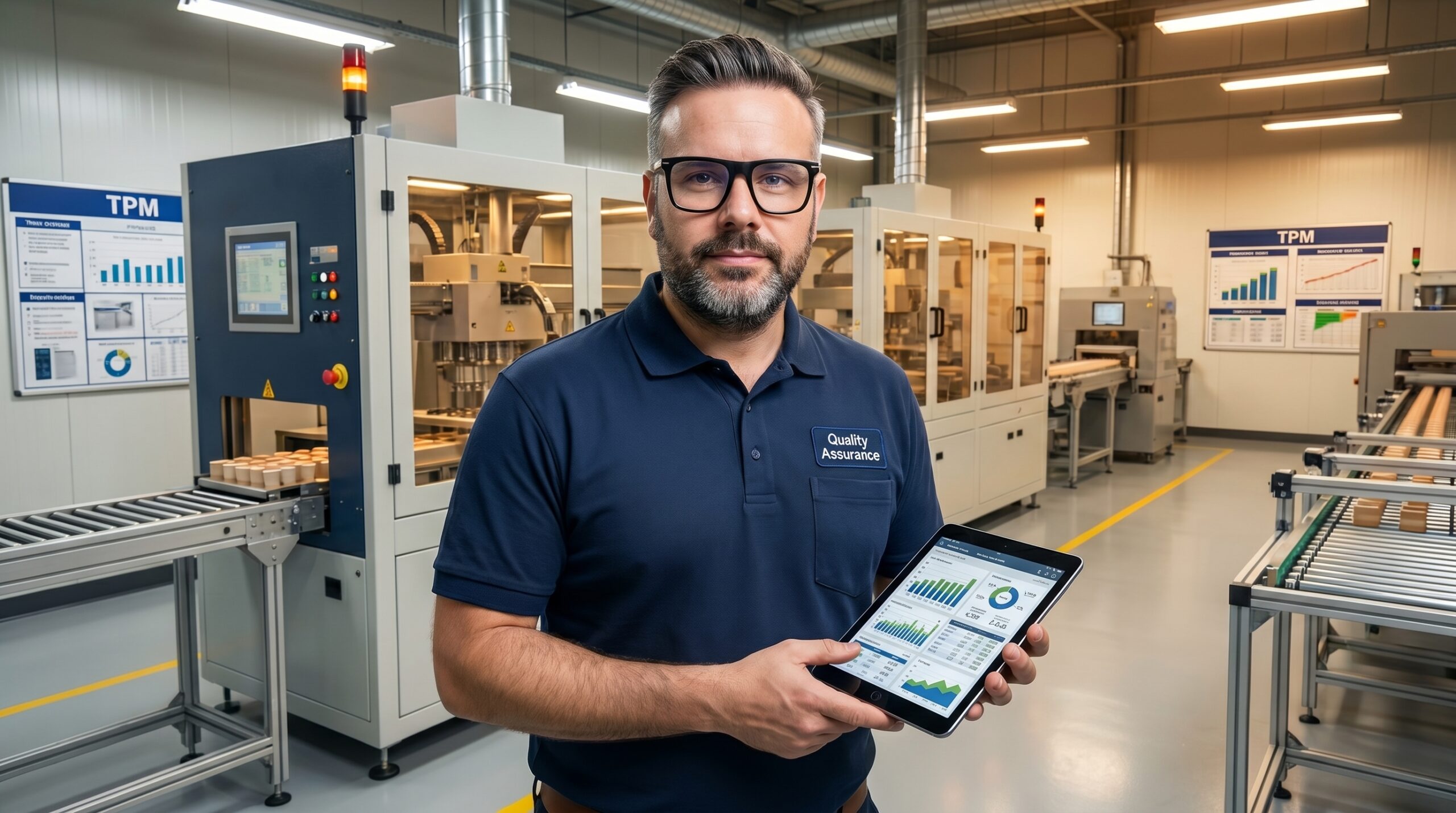
A plant manager from an automotive supplier in Central Europe called me with a familiar problem. Their Overall Equipment Effectiveness (OEE) was stuck at 52 percent. He knew this was unacceptable, but his data dashboards could not tell him where the losses were hiding. The analysis ended at the spreadsheet level; the reality was on the shop floor.
I told him to ignore the management reports and walk to the machines. What we found was operational neglect. Equipment was covered in process dust, active oil leaks were being ignored, and machine operators had no understanding of the basic mechanics of their stations. The maintenance team was entirely reactive — a distant function that arrived only after production had already halted.
This scenario repeats across the manufacturing industry. The solution is Total Productive Maintenance (TPM). Developed in conjunction with the Japan Institute of Plant Maintenance (JIPM), TPM radically redefined the relationship between the operator and the machine, establishing a disciplined framework for equipment reliability.
The Operational Mechanics of TPM
Before TPM, industrial maintenance was strictly a reactive function. A machine failed, production stopped, and maintenance stepped in to repair the damage. This cycle caused severe schedule disruptions, tied up capital in excess inventory, and degraded product quality. No one held structural accountability for preventing the failure before it occurred.
TPM systematically shifts this dynamic. The core principle is that the operator is the first line of defence in equipment reliability, not just a passive consumer of the machine's cycle time. This is operationalised through eight distinct pillars that bridge the gap between production and maintenance.
These pillars range from Autonomous Maintenance — where operators take ownership of basic cleaning, lubrication, and visual inspection — to Planned Maintenance, which relies on MTBF (Mean Time Between Failures) and MTTR (Mean Time To Repair) data rather than guesswork. Together, they transform equipment management from an unpredictable cost centre into a measurable, reliability-driven engineering function.
Autonomous Maintenance as the Foundation
Autonomous Maintenance (Jishu Hozen) is the heart of TPM. Operators assume responsibility for basic equipment care: cleaning, lubrication, visual checks, and minor adjustments. These are tasks that take minutes to perform but, if neglected, inevitably cascade into major mechanical or electrical failures that halt production.
In practice, an operator spends the first five to ten minutes of a shift inspecting the station. They identify an oil leak and tag it; they notice an abnormal acoustic signature and investigate the source. They know exactly where the lubrication points are and the required intervals. They are not acting as maintenance technicians, but as trained stakeholders who understand the physical baseline of their equipment.
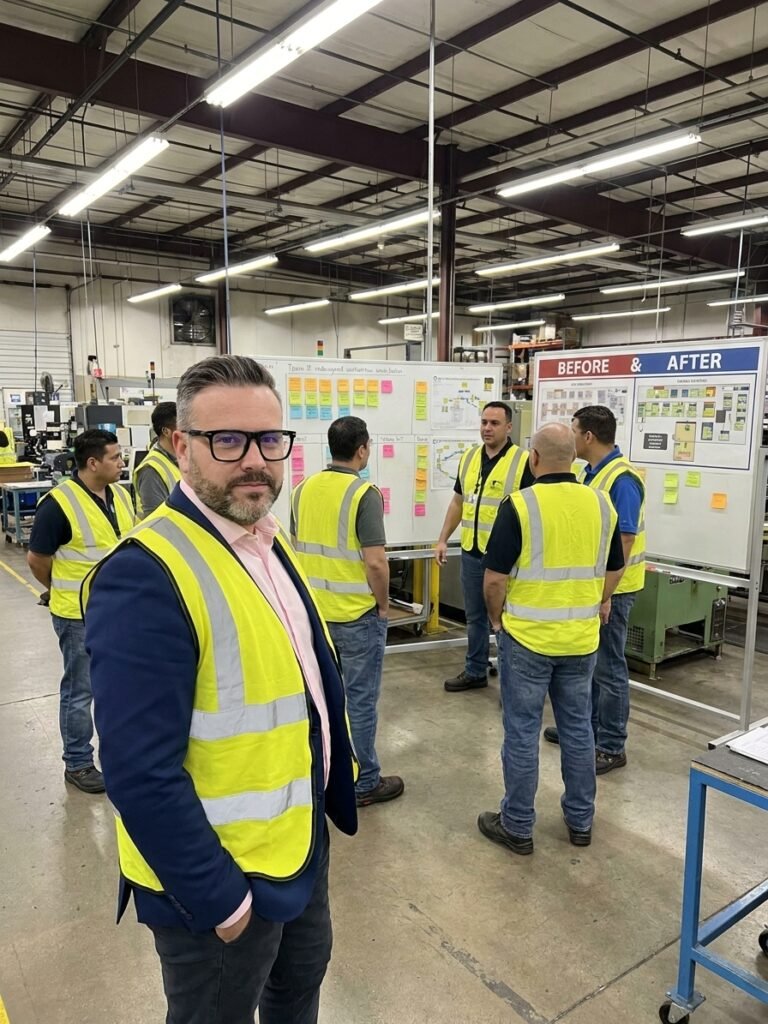
At that Central European automotive plant, we launched Autonomous Maintenance on a single pilot line. Within four weeks, unplanned stoppages dropped by 40 percent. After three months, the reduction reached 60 percent. The improvement was driven directly by operators who were finally given the training and authority to understand and maintain their own machines.
Quantifying and Eliminating the 16 Major Losses
TPM defines sixteen major losses that degrade equipment efficiency, grouped into four operational categories. Kobetsu Kaizen, the focused improvement pillar, targets these losses systematically using root cause analysis tools like 5 Why, Ishikawa diagrams, and Pareto charts to permanently eliminate them.
To visualise the impact of these losses, look no further than the OEE calculation. Availability losses stem from equipment failures and setup adjustments. Performance losses arise from micro-stoppages, sensor blockages, and idling. Quality losses account for scrap and rework. Measuring OEE exposes exactly where these structural losses consume your manufacturing capacity.
OEE Performance Thresholds
Defining these losses is only the first step; making them visible at the Gemba is what drives action. In the plant I was auditing, 50 percent of all unplanned stoppages originated from just three machines. Within those three machines, 80 percent of the downtime was traced to two root causes: degraded seals and fouled proximity sensors.
The corrective action was fundamentally pragmatic. We implemented a condition-based replacement schedule for the seals, abandoning the useless calendar-based system. We established a strict operator rule: if a sensor fouls three times in a shift, it must be logged and escalated immediately, rather than wiped clean and ignored until a total failure occurs.
Integrating Quality and Early Equipment Management
A machine can run continuously and still destroy value if it produces non-conforming parts. The Quality Maintenance pillar fuses TPM with quality engineering. It dictates that machines must reliably hold process parameters, and the physical conditions that generate defects must be identified and engineered out of the system.
Early Equipment Management prevents reliability issues from being designed into your process from day one. Without it, new machinery often arrives with inaccessible maintenance points, components requiring full teardowns to replace, and inadequate documentation. This pillar forces maintenance and operator feedback directly into the procurement and specification phase of new capital equipment.
Training is the vital connective tissue. Operators must understand the mechanics behind their daily checks, not just go through the motions. Maintenance technicians need advanced diagnostic capabilities to trace symptoms to root causes. Management must treat TPM as a core operational strategy, not a temporary lean project to be abandoned when the next quarterly target shifts.
Technology is the tool. The operator who understands the machine is the actual solution.
Common Implementation Failures
Over my career, I have seen TPM implementations fail for predictable reasons. The most common error is attempting a plant-wide rollout simultaneously. This overwhelms the organisation. TPM must begin with a single, highly visible pilot line where management can prove the concept, refine the standards, and build momentum before scaling.
Another structural failure is excluding the operators from the initial design. Engineers prefer to focus on the mechanical hardware, but TPM is fundamentally a human discipline. If you deploy new maintenance standards without first training the workforce on why these standards matter, the entire system collapses within weeks of the launch.
Reactive vs. TPM-Driven Maintenance
Reactive Operation
- Maintenance is a distant, post-failure function.
- Operators ignore abnormal sounds, leaks, and micro-stoppages.
- Sensors are wiped clean until they ultimately fail and halt production.
- Seals are replaced only after catastrophic fluid loss occurs.
TPM-Driven Reliability
- Operators own daily cleaning, visual checks, and lubrication.
- Abnormal conditions are tagged and escalated before they escalate.
- Recurring faults trigger immediate root cause analysis.
- Maintenance schedules are dictated by data (MTBF) and condition.
Organisations also fail by treating TPM as a finite project with an end date. If a manager declares that TPM is 'finished', they have fundamentally misunderstood the methodology. Continuous improvement requires permanent vigilance. Industry 4.0 sensors, predictive analytics, and digital twins will accelerate this process, but the foundational requirement remains the disciplined engagement of the operator.
Executing a Pilot: The Pragmatic Approach
If you intend to implement TPM, start by establishing a rigorous OEE baseline on your critical assets. Without this quantitative foundation, you will have no way to verify if your improvement efforts are actually yielding financial returns. Select a pilot zone where the operational pain is most visible and the local team is open to change.
Begin the physical transformation with a deep clean. Pressure wash the machine, remove guards, and expose the baseline condition. Operators will immediately discover hidden cracks, degraded wiring, and severe leak points during this phase. This exacting cleaning process is the physical start of Autonomous Maintenance.
Following the initial clean, deploy visual management. Install lubrication maps, standardised inspection checklists, and shadow boards for critical tools. Hold daily, five-minute shift handovers directly at the machine to review the previous shift's stoppage log. Establish the rhythm of continuous monitoring and immediate corrective action.
The Central European supplier that began with a 52 percent OEE and operators who ignored oil leaks now runs at 84 percent. Their most optimised line sustains a 91 percent OEE. The maintenance team plans interventions based on condition data, and the plant manager finally has a reliable, predictable manufacturing system. That is the operational reality of TPM.