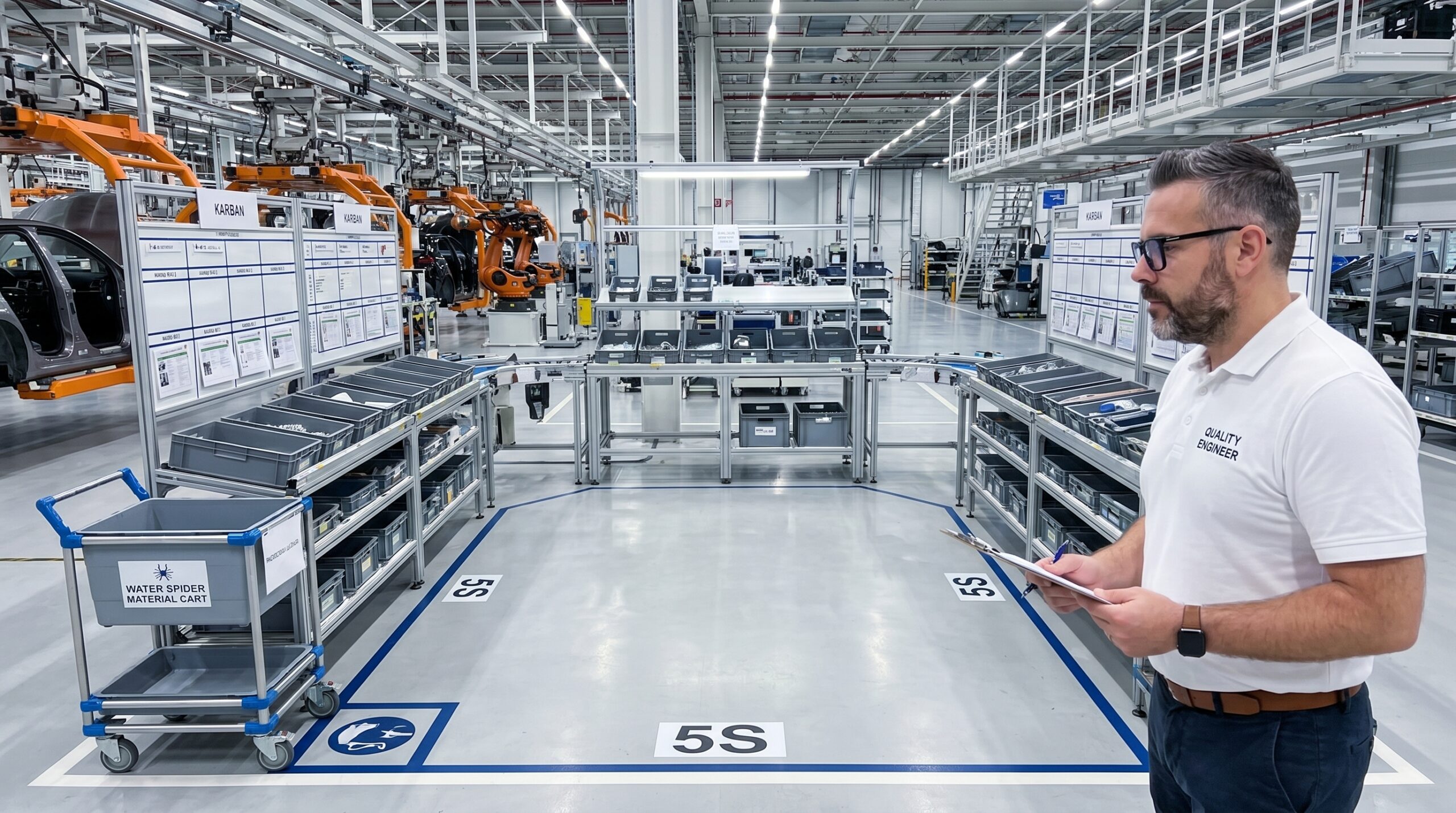
Suppliers are frequently measured on dock-to-stock time. A component arrives from an external supplier, passes incoming inspection, and is placed in the internal supermarket. By the supplier's metrics and the incoming goods report, the handover was a success. The parts are in the building, paid for, and available.
Yet production halts three hours later because those same parts never reached the point of use. The internal supply chain failed at the boundary between the warehouse and the assembly line. This is not a supplier defect. It is an internal logistics failure that breeds illegitimate supplier escalations.
Across two decades in automotive and aerospace manufacturing, I have seen plants blame tier-1 and tier-2 suppliers for stoppages caused entirely by their own missing internal delivery mechanism. The supplier delivered on schedule. The plant simply failed to move the material thirty metres from the supermarket rack to the assembly fixture.
The False Escalation Problem
When a line stops, the default response in most plants is to check the ERP system for incoming shipments. If the parts are logged as received, the buyer calls the supplier to complain about a shortage. The supplier pushes back, citing a signed Proof of Delivery. The dispute consumes hours while the line remains idle.
This scenario happens because the plant has no formal role managing the final leg of material movement. The operator, paid to assemble or machine, abandons the workstation to hunt for parts. Takt time is lost, and the root cause is misclassified in the 8D report as a supplier delivery failure rather than an internal line-feeding breakdown.
A Mizusumashi, or Water Spider, eliminates this ambiguity. This specialised logistics worker owns the route between the internal supermarket and the point of use. They deliver parts at fixed intervals synchronised to the production takt. If a bin is empty at the supermarket, the Water Spider triggers the replenishment signal internally, not externally.
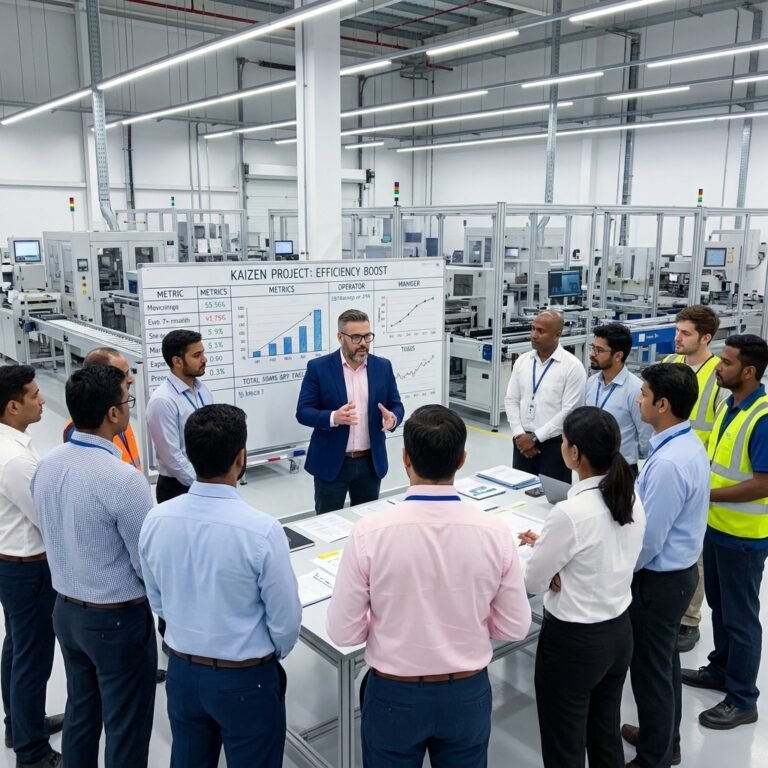
Engineering the Interface Between Goods-In and Assembly
The Water Spider operates strictly within the internal boundary. Incoming goods handlers and warehouse staff manage flow up to the line-side supermarket. They decant, count, and stage pallets. Their responsibility ends when the material hits the designated rack.
The Water Spider takes over from that exact point. They manage the critical final stretch, moving standardised containers from the supermarket directly to the operator's fingertips. This strict demarcation ensures that warehouse staff are not pulled onto the line and operators are not pulled into the warehouse.
This separation prevents the most common form of boundary creep. I have audited plants where a warehouse operative was informally tasked with feeding the line. When a fork-lift driver called in absent, the line-feeder was pulled to unload a lorry at the dock. The line stopped within twenty minutes. The Water Spider role must be ring-fenced.
Material Handover Responsibility
Warehouse / Goods-In (External Interface)
- Manages dock-to-supermarket flow
- Handles supplier discrepancies and POD checks
- Decants bulk packaging into standard line bins
- Stops at the line-side supermarket rack
Water Spider (Internal Interface)
- Manages supermarket-to-point-of-use flow
- Executes timed, takt-driven delivery loops
- Monitors kanban triggers and 5S compliance
- First responder for line-side abnormalities
Translating Supplier Packaging into Standard Work
Suppliers deliver in packaging designed for freight efficiency, not line-side ergonomics. A tier-1 supplier might ship five hundred clips in a bulk bag. The operator cannot dip into a bulk bag safely while maintaining a forty-second cycle time. Introducing the Water Spider forces the plant to solve this packaging mismatch.
The Water Spider decants the bulk supply into standardised, point-of-use containers at the supermarket. They check the engineering change level or batch traceability labels during this transfer. By the time the part reaches the operator, it is presentation-ready. The operator grabs the exact quantity without reading labels or counting pieces.
This decanting step is where supplier quality issues are often caught before they impact the line. A Water Spider trained to spot visual defects will notice a flash injection-moulding defect or a surface finish anomaly while repackaging. They quarantine the suspect batch and trigger a supplier quality engineer alert, preventing defective components from reaching the assembly cell.
Deploying the Route Without Disrupting Supply
Establishing a Water Spider route requires mapping the physical distance between the supermarket and every workstation. Go to the floor with a stopwatch. Document the replenishment frequency required at each station based on the established takt time and container capacity. The route timing must be a direct mathematical multiple of the takt.
The Line-Side Replenishment Cycle
- 01Supermarket stagingGoods-in transfers material from supplier packaging to standard line bins
- 02Kanban triggerOperator deposits an empty bin or visual signal at the point of use
- 03Timed interceptionWater Spider collects the signal and supplies a full bin on the loop
- 04Abnormality escalationHandler spots a defect or shortage and isolates it before line impact
Paint the physical path on the shop floor. Establish clear, marked stops where the handler checks kanban cards, exchanges containers, and verifies visual standards. Codify this routine in a Standardized Work Sheet. The sheet defines the exact task sequence, the allotted seconds per stop, and the escalation path for shortages.
Select an experienced operator for the role, not a junior hire. The Water Spider must understand the entire value stream, anticipate material consumption rates, and identify supplier abnormalities instantly. Assigning one handler to a logical line segment of roughly eight to fifteen workstations prevents route overload and superficial execution.
Measuring the Boundary
You cannot improve the supplier interface without isolating internal logistics failures from external delivery failures. When a line stoppage occurs, the classification must be immediate and accurate. If the material is in the supermarket but not at the point of use, it is an internal Water Spider failure, not a supplier failure.
Track the delta between warehouse staging time and line-side delivery time. If a part sits in the supermarket for four hours, the system is broken. The Water Spider loop should turn inventory from the supermarket rack to the operator in minutes, not hours. This metric clarifies supplier performance reviews by removing internal noise.
If a part is sitting in your supermarket but not at the point of use, your supplier is not the problem.
Process stability demands materials at the operator's fingertips. When an operator rushes to compensate for a late internal delivery, dimensional variation increases and Cpk values destabilise. A stable logistics loop guarantees stable cycle times, which is the absolute prerequisite for maintaining Cpk 1.33 and passing ISO 9001, IATF 16949, and AS9100 process audits.
Human Judgement at the Logistics Boundary
Automated guided vehicles and IoT bin sensors are useful tools for moving material and signalling depletion. They cannot replace the Water Spider. A sensor identifies an empty bin. It cannot identify whether the incoming raw casting from the supplier has developed flash, or whether the delivery label matches the required engineering change level.
The Water Spider applies human judgement at the critical boundary between storage and production. They hear the abnormal machine sound, spot the 5S deviation, and verify the material lot before it enters a high-value assembly process. They act as the final quality gate before the component is committed to the build.
Plants that treat line-feeding as a menial, temporary task will always struggle with process stability. Implementing a professional, ring-fenced Water Spider role requires zero capital expenditure on machinery. It requires management commitment to standardised work and a refusal to tolerate operators leaving their cells to fetch parts.
The supplier interface ends at the operator's hands, not at the warehouse dock. Without a dedicated, standardised logistics function bridging that gap, external supplier performance data is rendered meaningless. The Water Spider is the mechanism that completes the chain.