
I sat in a briefing with a plant manager at an automotive Tier 1 supplier. Scrap rates were climbing, internal rejections were bleeding margin, and line operators were ignoring established control plans. The manager wanted stricter end-of-line inspection. I told him the problem was not a lack of inspection. The problem was a lack of operator competency.
Training in manufacturing environments is routinely treated as an administrative hurdle. Human resources generates a spreadsheet, operators get a few hours of classroom instruction, and everyone signs an attendance list to satisfy an ISO 9001 or IATF 16949 audit. This approach guarantees failure. When an operator does not understand the critical characteristics of a part, they cannot control them.
Structured Training and Capacity Development is a systematic approach to building process capability through human capability. It moves training from a compliance exercise to a core quality mechanism. The goal is to transform line workers into process experts who can identify deviations and execute corrective actions before a defect propagates down the line.
Root Cause Analysis Replaces Generic Course Catalogues
Before you design a training programme, you must define the operational gap. Generic training fails because it assumes every operator has the same baseline of knowledge. In reality, process variations are highly specific to the machine, the tooling, and the material batch running that day.
A proper Training Needs Analysis maps the required skills against current performance. Start with your PFMEA. Identify the high-risk failure modes where operator error or lack of detection capability drives defects. If your PFMEA highlights incorrect torque application as a severe risk, but your operators cannot calibrate or read a torque wrench, you have identified a concrete training need.
This analysis must result in measurable goals. "Improve operator knowledge" is not a goal. "Reduce torque-related nonconformities by 30% within four weeks" is a goal. By tying the training output directly to a quality metric, you secure management buy-in and justify the investment over the cost.
Compliance Training vs. Capability Training
Compliance Approach
- Driven by HR attendance sheets and audit readiness
- Classroom-only instruction with generic materials
- Measures hours spent in training, not skill retention
- Fails to connect operator actions to PFMEA risk
Capability Approach
- Driven by scrap rates, nonconformance data, and PFMEA
- On-the-job instruction targeted at specific failure modes
- Measures defect reduction and process capability (Cpk)
- Empowers operators to execute immediate containment
Method Selection: Blending Classroom and Gemba
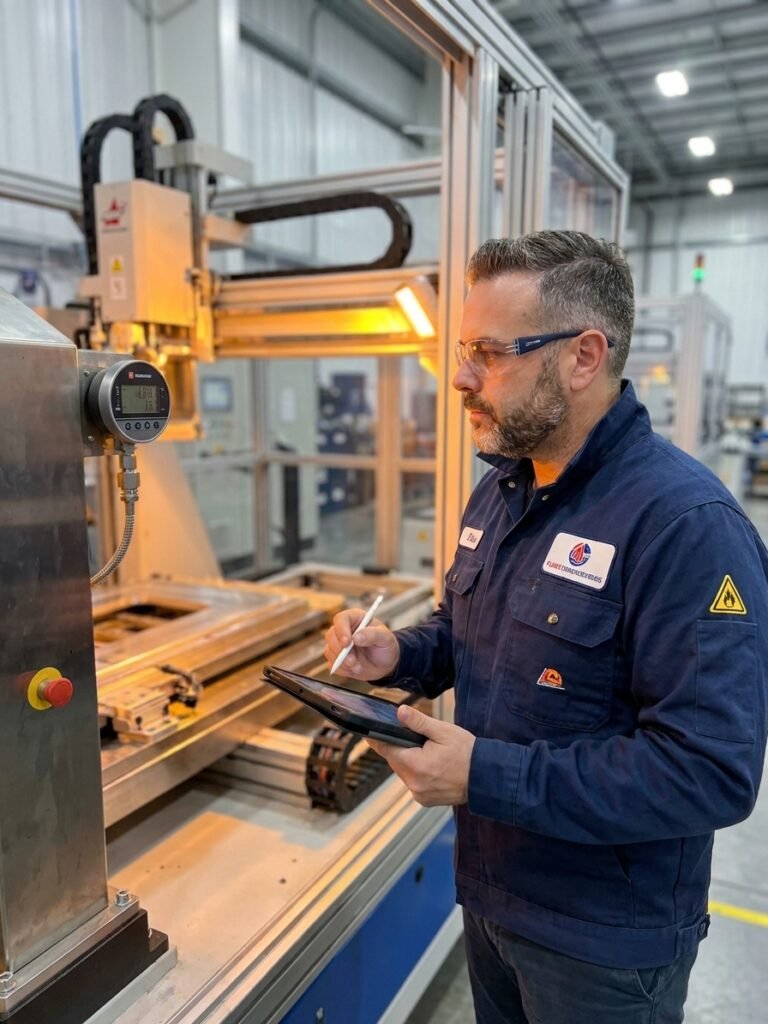
Classroom training is useful for establishing theoretical baselines, such as explaining statistical concepts or the requirements of an 8D problem-solving process. But theory does not prevent a defective weld. The most effective training happens at the machine, in the Gemba, where the operator interacts with the process.
On-the-job training (OJT) bridges the gap between theory and execution. An experienced mentor walks the operator through the control plan, demonstrating how to measure critical-to-quality (CTQ) characteristics and how to react when the data approaches a control limit. This direct transfer of tacit knowledge is far more durable than reading a standard operating procedure.
Blending methods increases retention. Combine classroom instruction for foundational knowledge, e-learning modules for standardised procedural updates, and intensive OJT for skill mastery. Simulations can also train operators on rare but high-risk scenarios, like a machine lockout/tagout (LOTO) emergency, without shutting down actual production.
Measuring Effectiveness: The Kirkpatrick Mechanism
If you do not evaluate the training, you cannot prove it worked. Many plants stop at Level 1 evaluation: handing out a satisfaction survey after a course. Asking operators if they liked the trainer provides zero data on whether they can actually perform the task on the line.
You must push to Level 3 and Level 4 evaluation. Level 3 measures behavioural change: does the operator actually follow the new control plan on the midnight shift when the supervisor is absent? Level 4 measures results: did the scrap rate actually drop? If you implemented a four-week training module on dimensional inspection and your first-pass yield remains flat, the training failed and must be redesigned.
I have audited plants that proudly presented hundreds of completed training records to satisfy IATF 16949 requirements. When I walked the floor, operators could not identify the critical characteristic they were supposed to control. The documentation was perfect, but the competency was absent.
Data closes this gap. Tracking defect rates, OEE, and Cpk before and after the intervention provides objective evidence. If an operator's training is effective, their individual scrap rate will decrease, and the overall equipment effectiveness of their station will rise. This is the only metric that matters to plant management.
If the training record is perfect but the Cpk is below 1.33, the training has failed.
Building a Competency Matrix for Succession Planning
Training is not a one-off event; it is the foundation of capacity development. In high-turnover manufacturing environments, relying on a single expert to know how to set up a complex stamping press creates massive operational risk. When that person is absent, the line stops, and delivery targets are missed.
A competency matrix mitigates this risk. Map every critical process against your workforce. Identify who is fully proficient, who requires supervision, and who is entirely untrained. This visual tool highlights vulnerability instantly. If a cell shows only one green name for a critical setup procedure, you have a bottleneck that requires immediate cross-training.
This matrix feeds directly into succession planning and performance management. It removes the emotion from promotions and development. Operators see a clear, objective path to higher grades and increased pay by mastering specific, high-value processes. This structure builds morale because it offers a tangible mechanism for career progression.
| Process Task | Proficient Operators | Action Required |
|---|---|---|
| CNC Setup & Tool Offsets | 2 of 8 | Cross-train 2 additional operators |
| CMM Fixturing & Measurement | 4 of 8 | Routine OJT for remaining shift |
| SPC Chart Interpretation | 8 of 8 | Maintain current standard |
| Minor Preventative Maintenance | 1 of 8 | Immediate maintenance team support |
Executing the Pilot: From Baseline to Process Control
When rolling out a capacity development programme, start with a targeted pilot on your worst-performing line. Baseline the current state. Document the scrap percentage, the cycle time, and the number of quality escapes over a four-week period. This data is your control group.
Implement the structured training intervention: classroom theory, intensive OJT, and daily mentoring. Monitor the same metrics closely. The goal is to demonstrate a rapid, measurable improvement in quality and productivity. When the pilot line drops its scrap rate and stabilises its Cpk, you have the business case to expand the programme across the plant.
During the pilot, expect resistance. Experienced operators may feel their expertise is being threatened. Frame the intervention as a method to standardise best practices, not to penalise individuals. When they see the data proving their line is running smoother and with fewer headaches, adoption accelerates.
Target Outcomes Post-Intervention
Integrating Training with Quality Management Systems
In aerospace manufacturing governed by AS9100, competency is not optional. The standard explicitly requires organisations to determine the necessary competence for personnel performing work affecting product quality. A structured training programme provides the objective evidence required to pass third-party audits without scrambling for documentation.
Integrate your training records directly into your Quality Management System. When a nonconformance is investigated using an 8D methodology, the root cause analysis must include a review of operator competency. If a defect occurred because the operator was unaware of a recent engineering change, the corrective action is a documented, targeted training update.
This integration transforms training from an administrative function into a critical quality control mechanism. Education and capacity development are not expenses to be minimised. They are the systematic tools you use to build a workforce capable of sustaining complex, high-margin manufacturing processes.