I have audited plants that held spotless ISO 9001 certificates yet ran at an 85% delivery rate. The paperwork was perfect. The production floor was in chaos. When the CEO of one such company sat across from me, exhausted by customer complaints and internal rework, he admitted he had tried every standard available. The problem was not a missing framework. The problem was that quality was an assigned responsibility rather than an operational culture.
Total Quality Management is not a certificate you earn from a registrar. It is an operating model. Originating in post-war Japanese manufacturing and refined globally, TQM treats quality as the aggregate output of every process, every decision, and every employee. When implemented correctly, it shifts the burden of quality from the inspection department to the entire value stream. This shift requires dismantling the traditional silo where a QA team chases defects after they occur.
Transitioning to TQM demands a structural rewrite of how an organisation measures success. You cannot implement it with a slogan. You implement it by linking customer satisfaction directly to daily operator KPIs, forcing management to own process capability, and treating suppliers as an extension of your own production line. The goal is to make quality the path of least resistance on the shop floor.
The Eight Principles That Move TQM from Theory to Operations
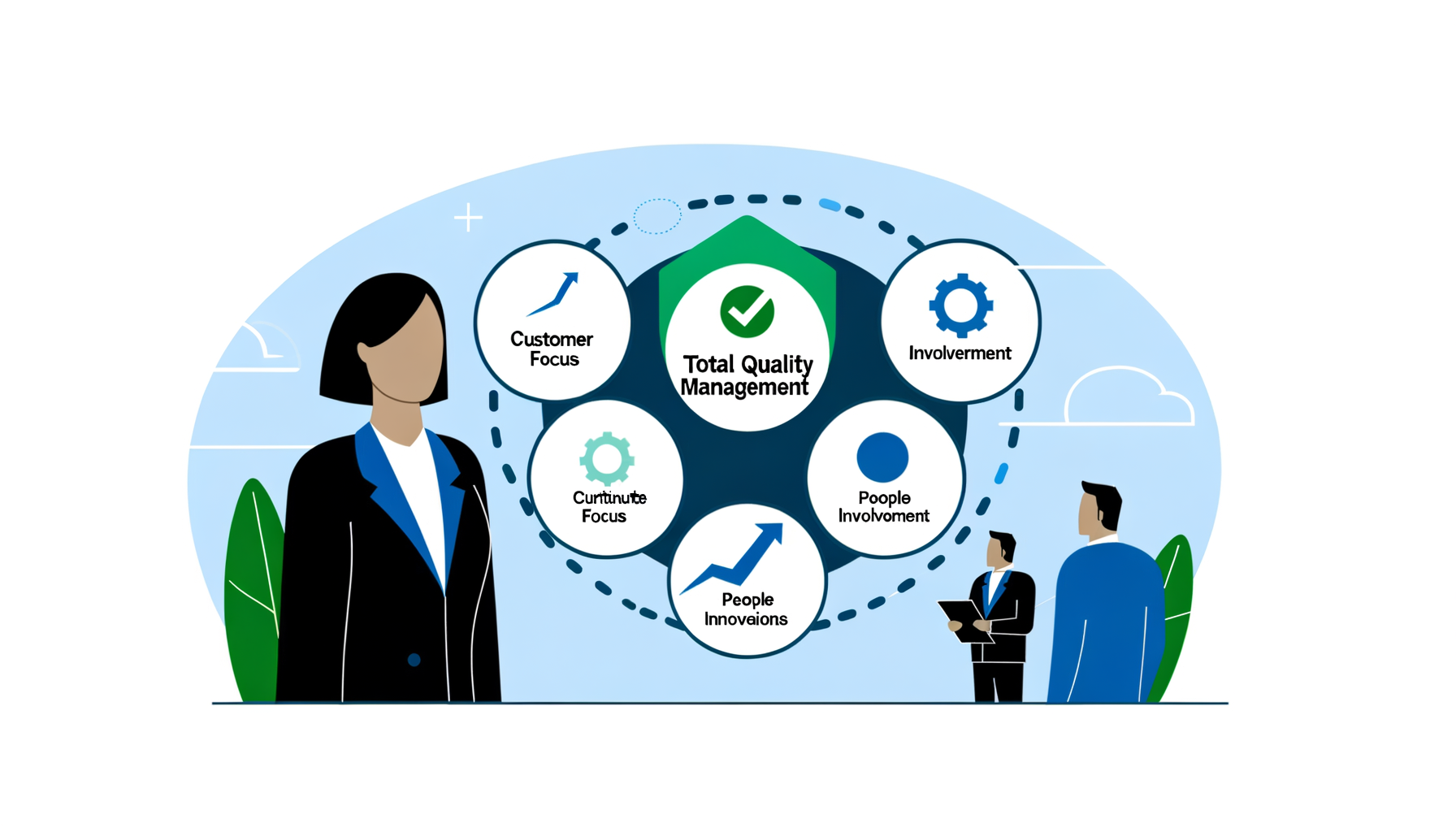
TQM operates on established quality management principles familiar to any ISO 9001 or IATF 16949 practitioner, but it demands strict operationalisation. Customer focus means tracking Net Promoter Scores and complaint resolution times, not just internal conformance rates. Quality must become everyone's responsibility by embedding it directly into performance reviews, from the C-suite to the machine operator.
A process approach means mapping the value stream and applying statistical process control (SPC) to manage variation before it becomes a defect. Continual improvement requires disciplined use of PDCA cycles and 8D problem-solving. Crucially, data-driven decision-making replaces gut feeling with real-time OEE monitoring and trend analysis. When these principles are actively managed rather than just documented, the standard manual transforms into an engineering specification.
Supplier relationships are the final, often neglected pillar. Incoming material quality dictates your final output capability. TQM demands that you audit, develop, and integrate your suppliers. You must share your performance data with them and treat their failures as your process failures. This eradicates the adversarial dynamic that plagues procurement departments.
Dismantling the Quality Silo: A Six-Month Turnaround
I have implemented this transition at companies facing existential threats. In one automotive supplier scenario, delivery quality hovered at 70%. The QA department was firefighting, and customer audits were failed. The root cause was structural: production managers optimised for volume, leaving quality as a downstream checkpoint. The solution required stripping the QA department of sole ownership for quality metrics.
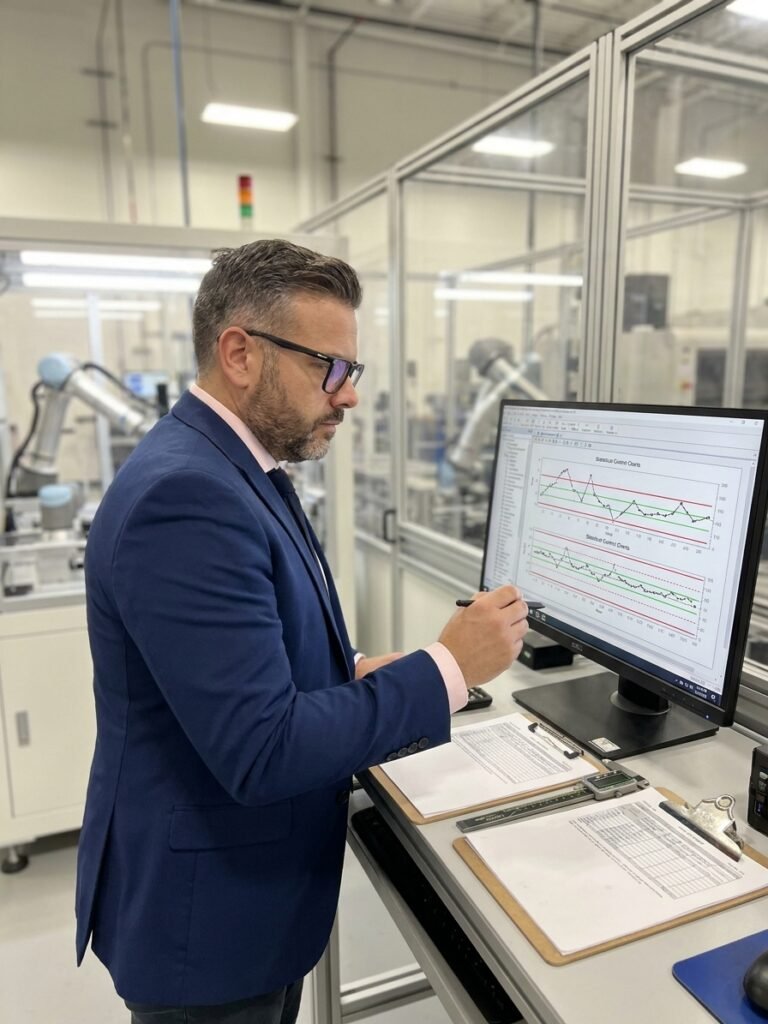
We rebuilt the management structure. The CEO became the visible sponsor of quality initiatives. Middle managers were assigned hard KPIs for defect containment and right-first-time rates. We introduced Kaizen boards directly on the shop floor, empowering operators to flag bottlenecks and propose process changes. The shift was immediate but difficult. Skepticism from operators accustomed to top-down mandates had to be actively managed through training and visible quick wins.
Siloed QA vs. Integrated TQM
What teams do
- Production optimises for volume, ignoring Cpk.
- QA isolates defects post-process via sorting.
- Supplier disputes handled only by procurement.
- Management reacts to monthly customer complaints.
What works
- Operators monitor SPC charts and stop the line.
- Root cause analysis prevents defect recurrence.
- Suppliers share process data and audit results.
- Daily management reviews track live KPI deviations.
By month three, the metrics began to stabilise. Lead times dropped from fourteen days to eleven. We reduced monthly customer complaints by twenty-five percent. The visible engagement of the management team was the primary catalyst. However, progress was initially slow because we had deployed too many isolated KPIs, diluting the focus of the workforce.
Pacing the Transformation: The Nine-Month Timeline
A TQM transition requires disciplined pacing. In the first three months, the goal is moving from chaos to stability. You achieve this by standardising work instructions, implementing visual management, and establishing baseline metrics. Expect resistance here. The focus must be on stabilising the most critical processes, not overhauling every department simultaneously.
Months three to six are about moving from stability to performance. This is where you recalibrate your KPIs, cutting the noise and focusing on the vital few drivers of customer dissatisfaction. Cross-functional communication becomes critical. The quality metrics must be understood and owned by logistics, engineering, and production equally.
The Three Phases of TQM Implementation
- 01StabiliseStandardise work instructions, map core processes, establish baseline defect rates.
- 02PerformDeploy focused KPIs, integrate cross-functional teams, enforce 8D problem-solving.
- 03SustainLock in gains via daily management routines, supplier integration, and live OEE tracking.
Months six to nine shift the focus from performance to excellence. At this stage, the culture is self-sustaining. Operators actively engage with PFMEA updates. Management relies on the data rather than instinct. Holding the gains is harder than achieving them. Standardisation of the new normal—through rigorous layered process Audits (LPA)—is what prevents regression.
Adapting TQM to Aerospace and AS9100 Environments
In aerospace manufacturing, the stakes are higher, and the regulatory burden is defined by AS9100. Here, TQM must directly address safety-critical processes and risk management. I have seen plants where the sheer complexity of aerospace components led to a fragmented understanding of quality. The solution is rigorous process mapping that ties every step to a specific safety or compliance requirement.
Applying TQM in this sector means aligning the quality management system with EASA or FAA expectations from day one. Key process indicators must prioritise safety, traceability, and defect prevention over simple throughput. When you embed these regulatory requirements into the daily TQM routines, you transform compliance from a documentation exercise into a predictable operational output.
The results are measurable. In one aerospace context, applying TQM alongside AS9100 frameworks reduced component defects to near zero, achieved a 99.5% quality rate, and eliminated safety incidents over an eighteen-month period. The key was intensive, systematic training that ensured every engineer and operator understood the direct line between their daily process checks and final flight safety.
When quality is a shared operational standard, you stop arguing about who owns the defect and start engineering the process that prevents it.
The Hard Mechanics of Sustaining TQM
Sustaining a TQM culture requires relentless data discipline. You must strip away vanity metrics. If a KPI does not directly inform a process adjustment on the shop floor, it has no place in your daily management routine. The goal is to drive decisions with real-time OEE, Cpk, and yield data, leaving no room for subjective debate.
When employees are genuinely involved, they stop acting as passive participants in someone else's quality system. They become the primary source of process improvement. When management commits to visible leadership and 8D methodology, the culture shifts from assigning blame to engineering solutions. The premise of TQM is simple, but the daily execution demands rigorous engineering and leadership accountability.