Autonomous Maintenance (AM), the Jishu Hozen pillar of Total Productive Maintenance (TPM), transfers routine equipment care from maintenance technicians to production operators. The goal is not to replace your maintenance department. It is to eliminate the chronic reliability losses caused by basic neglect: dust on sensors, dry guide rails, loose fasteners, and minor leaks that escalate into unplanned downtime.
In most plants, operators are trained to press a button and call maintenance when the cycle stops. This creates a passive dependency. The operator ignores a developing leak for hours because it is 'not their job,' while the maintenance technician spends thirty minutes filling out a work order and walking to the asset for a three-minute adjustment.
I have audited plants where maintenance teams spend over half their shift on tasks that require no specialised technical skill. When you shift cleaning, lubrication, visual inspection, and minor adjustments to the operators who run the equipment, maintenance engineers can focus on preventative maintenance, root cause analysis, and complex overhauls.
The Operator as the First Line of Equipment Diagnosis
The core principle of AM is that the person closest to the asset holds the most accurate data. An operator runs a CNC mill or press for eight hours a shift. They are the first to hear a change in the spindle frequency, feel an abnormal vibration in the frame, or spot a temperature fluctuation on a hydraulic unit.
Without AM, this sensory data is wasted. The operator does not report the anomaly because they are not assessed on equipment health. By the time the vibration triggers a sensor threshold or the machine faults, the bearing has already damaged the spindle. AM captures this intelligence early, treating the operator as a diagnostic resource rather than a cycle-time mechanism.
This shift requires a structural change in how you define the operator's role. They must be given the time, the visual standards, and the authority to stop the process and flag a deterioration. If the reward system only recognises output volume, operators will bypass emerging failures to hit shift targets.

The Seven-Step Implementation Sequence
AM is deployed through a strict seven-step sequence. Skipping steps to accelerate rollout guarantees failure. The progression moves from basic physical cleaning to full operational ownership, building technical competence and behavioural habit simultaneously.
The Jishu Hozen Seven-Step Progression
- 01Initial CleaningOperators deep-clean the asset, exposing hidden leaks, loose fasteners, and contamination sources.
- 02Eliminate Contamination SourcesCountermeasures are designed to stop dirt and leaks at their origin; hard-to-reach areas are made accessible.
- 03Establish Cleaning and Lubrication StandardsVisual, single-page standards define what to clean, lubricate, and inspect, and at what frequency.
- 04General Inspection TrainingOperators learn basic technical skills: checking pressure, identifying abnormal vibration, reading thermal profiles.
- 05Autonomous InspectionOperators take full ownership of daily routine inspections and minor maintenance tasks.
- 06StandardisationProcedures are unified across shifts to ensure consistent execution regardless of who is running the line.
- 07Fully Autonomous ManagementOperators continuously monitor condition, propose improvements, and train new personnel.
Step one, initial cleaning, is where most of the critical data is found. When operators strip guards and clean accumulated grime, they uncover the cracked cables, the leaking seals, and the missing fasteners that have been silently degrading process capability.
Connecting AM to Process Capability and Scrap Reduction
Quality engineers often treat AM as a maintenance initiative, separate from IATF 16949 or ISO 9001 objectives. This is a mistake. Every mechanical deviation eventually manifests as a dimensional or cosmetic defect on the part.
Contaminated linear guides cause inconsistent positioning, which drops your Cpk. A loose clamping fixture introduces vibration, degrading surface finish and accelerating tool wear. Worn pneumatic seals lead to inconsistent clamping force, causing parts to shift during machining.
When operators own basic equipment care, they are actively protecting process capability. A daily visual check of coolant concentration or hydraulic pressure is a preventive quality control. AM reduces the variation in your process by ensuring the machine operates within its designed mechanical baseline every single cycle.
Standardisation and the Two-Shift Verification
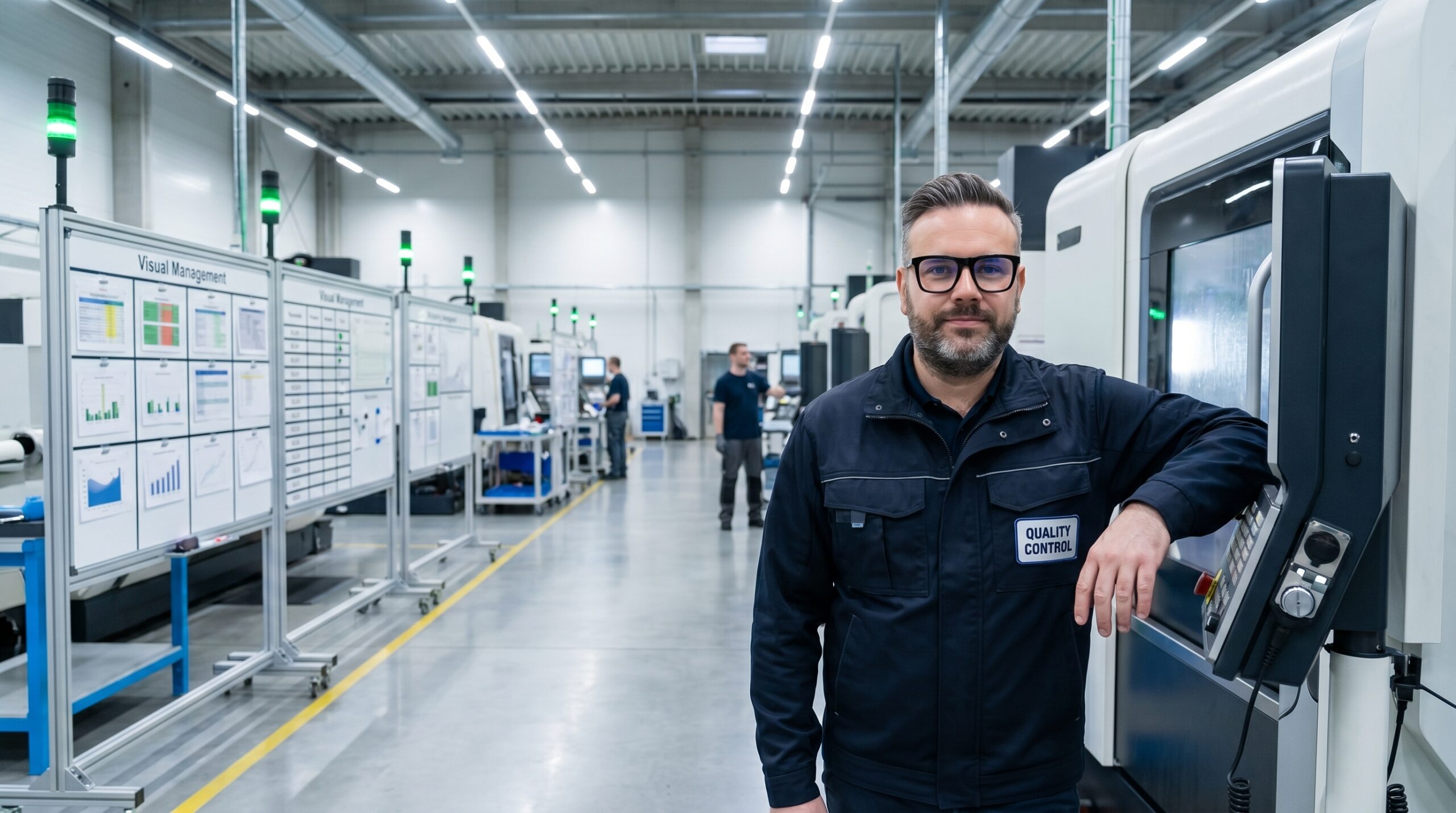
An AM standard is useless if it lives in a binder in the supervisor's office. AM relies on visual management applied directly to the asset. Lubrication points are colour-coded. Gauge safe zones are marked with green and red bands. Cleaning checklists are mounted at the point of use.
The objective is to make the correct action obvious and the incorrect action immediately visible. An operator on the morning shift should be able to verify the lubrication status of a guide rail in three seconds by checking a visual tag. If a deviation occurred on the night shift, the tag will show it.
Standard Deployment: Document vs Point-of-Use
Centralised documentation
- Detailed SOPs stored digitally or in binders
- Inspection frequencies determined by memory or schedule
- Deviations discovered after the defect occurs
- Audits rely on paperwork review
Point-of-use visual management
- Single-page standards mounted at the asset
- Colour-coded gauges and lubrication routes
- Anomalies identified visually in real time
- Audits confirm conditions directly at the machine
Standardisation also eliminates shift-to-shift variation. Without visual standards, the morning shift might lubricate a bearing daily, while the night shift lubricates it weekly. This inconsistency accelerates wear and makes root cause analysis nearly impossible when a failure finally occurs.
Overcoming the Failure Patterns of AM Implementation
Most AM programmes fail not because the methodology is flawed, but because management underestimates the cultural resistance. The most common objection is that operators do not have time for inspections. This is a scheduling failure, not an operator failure.
If a five-minute autonomous inspection prevents a two-hour breakdown, the return on investment is immediate and verifiable in your OEE data.
Management must allocate specific time blocks for AM activities. If you expect operators to perform equipment checks on top of a fully loaded production schedule, they will skip the checks to meet output targets. The time must be planned, mandated, and defended by plant leadership against short-term production pressure.
The second major failure pattern is treating initial cleaning as a one-off event. A plant runs a weekend cleaning blitz, takes photographs for the monthly report, and abandons the process. Within a month, the contamination returns, the standards are ignored, and the equipment degrades back to its previous state. Sustaining AM requires weekly audits and consistent leadership presence on the shop floor.
Integrating Industry 4.0 Tools with Operator Senses
Modern AM leverages IoT sensors and digital dashboards to support the operator, not to replace them. Vibration sensors and thermal cameras provide objective data that validates the operator's sensory observations. This allows the team to move from subjective feelings ('the spindle sounds rough') to quantifiable thresholds ('vibration acceleration has increased by 15%').
However, a sensor only triggers when a parameter crosses a programmed threshold. A trained operator will notice a change in the machine's acoustics days before the vibration trend breaches the alarm limit. The technology provides the hard data for the 8D report; the operator provides the early warning that prevents the failure from occurring at all.
Deploy mobile checklists on tablets to replace paper logs. This ensures real-time data capture and prevents the common practice of filling out inspection sheets at the end of the shift from memory. When digital checklists are tied to the CMMS, anomalies flagged by operators can trigger maintenance work orders instantly, closing the loop between detection and response.
Measuring the Impact on Reliability and Quality
The success of an AM programme is measured in three primary metrics: a reduction in unplanned downtime, an increase in Overall Equipment Effectiveness (OEE), and a reduction in scrap and rework. Plants that successfully implement AM typically see a 15-30% reduction in unplanned downtime within the first year.
Track the number of operator-initiated maintenance work orders. In a functioning AM system, this number should rise initially as operators become more adept at spotting early-stage failures. As the chronic issues are resolved and the equipment stabilises, the number of critical breakdowns will drop significantly.
Autonomous Maintenance is not a maintenance department project. It is an operational strategy that stabilises equipment condition, reduces process variation, and secures your quality outputs. By transferring routine care to the operator, you build a production system where problems are identified and contained at the source, before they escalate into costly downtime or customer complaints.