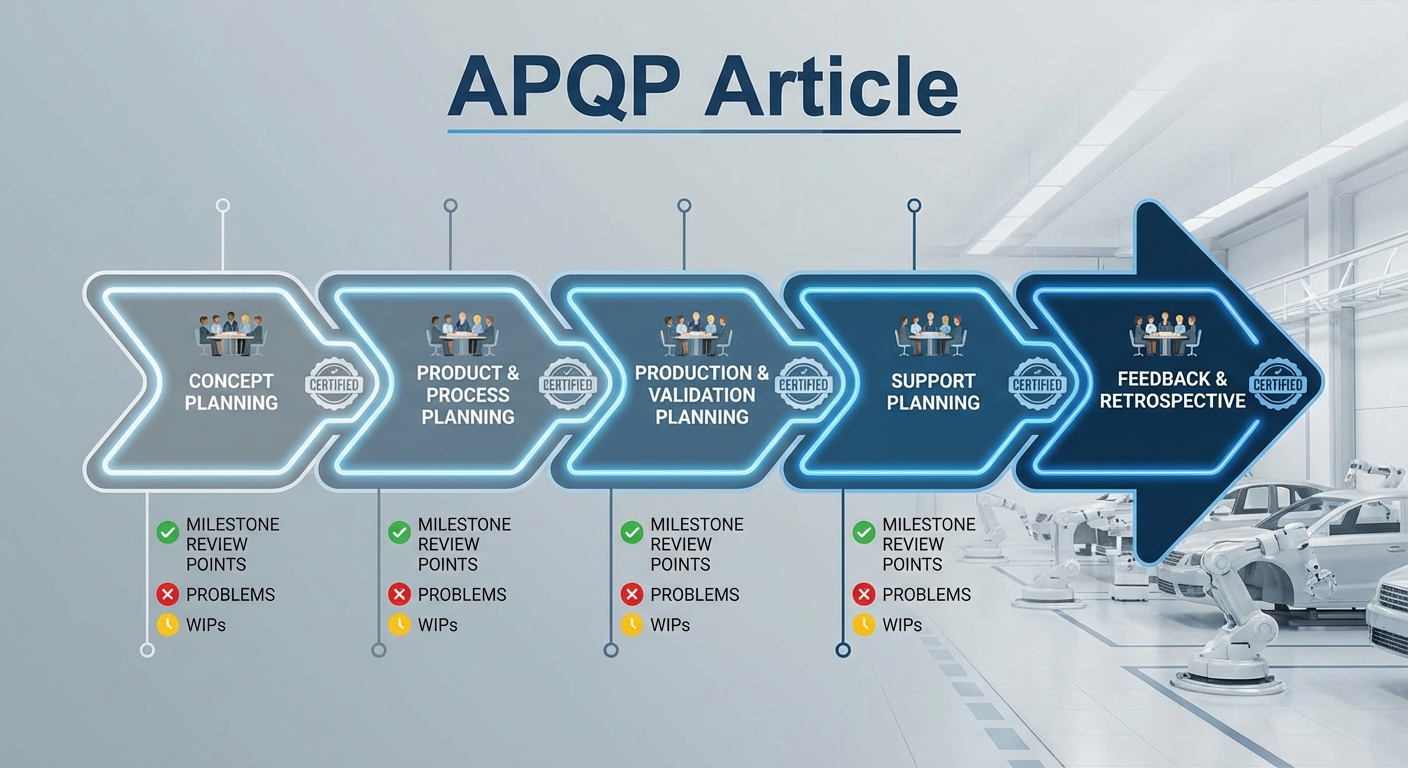
Advanced Product Quality Planning (APQP) is a structured framework that forces organisations to define, control, and verify quality parameters before a single part enters mass production. Originated by the major automotive OEMs, it is a mandatory discipline under the IATF 16949 standard. Yet many tier-one suppliers treat it as a documentation hurdle rather than an engineering tool.
The consequence of that mindset is predictable. Defects are discovered during pre-series runs or, worse, by the customer. Tooling requires expensive late-stage modifications. Cross-functional teams blame each other for unmanufactable designs. APQP exists to push these failure modes upstream, where they cost a fraction of what they cost at launch.
Implementing APQP effectively requires shifting the focus from paperwork to synchronisation. The deliverables, such as the PPAP submission package, are merely outputs of a rigorous planning process. When the process fails, it is almost always because the meetings turned into status updates instead of engineering reviews.
The core principle: quality by design, not by inspection
The traditional quality model inspects out non-conformances at the end of the line. APQP demands that you design quality into the product from the concept stage. This means defining the Voice of the Customer (VOC) and translating it directly into measurable engineering specifications, such as dimensional tolerances, material performance targets, and process capability indices.
This translation requires a multi-disciplinary team from day one. Development, production, quality, purchasing, and service cannot operate sequentially. If design engineering releases a drawing without consulting the manufacturing floor, they invite failure. APQP enforces a cross-functional approach where these departments evaluate trade-offs simultaneously.
The standard cross-functional team includes design and development engineers, manufacturing and process planners, quality assurance, procurement, and field service. This team is managed by an APQP leader whose sole responsibility is coordination and escalation. Without a dedicated leader, the framework collapses into siloed work.
The five phases of structured quality planning
APQP breaks the product lifecycle into five distinct phases. Each phase has specific deliverables, gate reviews, and exit criteria. A project cannot proceed to the next phase until the previous gate is cleared. This prevents the accumulation of unresolved technical debt that plagues undisciplined launches.
The Five Phases of APQP
- 01Phase 1: Plan & Define ProgrammeTranslate Voice of the Customer (VOC) into design targets, reliability goals, and quality objectives.
- 02Phase 2: Product Design & DevelopmentAssess engineering feasibility via Design FMEA, construct prototypes, and confirm that the design meets specifications.
- 03Phase 3: Process Design & DevelopmentDevelop the manufacturing system, determine production standards, and build the control plan.
- 04Phase 4: Product & Process ValidationRun pre-series production, validate measurement systems (MSA), and verify process capability (Cpk).
- 05Phase 5: Feedback, Assessment & Corrective ActionCapture lessons learned, resolve field issues, and feed improvements into future product development.
Resolving design and manufacturing conflict
During phase two, the most critical APQP activity occurs: reconciling the engineering design with manufacturing reality. When a cross-functional team maps out the Process Flow Diagram and begins drafting the PFMEA, design inconsistencies often surface. Operations will legitimately claim that a perfectly functional drawing is impossible to assemble at high volume.
This conflict is not a failure of the system; it is the exact reason APQP exists. The framework forces development and production into a room to solve the discrepancy. The typical output is a controlled design adjustment that maintains functionality while fitting the capabilities of the assembly line and tooling.
Resolving this early is a matter of cost control. Modifying a 3D CAD model takes hours. Modifying hardened steel tooling after a pre-series run takes weeks, costs tens of thousands of euros, and delays the customer's launch schedule. The APQP gate review process is the mechanism that prevents downstream firefighting.
Validating measurement systems and process capability
Phase four is where quality engineering must be rigorous. You must prove that the manufacturing process is capable of consistently producing conforming product. Two mechanisms drive this verification: Measurement Systems Analysis (MSA) and statistical process control. If your measurement system is flawed, your capability data is useless.
During the pre-series build, you validate the Production Control Plan. Every dimension and parameter on the engineering drawing must have an assigned measurement method. First Article Inspection (FAI) reports confirm that the physical part matches the design intent. Any critical-to-quality (CTQ) characteristic requires a capability study.
If your measurement system cannot reliably detect variation, your capability indices are just random numbers.
The target for initial process capability on new projects is typically a Cpk of 1.67 for critical characteristics. Hitting this number requires controlling the inputs, not inspecting the outputs. When the capability study reveals a Cpk below 1.33, the team must execute a structured root cause analysis before the customer grants production part approval.
The contrast between APQP and reactive quality control
Organisations that fail to implement APQP operate on a reactive model. They treat quality as a sorting exercise at the end of the line. Engineering throws drawings over the wall, manufacturing builds what they can, and quality attempts to inspect defects out of the batch. This approach creates high scrap rates, late deliveries, and warranty claims.
Reactive Quality vs Proactive APQP
Reactive Quality Control
- Planning is ad-hoc, managed department by department
- Quality focus is end-of-line inspection and sorting
- Suppliers selected primarily on lowest piece price
- Defects discovered during pre-series or mass production
Proactive APQP
- Planning is structured through mandatory cross-functional gates
- Quality is designed into the product and verified upstream
- Suppliers integrated into the development lifecycle early
- Risks identified and mitigated via PFMEA before tooling is cut
APQP forces the opposite behaviour. Because the framework demands the involvement of the supply chain and service teams early in the planning phase, risks are identified when they are inexpensive to fix. Procurement evaluates supplier capability against the design requirements before the contract is signed, preventing raw material defects later.
Digital transformation and lessons learned
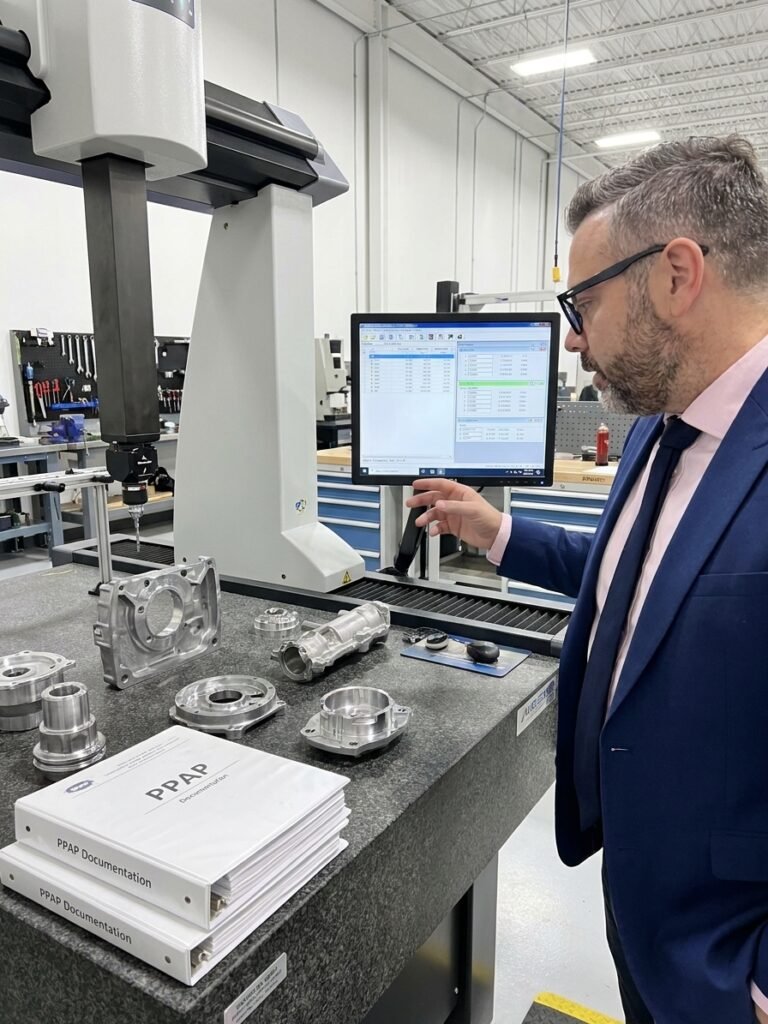
The application of APQP is evolving through digital integration. PLM (Product Lifecycle Management) systems and electronic workflows have replaced physical binders of PPAP documentation. This digitisation enables real-time visibility of gate status, immediate distribution of updated control plans, and electronic signatures for engineering releases.
However, software cannot replace the fundamental requirement: disciplined cross-functional collaboration. A digital APQP system that simply automates the routing of incomplete documents only accelerates failure. The value of the framework remains in the engineering debates that happen during the gate reviews.
Phase five closes the loop. Once the product is in mass production, the team must systematically analyse field failures, warranty data, and internal scrap rates. These lessons learned, captured during retrospectives, must be fed back into phase one of the next project. Without this feedback mechanism, organisations repeat the same engineering mistakes on every new launch.