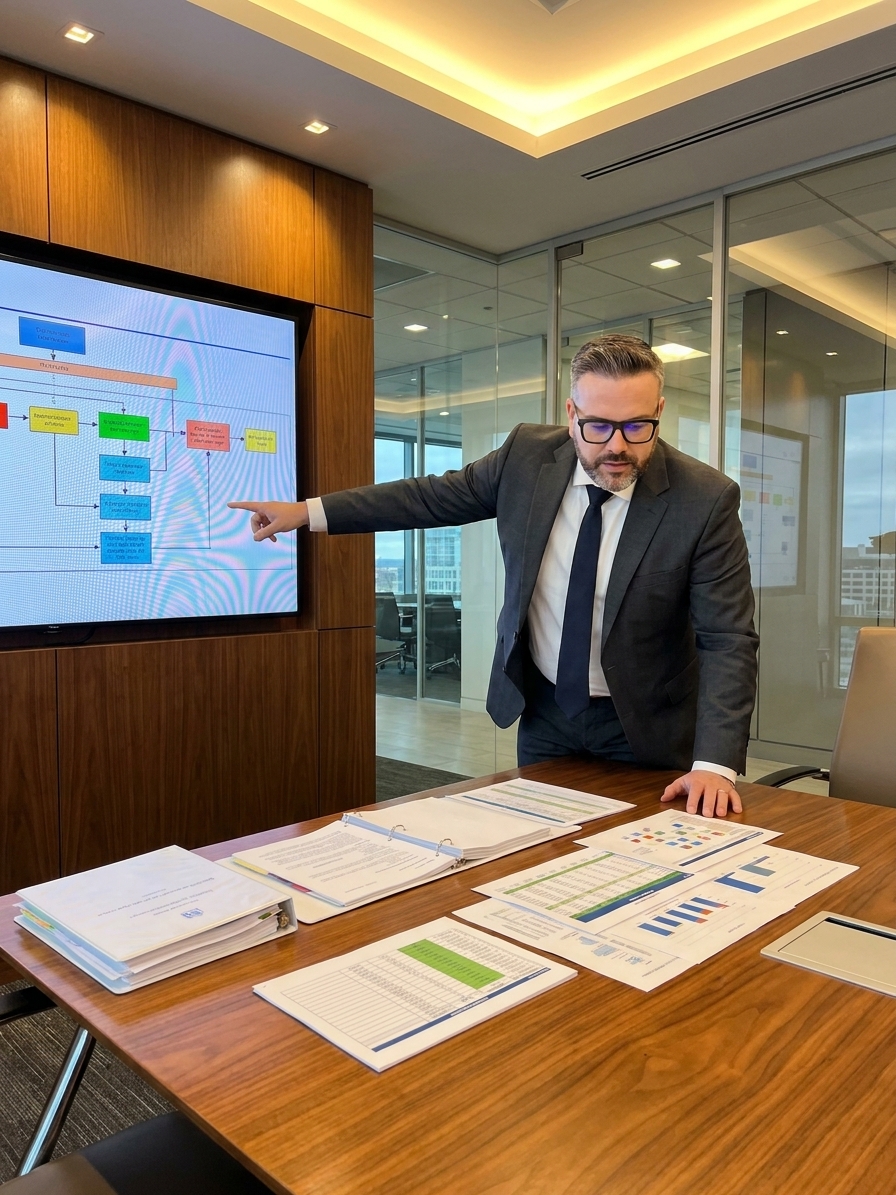
In 1957, C. Northcote Parkinson observed a committee approve a ten-million-pound nuclear power plant in under three minutes, then spend forty-five minutes debating the construction of a two-thousand-pound bicycle shed. The committee understood bike sheds. They did not understand nuclear reactors. Parkinson called this the Law of Triviality, and it is one of the most destructive forces operating inside quality management systems today.
I have audited dozens of plants where management reviews and quality system committees exhibit this exact pattern. A proposed change to the supplier approval process that affects millions of euros in material costs receives ten minutes of polite nodding. The layout of the new quality dashboard gets forty minutes of vigorous debate. The cognitive energy of the leadership team flows toward what they understand, not toward what matters.
The result is a structural vulnerability. Critical decisions pass through governance with insufficient scrutiny while trivial items are polished to perfection. The organization develops an impressive visual management system and an underdeveloped process capability system. When the inevitable field failure arrives, the same committee convenes to discuss the 8D report formatting.
How Triviality Captures Quality Governance
Bike-shedding in a quality organization follows a predictable sequence. The monthly quality review begins with twelve agenda items. One item is a proposed change to the PPAP submission requirements that would add two weeks to onboarding but reduce defective incoming material significantly. Another is the colour-coding system for inspection area floor markings.
The supplier process change gets fifteen minutes because only three people in the room understand the supply chain implications, and they are reluctant to hold up the meeting with explanations. The floor markings get the remaining time because everyone has stood on a factory floor and has an opinion about colour. The committee mistakes participation for rigour.
Three months later, when the defective material rate has not improved, the same committee meets to wonder why. The connection between their time allocation and the unresolved quality problem is never made, because the system never records how little time was spent on the decision that actually governed the outcome.
Time Allocation vs Decision Impact
The Psychology of the Committee Room
Three psychological mechanisms drive triviality in group settings. The first is the illusion of competence through simplicity. When a topic is complex, like the statistical basis for an MSA study or the metallurgical reasons behind a heat treatment failure, most participants defer to the expert. When a topic is simple, everyone becomes an expert. The meeting becomes a democracy of opinions on a subject that does not warrant democracy.

The second is the anxiety of silence. In group settings, silence is interpreted as incompetence. Participants who cannot evaluate a validation strategy will question whether the protocol uses the right template. They cannot contribute to the statistical analysis, so they ask about the formatting of the report. The contribution becomes a proxy for participation.
The third is the avoidance of accountability. Complex quality decisions carry real consequences. If you approve a new PFMEA methodology and it fails, your name is on the decision. If you debate the header layout on the PFMEA form, you have contributed without exposure. The trivial discussion provides the psychological reward of engagement without the risk of accountability.
The Cost to System Integrity
The most insidious consequence of bike-shedding is that the trivial items, having been debated thoroughly, actually become good. The dashboard is beautiful. The floor markings are colour-coded with consistency. The forms are perfectly formatted. This creates a dangerous illusion of quality system health. Everything the committee can see has been polished.
The things nobody can see remain underdeveloped. The measurement system analyses are incomplete. The root cause investigations stop at the physical cause without reaching the systemic cause. The process capability studies for safety-critical characteristics sit in a folder, flagged red, untouched. The visual excellence of the system masks the analytical weakness beneath it.
Expert voices are marginalized in this environment. The people who understand the complex topics best are often engineers and specialists who value precision over persuasion. When meeting culture rewards loud opinions on simple topics, the quiet expert who has the answer to the complex problem stops trying to be heard. The organization loses access to its own expertise at the moment it needs it most.
Recognizing the Pattern in Real Time
Bike-shedding is easiest to spot in retrospect, but warning signs appear in real time if you know what to watch for. The primary indicator is inverse proportionality between topic importance and discussion time. If your two-hour management review spends ninety minutes on visual management standards and ten minutes on the customer complaint trend analysis, the pattern is already established and driving your quality outcomes.
A second indicator is uniform participation across all topics. When the maintenance manager has equally strong opinions about the AS9100 internal audit schedule and the colour of the audit report cover, you are witnessing triviality in its purest form. Expertise has been replaced by entitlement, and the meeting has become a forum for general preferences rather than technical scrutiny.
A third indicator is the speed of complex decisions. Fast decisions on complex issues feel efficient but are usually the result of collective incomprehension. If the room goes quiet when the Cpk study comes up, that silence is not agreement. It is the sound of a committee that does not understand the material well enough to challenge it, and is too uncomfortable to admit it.
Bike-Shedded Review vs Structured Quality Governance
What teams do
- Mix strategic and operational items on one agenda
- Allow operational topics to consume strategic discussion time
- Reward broad participation regardless of topic relevance
- Approve complex items quickly with minimal technical challenge
What works
- Separate strategic decisions from operational updates entirely
- Weight time allocation to complexity and quality impact
- Require pre-reads and designate a devil's advocate for critical items
- Track decision quality, not meeting activity or attendance
Architecture for Decision Quality
Preventing bike-shedding requires structural changes to how quality meetings are designed, not appeals to discipline. The first intervention is to separate strategic decisions from operational ones. Do not put the supplier qualification policy change and the floor marking update on the same agenda. They require different participants, different levels of expertise, and different decision mechanisms. Mixing them guarantees the operational items cannibalize the strategic ones.
The second is complexity-weighted time allocation. Before the meeting, estimate the real impact of each agenda item. A proposed change to your corrective action process that affects every product line should receive ten times the discussion of a visual management update. Write the allocation on the agenda and enforce it with a timer. The act of writing it down forces the organizer to confront how disproportionate the current pattern is.
Quality culture is everyone's responsibility. Quality engineering is not.
The third is mandatory pre-reads for complex topics. The reason people cannot discuss a sampling plan meaningfully is often that they do not understand it. Circulate a concise briefing before the meeting that explains the problem, the proposed solution, the supporting data, and the risks. Informed participants ask about assumptions. Uninformed participants ask about formatting.
The fourth is a designated devil's advocate for every critical decision. Assign someone the explicit role of challenging the proposal. This role should rotate, so no single person is always the dissenter. The advocate prepares before the meeting, reviews the data, and identifies the weakest assumptions. This forces the level of scrutiny that the natural dynamics of the room will not produce on their own.
The Competence Gap Beneath the Triviality
I once sat in a quality review where the team spent ninety minutes debating whether inspection work instructions should use photographs or illustrations. Meanwhile, a safety-critical dimension was running at a Cpk of 0.89, well below the required 1.33. The capability study received seven minutes. Three months later, a customer found the defect in the field, and the 8D corrective action review took forty-five minutes, most of it spent on report formatting.
If you restructure your meetings and the discussion of complex items remains shallow, you have a bigger problem than bike-shedding. You have a competence gap. Your team may not have the expertise to engage with the critical issues, and they are hiding behind trivial ones because trivial ones are all they can reach.
In that case, the solution is not better facilitation. It is capability development. Invest in training. Bring in expertise. Build the analytical muscle your team needs to engage with MSA, SPC, and advanced problem-solving. The worst version of the Law of Triviality is not when your team spends too much time on the wrong problems. It is when they spend time there because the right problems are beyond their reach.