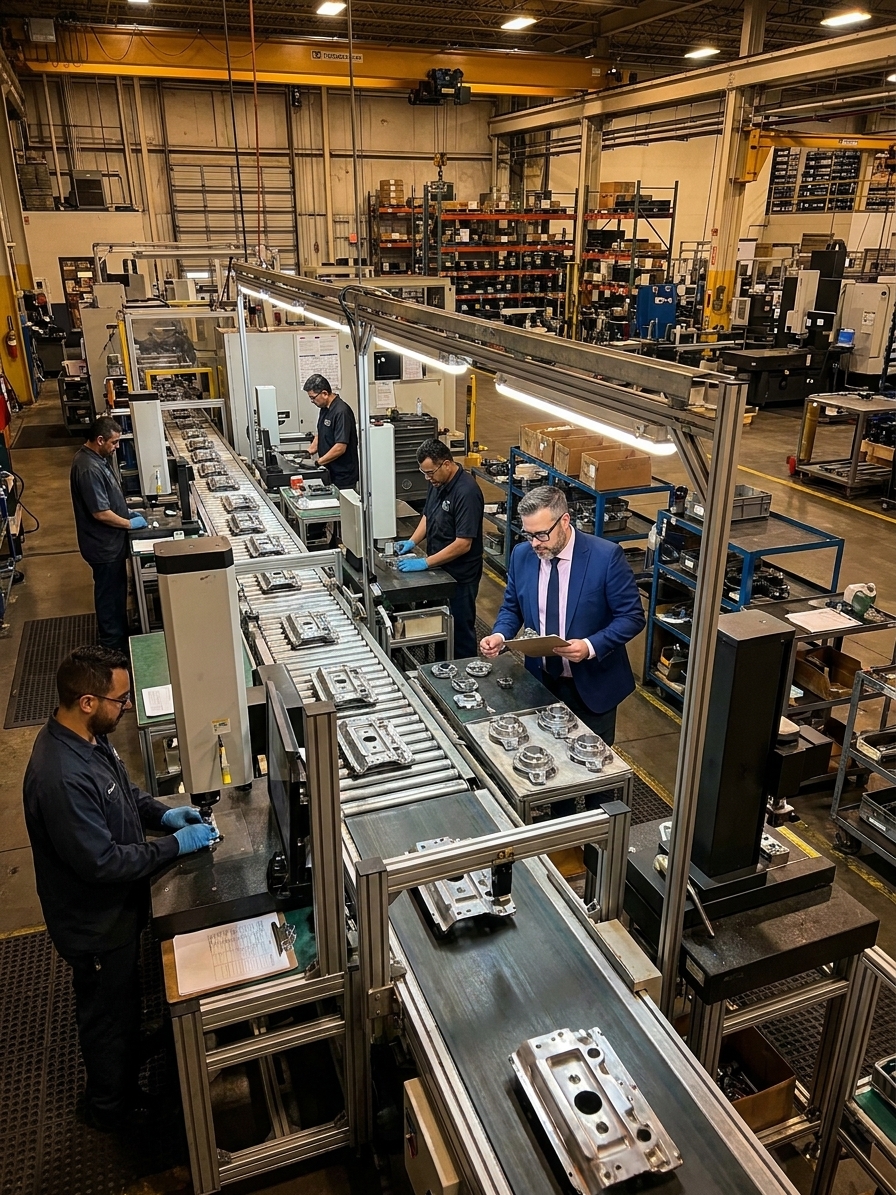
A defect moves through your production line — past the operator, past the in-process inspector, past the quality gate, past the final inspector, past the shipping review. Five checkpoints. Forty pairs of hands. Not one person stopped it. When the customer complaint lands on your desk, you ask the question every quality manager has asked: how did this get past everyone?
The answer is uncomfortable. It got past everyone precisely because it got past everyone. This is the Bystander Effect in manufacturing, and it is one of the most destructive forces in quality management. Almost no organisation recognises it by name. They see the symptoms — repeated escapes, unclaimed defects, vague accountability — but they treat each incident as an isolated failure of attention rather than what it actually is.
What you are dealing with is a systematic psychological failure built into the way you have structured your quality checks. The more inspection points you add, the more quality gates you install, and the more people who touch the product, the less likely any single person is to feel personally responsible for catching a defect. Every additional checkpoint does not double your protection. It dilutes it.
How the Diffusion of Responsibility Works on the Line
Consider a typical automotive parts manufacturer. A machined bracket goes through CNC machining, deburring, in-process CMM inspection, assembly, final dimensional inspection, and packaging verification. Six checkpoints, every one staffed by a competent human being with the tools and training to catch defects. And yet defects escape. Not occasionally. Routinely.
When you investigate the escapes, you find a pattern. It is not that people are incompetent or careless. Each person at each checkpoint unconsciously calculates that the next person will catch it if they miss it. Looking backward, they assume the previous person should have caught it already. Both calculations relieve the individual of the psychological burden of personal responsibility.
The CNC operator thinks the CMM will catch anything missed. The CMM technician thinks final inspection will catch what the CMM does not. The final inspector assumes the in-process check already validated the part. The packager assumes the part has been checked six times already so it must be fine. The defect passes through a gap that exists not because of tooling or training but because of psychology.

The Paradox of Adding Inspection Layers
The technical term is diffusion of responsibility, and it is the engine that drives the Bystander Effect in organisations. In laboratory experiments, subjects were less likely to report smoke filling a room when other people were present. In your factory, inspectors are less likely to flag a marginal defect when they know three more people will look at the same part after them.
This is not laziness or negligence. It is a well-documented cognitive bias that operates below conscious awareness. Your people are not choosing to let defects pass. They are unconsciously recalibrating their vigilance based on the presence of other checkpoints. The more layers you add, the worse the bias becomes.
This is the paradox that traps organisations. A customer complaint arrives. Management responds by adding another inspection step. The Bystander Effect intensifies because responsibility is further diluted. The next escape is worse, not better. Management adds yet another layer. The cycle continues until your quality system is a bloated bureaucracy of overlapping checks, none of which work as intended.
The inspection paradox
What teams do
- Add a new gate after every customer escape
- Assign overlapping visual inspection to three roles
- Record checks by station number or shift code
- Assume redundancy provides a safety net
What works
- Consolidate to three gates with one named owner per check
- Assign each characteristic to exactly one person at one point
- Record every sign-off by individual name, not station
- Treat ownership clarity, not layer count, as the safety mechanism
Ambiguity: Where the Effect Feeds
The Bystander Effect is amplified by ambiguity. In the classic experiments, bystanders were slower to act when the situation was unclear — when it was not obvious whether the event was an emergency. In manufacturing, ambiguity is the norm. Is that scratch within specification? Is that burr acceptable? Is that colour variation normal or a sign of process drift?
These judgment calls happen hundreds of times per shift. When the decision is clear — a part is obviously cracked, a dimension is wildly out of tolerance — people act immediately. When the decision is ambiguous, the Bystander Effect takes over. The inspector looks at a marginal condition, knows the next station will look at it too, and passes it. The next inspector sees it, makes the same calculation, and passes it again.
This is why your most dangerous defects are not the catastrophic ones. Those are caught because they are unambiguous. Your most dangerous defects are the marginal ones, the borderline cases that sit in the grey zone between acceptable and not acceptable. The ambiguity provides cover for inaction, and the presence of other checkpoints provides the psychological justification.
Pluralistic Ignorance on the Production Floor
A related mechanism makes things worse. Pluralistic ignorance occurs when each individual privately believes something is wrong but looks to the behaviour of others for cues. When nobody else seems concerned, each person concludes that the situation must be normal — even when everyone individually suspects it is not.
On the production floor, this looks like a subtle defect that multiple people notice but none of them flag. A CNC operator sees slight discolouration on a batch of parts. He does not say anything because the in-process inspector did not flag the previous batch, and that batch looked similar. The in-process inspector notices the discolouration too but does not flag it because the CNC operator did not mention it at handoff.
Each person's silence becomes evidence to the other that the condition is normal. By the time the parts reach final inspection, the discolouration has been implicitly validated by every person who looked at the parts and did not react. Nobody was wrong. Nobody was negligent. The system produced a collective failure from a series of individually rational decisions.
Redundancy without ownership is not a safety net. It is a sieve.
Organisational Factors That Amplify the Failure
Several structural factors make the Bystander Effect worse. Overlapping inspection roles are the most common offender. When multiple people are responsible for the same check, nobody owns it. If three people are all responsible for visual inspection, none of them is. Clear, exclusive ownership of specific quality characteristics is the only antidote.
Lack of feedback loops erodes personal impact. When inspectors never learn whether the defects they passed or caught actually mattered, they gradually stop caring. An inspector who flags a defect and never hears what happened loses investment. An inspector who passes a marginal part and never hears about a complaint gets false confirmation that passing marginal parts is safe.
Anonymous quality systems dissolve accountability. When checks are recorded by station or shift rather than by individual, personal responsibility evaporates. A quality record that says Station 4 passed carries no psychological weight. A record that says a specific named person passed carries enormous weight — not because you are looking to blame someone, but because that person knows the record carries their name.
Production pressure short-circuits the deliberation that might overcome the Bystander Effect. When people are rushing, they default to the psychologically easiest path: assume the next person will handle it. The faster the line moves, the stronger the bias becomes. And in organisations where quality is seen exclusively as the quality department's job, the Bystander Effect is not a bias — it is policy.
What exclusive ownership looks like in practice
Structural Fixes That Break the Cycle
Breaking the Bystander Effect requires a fundamentally different approach to quality checks. The counterintuitive step most organisations resist is reducing the number of checkpoints. Fewer checkpoints, each with clear ownership and adequate time, consistently outperform many checkpoints with diffuse responsibility. I have seen plants reduce their inspection layers from six to three and simultaneously improve their escape rate.
Every quality characteristic must have exactly one owner at exactly one point in the process. Not two owners. Not shared responsibility. One person, one check, one point. The CMM technician owns dimensional verification. The final inspector owns visual inspection. Never overlap. When ownership is exclusive, the psychological calculation changes completely.
Make ownership visible and close the feedback loop. Quality records should be individual, not collective. Every inspector should know, within a reasonable timeframe, what happened to the parts they inspected. Did defects they caught turn out to be genuine? Did parts they passed generate complaints? This feedback is the fuel that drives personal investment in quality. Without it, inspection becomes a rote exercise.
Train specifically for ambiguity. Since borderline conditions are where the Bystander Effect thrives, focus your training on marginal defects. Give inspectors practice making judgment calls on grey-zone cases. Discuss the reasoning. Build shared standards for the ambiguous areas. The more confident people are in their judgment, the less they defer to the imaginary judgment of the next person in line.
Create a speak-up culture with genuine teeth. Many organisations say they encourage people to raise concerns. Few actually reward it. If you want people to override the Bystander Effect, you must make it psychologically safe and organisationally rewarding to flag concerns — even concerns that turn out to be nothing. Every false alarm is evidence that your inspection system is working, not a waste of time.
Finally, use technology to force accountability. Digital inspection systems that require individual sign-off, timestamp each check, and prevent downstream processing without upstream verification remove the ambiguity that fuels the Bystander Effect. The system does not allow someone else to catch it because the system will not let the part move until the named individual has acted.
The Three Questions That Define a Working System
The Bystander Effect in manufacturing is a symptom of a deeper problem: confusing redundancy with robustness. Redundancy — multiple layers of inspection — feels robust. It feels like you have built a safety net. But redundancy without ownership is not a safety net. Robustness comes from clarity. Clarity of ownership, clarity of standards, clarity of accountability, and clarity of feedback.
The most effective quality systems I have seen are not the ones with the most inspection points. They are the ones where every person on the line can answer three questions without hesitation: What am I responsible for checking? How do I know if it passes? What happens if I get it wrong?
If your people cannot answer those three questions, no amount of additional inspection layers will save you. The defects will keep passing through your forty pairs of hands, and you will keep asking the same question: how did this get past everyone? It got past everyone because everyone assumed someone else would catch it. That assumption is the defect you actually need to fix.