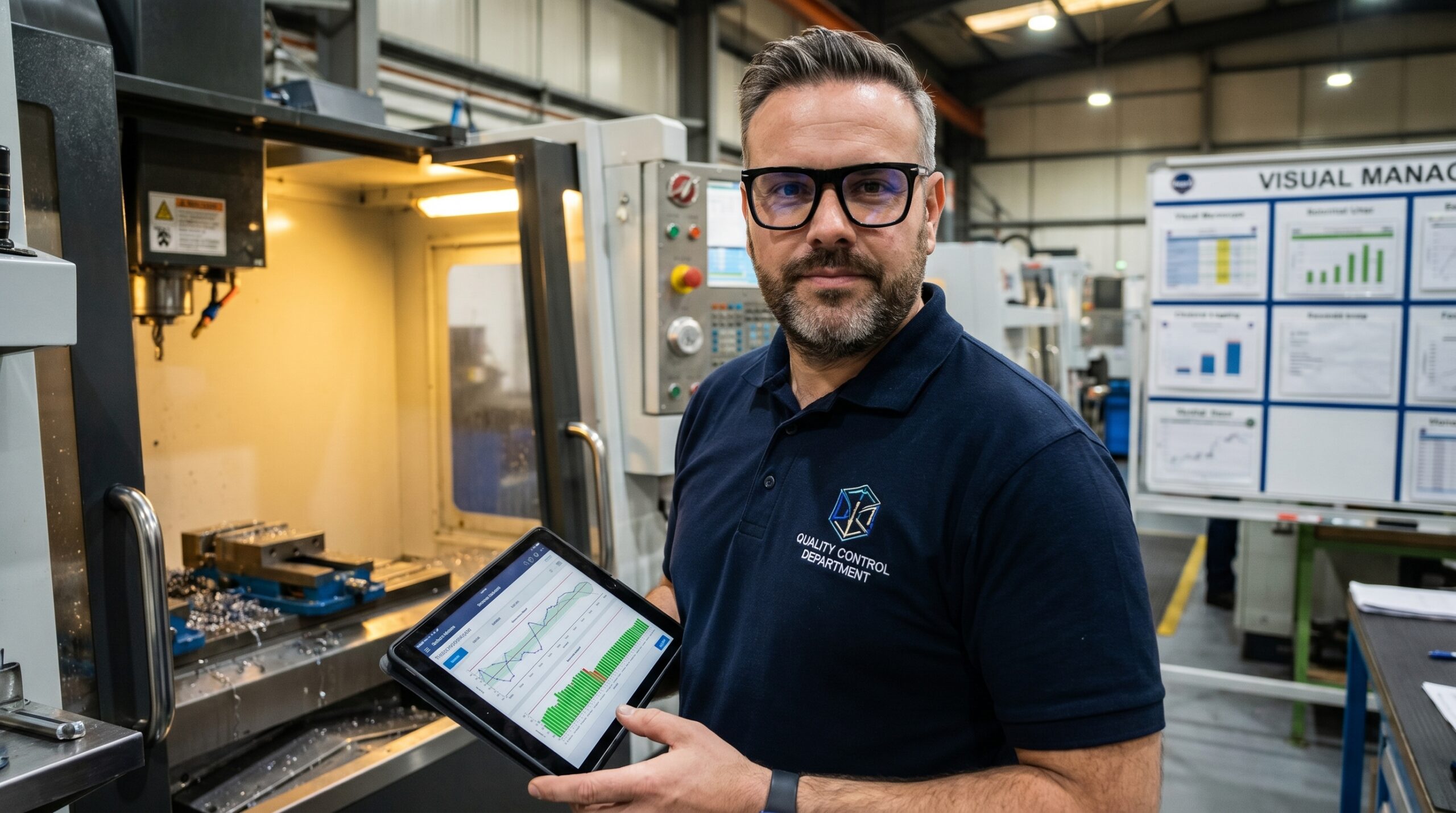
A CNC setup technician retires on a Friday. By Monday afternoon, the production line for the highest-revenue product grinds to a halt. The setup sheets specify standard parameters, but the technician's hands knew differently. The gap between documented procedure and actual practice was the difference between a 0.3% scrap rate and an 18% scrap rate. Nobody wrote it down because nobody knew it needed writing.
I have implemented and transitioned quality systems at major automotive and aerospace plants across Europe. In every single facility, I have found a gap between what the ISO 9001 or IATF 16949 documentation states and what the operators actually do to make the process run. That gap is filled by tribal knowledge—undocumented know-how that lives in muscle memory and decades of pattern recognition. It is the single most underestimated risk in manufacturing today.
Tribal knowledge is the body of adjustments, diagnostic criteria, and decision-making shortcuts that exist only in the minds of experienced workers. Quality management systems are built on the premise that understood processes can be documented, and documented processes can be controlled. The uncomfortable reality is that in most plants, the actual process relies on compensatory actions that formal systems do not capture.
Classifying the Undocumented
Not all tribal knowledge is identical, and treating it as a single block makes it impossible to manage. To extract expertise effectively, you must first classify the knowledge type holding your process together. Quality directors need to look past the general idea of experience and identify the specific mechanisms operating on the shop floor.
Compensatory knowledge corrects known deficiencies in the documented process. The work instruction dictates torquing a bolt to 85 Nm, but every experienced mechanic knows that on fixture position seven, 82 Nm is required due to a slight casting distortion in the aluminum boss. This knowledge exists because the original documentation was not precise enough, and process engineering failed to detect the variance.
Diagnostic knowledge is the ability to instantly recognize what is going wrong and apply a fix based on patterns that are never formally described. It is the operator who can look at a weld bead and determine that the wire feed speed is off by 2 meters per minute. It is the technician who hears a spindle bearing failing three weeks before the vibration sensor flags it. This knowledge is built through thousands of repetitions.
Contextual knowledge provides the deep understanding of why things are done a certain way, enabling intelligent decisions when variables change. The process engineer knows that material batch B from supplier X runs better at a 5°C lower temperature because of an unflagged variance in melt flow index. This connects dots that formal PFMEA and control plans do not even recognize as related.
The Operational Cost of Inaction
When undocumented expertise walks out the door, the financial and operational costs cascade immediately. Scrap rates spike, setup times increase, and cycle times lengthen. A line that historically ran at 95% OEE drops to 78%, and the shift leaders cannot explain why. These visible costs hit production within the first two weeks of a key person leaving.

Quality costs hit just as hard. Customer complaints spike, internal defect rates rise, and failure modes that have not appeared in years suddenly dominate the 8D reports. The cost is not just in the defects themselves, but in the frantic, expensive investigations that follow. The people who could have diagnosed the root cause in minutes are permanently unavailable.
The hidden cost is the loss of continuous improvement capacity. Tribal knowledge is not just about maintaining the status quo; it is the absolute foundation for process innovation. The person who understands every quirk of a machine is the only person who can see a better way to run it. When they leave, the organization loses its ability to advance its own production capability.
Converging Risk Factors
Three converging factors make tribal knowledge a critical threat to manufacturing stability right now. First, the demographic cliff is hitting the shop floor. Across European manufacturing, the average age of skilled production workers is climbing past fifty. In precision machining, toolmaking, and specialized assembly, the average is even higher, with significant percentages of the workforce within ten years of retirement.
Second, the acceleration of change outpaces human documentation. When a process remained stable for twenty years, tribal knowledge could comfortably coexist with it. Industry 4.0, new materials, and automated cells mean processes are changing faster than ever. Each engineering change order or new product introduction creates new tribal knowledge faster than the quality team can capture it.
Third, the apprenticeship culture has collapsed. Historically, undocumented knowledge transferred naturally through years of guided observation and practice. Today's workforce is highly mobile, corporate training programs are severely compressed, and leadership operates on the assumption that standard documentation will be sufficient. In highly automated or complex assembly environments, it rarely is.
Measuring Knowledge Attrition Risk
Structured Extraction Techniques
Capturing this knowledge cannot be done by forcing experienced workers to write manuals. Most of them genuinely cannot articulate what they know; the knowledge has become automatic. To document it, quality engineers must use structured approaches that extract information through observation and targeted dialogue. Relying on standard interviews or process audits will not surface the required depth of data.
Critical Incident Technique focuses on specific failures. Instead of asking general questions, ask the expert to walk through the last time they deviated from the standard setup to fix an issue. General questions produce useless generalizations. Asking what happened when a specific material batch arrived last month produces specific parameters, and from those specifics, actual control patterns emerge.
Shadow Documentation and Video-Based Process Analysis are highly effective for capturing compensatory actions. Pair a process engineer with the expert for several weeks. The engineer's sole job is to document every deviation from the standard procedure. Recording the expert performing a complete setup, then reviewing the footage at half speed while they narrate their decisions, forces automatic behaviors into articulable concepts.
Forced Perturbation is a method borrowed from resilience engineering. Deliberately alter one process parameter and observe how the expert responds. Ask what they would do if the coolant temperature rose by 5°C. Their answers reveal decision rules and compensatory knowledge that normal observation would never uncover, because experts make preemptive adjustments before parameters ever reach the warning limits.
Integrating Capture into the QMS
Capturing tribal knowledge cannot be a reactive project triggered by a retirement notice. It must be a continuous process integrated directly into your Quality Management System. I have built greenfield QA departments, and the first priority is always establishing a formal knowledge retention framework. Without this structure, expertise extraction is ignored until it becomes a crisis.
If your documented process is perfectly followed but yields scrap, your documentation is the defect.
Establish a risk-based schedule to identify critical knowledge holders. For each core process, evaluate the uniqueness of the knowledge, the difficulty of replacing the individual, and the business impact of their departure. Begin capturing data for the highest-risk positions immediately, regardless of their expected retirement timeline. Do not wait for human resources to announce a transition date.
The most critical step in this framework is validation. Have someone other than the original expert attempt to perform the task using only the newly captured documentation. If they cannot replicate the process successfully, the capture is incomplete. This validation step almost always reveals additional layers of diagnostic criteria that the initial extraction missed entirely.
The Knowledge Validation Cycle
- 01Risk AssessmentScore roles on knowledge uniqueness, replacement difficulty, and operational impact.
- 02Targeted ExtractionApply video shadowing, critical incident reviews, and forced perturbation.
- 03Independent ValidationA different operator attempts the task using only the newly documented standard.
- 04PFMEA IntegrationUpdate control plans, detection methods, and failure modes with captured data.
Managing Cultural Resistance
Addressing tribal knowledge is as much a cultural challenge as a technical one. Experienced workers frequently resist knowledge capture for legitimate reasons. For someone who has built a thirty-year career on being the only person who can make a specific machine run properly, documenting that knowledge feels like a direct threat to their value proposition and job security.
Quality concerns also drive resistance. Skilled technicians understand that over-simplifying their expertise into a rigid checklist can actually result in worse quality outcomes. They know that process variability requires dynamic judgment, not blind adherence to a static work instruction. When documentation removes the required judgment, defect rates inevitably climb.
Overcoming this requires leadership to reframe knowledge capture as professional legacy-building rather than a commoditization plan. The goal is to augment the capabilities of the broader team, not to cheapen the expert's contribution. Integrate knowledge sharing into the performance criteria for senior technical roles, and reward the experts who actively elevate the organization's process intelligence.
At the plant I mentioned earlier, the retiree returned part-time. It took four months of shadowing, video recording, and iterative validation to decode what was in his hands. The resulting setup guide expanded from 2 pages to 14, detailing conditional adjustments for scenarios nobody else knew existed. Eighteen months later, when the next senior technician retired, the extraction process took three weeks instead of four months. The system was already in place.