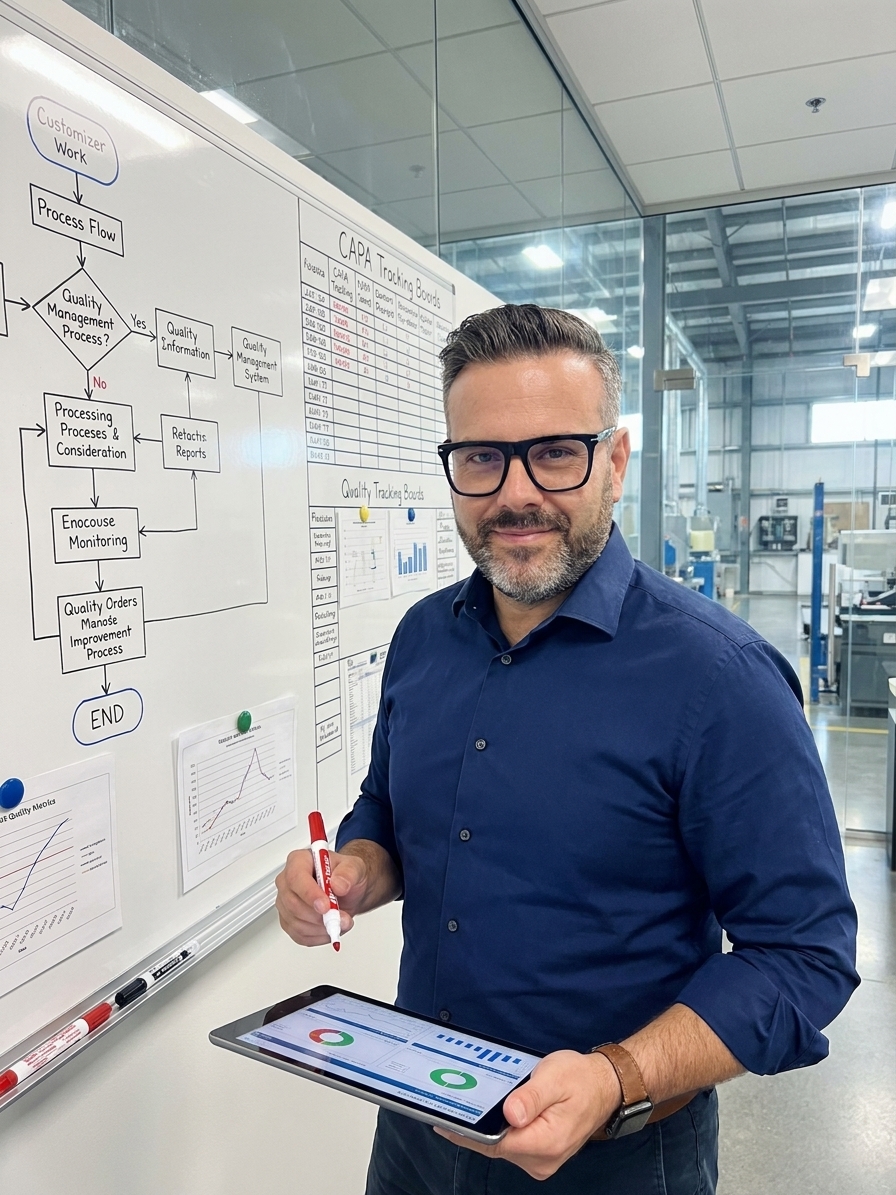
Every manufacturing plant has a recurring meeting where the energy dies. It is the weekly corrective action board or the CAPA review. The intent is to drive closure, but the reality is a litany of 'still pending' updates. The same issues appear week after week while new nonconformances stack on top of old audit findings. The quality manager stops driving improvement and starts drowning in administrative friction.
This is the Zeigarnik Effect at work. In the 1920s, psychologist Bluma Zeigarnik observed that people remember uncompleted or interrupted tasks far better than completed ones. A waiter could recall a complex order perfectly until the bill was paid, at which point the details vanished. Unfinished tasks do not sit quietly. They occupy active cognitive space and create persistent mental tension.
In quality management, this translates directly to the open CAPA log. Each unresolved action item, pending supplier response, and incomplete 8D investigation is a small tax on your team's mental bandwidth. When you accumulate dozens of these open loops across a department, the tax becomes crippling. Quality professionals lose the capacity for deep, focused root cause analysis because their brains are silently processing unresolved backlog.
Why Quality Systems Accumulate Open Loops
Quality work is inherently reactive, making it uniquely vulnerable to cognitive overload. Most activities are triggered by unpredictable failures: customer complaints, internal nonconformances, and audit findings. When a major PRR from the OEM lands on the same day as an IATF 16949 surveillance audit finding, the team does not finish the first before starting the second. They triage, multitask, and open new loops.
Unlike a production order that ships and closes, quality problems rarely have clean endings. Root cause analysis under the 8D methodology is uncertain. Corrective actions need implementation, and effectiveness checks require time to pass. The lifecycle of a genuine quality problem is long and full of false finishes. Moments where you think you have resolved an issue often lead to the discovery of a deeper systemic failure.
The structural demand of standards like ISO 9001, AS9100, and IATF 16949 compounds this ambiguity with documentation. You cannot simply fix the problem on the line. You must document the containment, root cause, corrective action, implementation, and verification of effectiveness. Each of these steps is itself a task that can remain open. The engineering fix might take a day, but the paperwork holds the loop open for a month.

Finally, quality departments are typically understaffed relative to demand. Quality is frequently classified as overhead rather than value-add. The ratio of open problems to available problem-solvers is structurally unfavorable. More open loops per engineer means a higher cognitive tax per engineer, which reduces the department's overall ability to execute deep problem-solving.
The Hidden Cost of the Backlog
Traditional metrics fail to capture the damage of the Zeigarnik Effect. Consider two quality engineers. Engineer A has twelve closed CAPAs and zero open ones. Engineer B has twelve closed CAPAs and fifteen open ones. A standard KPI dashboard rates them similarly. Both closed twelve items. But Engineer B is carrying the cognitive weight of fifteen unresolved investigations.
Every morning when Engineer B opens the QMS, those fifteen open items compete for attention with whatever new problem just arrived. Their effective problem-solving capacity is reduced because their brain is spending processing power on maintaining awareness of issues they are not actively working on. This is how departments with the most open improvement projects often make the least actual progress.
The True Cost of an Open Loop
Cognitive psychology indicates that each open task consumes working memory regardless of its priority. Your brain does not differentiate between an important open task and a trivial one when calculating the Zeigarnik tax. It simply registers 'unfinished' and allocates resources to maintaining that awareness. A trivial CAPA sitting open for eighteen months consumes the same bandwidth as a critical customer complaint that arrived yesterday.
Strategy 1: The Zero Open CAPA Mandate
Closing loops aggressively is the first imperative. I have audited plants where the new Quality Director's first directive was not to train people or implement new software. The directive was to close every CAPA that could be closed in thirty days. The team had to categorize every open item into three buckets based on the actual effort required to achieve documented closure.
The 30-Day CAPA Triage
- 01Bucket A: Paperwork onlyProblem solved, documentation pending. Close within 7 days.
- 02Bucket B: Focused effortNeeds genuine investigation but achievable in 30 days.
- 03Bucket C: ComplexGenuinely requires extended timelines. Escalate and resource accordingly.
- 04Rapid ExecutionDedicate resources to close A and B immediately to free cognitive space.
In one organization, this triage revealed that sixty percent of open items fell into Bucket A. The problems were already solved, but no one had completed the 8D documentation or updated the FMEA. The team had been carrying the cognitive weight of resolved issues simply because the paperwork was lagging. The remaining items were genuine, but the backlog made them look enormous.
In six weeks, the team closed over a hundred and fifty CAPAs. They did not solve a hundred and fifty new problems. They closed a hundred and fifty open cognitive loops. The impact on the team's energy and problem-solving speed was immediate. The engineers reported feeling more capable of tackling the genuinely complex issues that remained on the list.
Strategy 2: Stop Opening Loops You Cannot Close
Prevention is the second strategy. Every time you initiate a formal CAPA, you create an open loop. If you do not have the resources to close it, you are creating future cognitive debt. Not every nonconformance needs a formal corrective action cycle. Some problems can be fixed immediately and documented as a correction.
The distinction between correction and corrective action is critical. A misaligned fixture that can be recalibrated in five minutes does not need a formal root cause investigation. It needs a correction. Reserving the formal CAPA process for systemic issues prevents the system from drowning in low-level administrative tasks. When the default response to any minor nonconformance is to open a CAPA, you build backlog, not discipline.
Establish strict criteria for what requires formal corrective action versus what can be handled immediately. Simple documentation errors do not require a cross-functional 8D team. Clear triage rules at the point of nonconformance detection keep the open loop count manageable. This protects the cognitive bandwidth needed for true root cause analysis on issues that genuinely demand it.
Strategy 3: The Closing Ritual
The third strategy addresses the psychological dimension of quality work. Your team needs to experience the feeling of completion regularly. The brain rewards closure with a dopamine release that reinforces problem-solving behavior. If your quality team never experiences closure because the backlog is too deep, they lose the neurological reinforcement that makes the work feel rewarding.
Implement a weekly closing ritual. Every Friday, gather the quality team for fifteen minutes. Each person shares one loop they closed that week. They do not share what is still open. They do not share what is new. They share what is done. This practice creates a visible record of progress and trains the team to associate quality work with completion rather than endless accumulation.
The open list doesn't create accountability. It creates anxiety, and anxiety degrades problem-solving performance.
Real accountability comes from clear ownership, realistic timelines, and adequate resourcing. Maintaining a massive open list as a 'reminder' is a failure of management. It drives the team toward cognitive exhaustion. Over time, a weekly closing ritual changes the departmental culture. Engineers begin prioritizing closure over initiation. They look for ways to close loops faster instead of documenting them more thoroughly.
Treating Open Loops as Inventory
World-class organizations treat open quality loops like work-in-process inventory. In lean manufacturing, excess inventory is waste. It ties up capital, hides defects, and reduces operational flexibility. Open quality loops are cognitive inventory. They tie up mental capital, obscure real priorities, and reduce the team's ability to respond to new challenges with necessary speed.
Apply the same discipline to closing quality loops that you apply to reducing WIP on the shop floor. Set hard limits. I have worked with automotive suppliers that maintained a rule of no more than ten open CAPAs at any given time. If a new CAPA was required and the list was at ten, the quality manager had to close one or justify why all ten were of higher priority.
This is a deliberate strategy to prevent the Zeigarnik tax from accumulating. In one facility, enforcing this WIP limit reduced average CAPA closure time from ninety days to twenty-three days. Problem-solving effectiveness improved because the engineers were solving issues with clear minds instead of navigating a cluttered backlog. They finally had the mental space to think deeply.