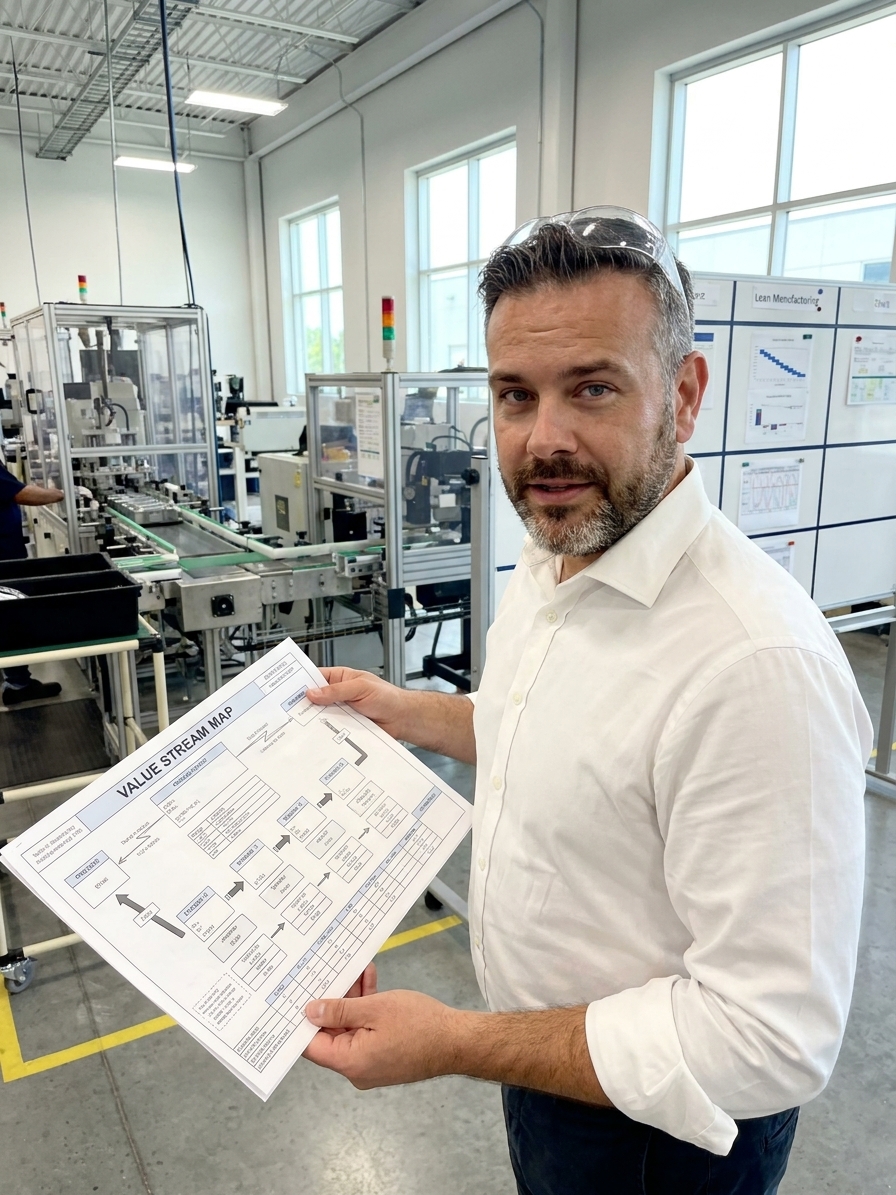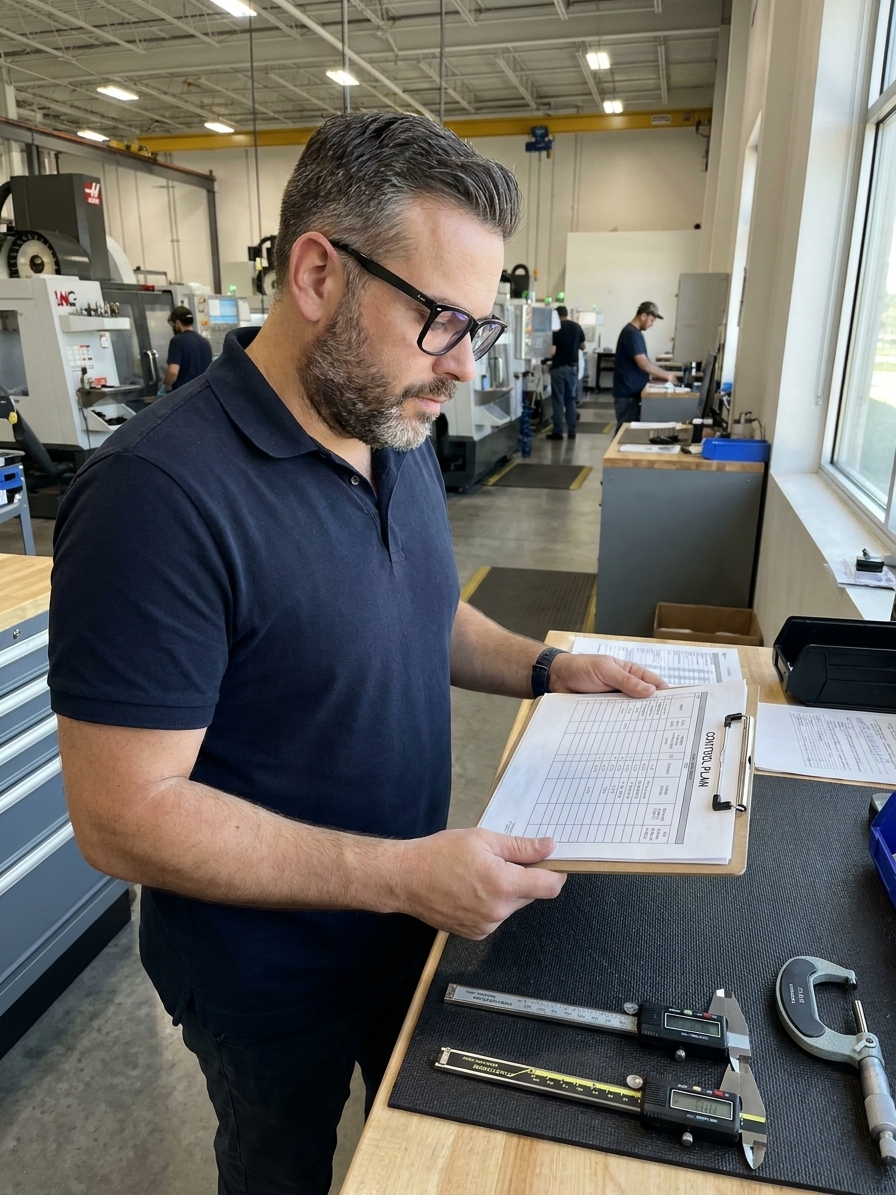
Every automotive supplier has one. Every auditor asks to see it.
Every quality manager has spent hours building one. And on the shop
floor, it sits in a binder — dusty, outdated, and ignored by the very
people it was designed to guide.
The Control Plan.
It is supposed to be the connective tissue between everything your
quality system promises and what actually happens at the machine. APQP
defines the requirements. FMEA identifies the risks. The Control Plan
translates both into specific, actionable controls at each process step:
what to check, how to check it, how often, and what to do when something
goes wrong.
In theory, it is the most practical document in your entire quality
system.
In practice, it has become the most forgotten.
What a Control Plan Was
Meant To Be
Let us start with the intent — because the intent is genuinely
powerful.
A Control Plan is a written summary of how you will control your
process. For each characteristic that matters, it specifies:
- The process step where control occurs
- The characteristic being controlled (dimension,
parameter, attribute) - The control method — what tool, gage, or technique
is used - The frequency — how often you check
- The reaction plan — what happens when the check
fails
That last column is what separates a Control Plan from a checklist. A
checklist tells you what to verify. A Control Plan tells you what to do
when verification fails. It forces the organization to pre-decide its
response rather than improvising under pressure.
When built correctly, a Control Plan is the operational backbone of
process control. It ensures that every critical characteristic
identified during FMEA has a corresponding safeguard on the floor. It
creates accountability — not abstract accountability, but specific
people checking specific things at specific intervals.
And when followed, it works. Defect rates drop. Escapes are caught.
Customers notice.
Where It Goes Wrong
So what happens between the APQP kickoff and the moment the Control
Plan lands in a binder nobody opens?
The answer is almost never malicious intent. Nobody sets out to
create a dead document. But a series of predictable failures transforms
the Control Plan from a living tool into bureaucratic residue.
The copy-paste problem. Most Control Plans are not
written from scratch. They are copied from a previous program, a sister
product, or a template. Someone takes an existing plan, changes the part
number, and ships it. The FMEA was different, the process was different,
the failure modes were different — but the Control Plan stays the same.
Why? Because writing a real one takes days of cross-functional work, and
the customer submission deadline is Friday.
The operating-points disconnect. A Control Plan
should reference the specific process settings validated during the
capability study. But when engineering optimizes the process after PPAP
approval, nobody updates the Control Plan. The document now lists
operating parameters that the machine no longer uses. Operators who try
to follow it are checking settings that were relevant six months
ago.
The reaction plan void. This is the most damaging
failure. The reaction plan column — arguably the entire point of a
Control Plan — is routinely left blank, filled with “notify supervisor,”
or copied verbatim from another row. When an operator finds an
out-of-control condition, they have no pre-defined response. So they do
what humans always do: they make something up. The part gets reworked,
re-checked, or quietly passed. No root cause. No containment. No
learning.
The frequency fiction. Control Plans specify
checking frequencies: every piece, every 5th piece, hourly, per shift,
per batch. But nobody asks whether the organization can actually sustain
that frequency. A plan that calls for hourly checks on a line running
three shifts with one quality technician is mathematically impossible to
follow. So the frequency column becomes an aspiration rather than a
constraint — and everyone knows it.
The APQP Connection Nobody
Makes
Here is something I see consistently across suppliers: the Control
Plan is treated as a PPAP deliverable, not a manufacturing tool.
What does that mean in practice?
It means the quality engineer writes it alone, at a desk, three days
before the submission. They pull the FMEA, copy the characteristics with
high RPN numbers, assign control methods and frequencies from a
template, and format it on the official form. The production supervisor
never sees it. The operator never sees it. The process engineer who
designed the line might review it for five minutes.
Then it goes to the customer as part of the PPAP package. It gets
approved. And it goes into the file.
Six months later, during a customer audit, the auditor asks to see
the Control Plan. The quality manager pulls it from the PPAP binder. The
auditor checks it against the FMEA — looks consistent. The auditor walks
to the floor and asks the operator what checks they perform. The
operator describes a completely different set of measurements, at
different frequencies, using different gages.
Nobody is lying. The operator is doing their job. The Control Plan is
doing its job. They are simply not the same job.
The Hidden Cost of
Control Plan Theater
When the document and the reality diverge, the costs accumulate
quietly — but they accumulate significantly.
Audit findings that should have been preventable.
Customer and certification auditors increasingly go to the gemba. They
do not just read the plan; they watch the process. When the plan says
“check every 10 pieces” and the operator checks whenever the spirit
moves them, that is a major nonconformance. It does not matter that your
quality system is otherwise solid. The gap between paper and practice is
the finding.
Escapes that the plan was designed to catch. Every
Control Plan characteristic was selected because an FMEA identified a
failure mode. When those controls are not performed — or are performed
incorrectly — the exact defects the plan was designed to prevent slip
through. The customer finds them. You issue an 8D. The 8D’s corrective
action? “Update Control Plan and retrain operators.” You are now fixing
the document you should have been using all along.
Capability degradation that goes undetected. A
functioning Control Plan generates data — checksheet readings, SPC chart
points, gage measurements. This data is how you detect process drift
before it produces defects. When the plan is not followed, you lose
visibility. The process degrades silently. By the time a defect appears,
the drift has been happening for weeks.
The credibility tax. When shop floor personnel know
the Control Plan is fiction, it erodes trust in the entire quality
system. If this document is theater, why should they believe the work
instructions? The standard work? The visual aids? One dead document
casts doubt on every document.
What a Living Control
Plan Looks Like
I have seen Control Plans that work. They are rare, but they exist —
and they share specific characteristics that distinguish them from the
paper-only variety.
Built cross-functionally, not in isolation. A real
Control Plan is created in a room with the process engineer, the quality
engineer, the production supervisor, and ideally an experienced
operator. Each person brings knowledge the others lack. The engineer
knows the process settings. The supervisor knows the staffing
constraints. The operator knows what actually happens during a shift.
Without all three perspectives, the plan is guesswork.
Updated when the process changes, not when the auditor
visits. Process changes trigger Control Plan updates. New
tooling, revised parameters, a different material lot, feedback from
capability studies — each of these should prompt a review. The plan is
version-controlled, dated, and communicated to the floor. It is a
controlled document in the truest sense: controlled because it reflects
current reality.
Reaction plans that are specific and actionable.
Instead of “notify supervisor,” a living reaction plan says: “Stop the
line. Tag the last 5 parts for 100% inspection. Call maintenance to
check the fixture pressure. Document on Form QC-207.” An operator
reading that knows exactly what to do. No ambiguity. No
improvisation.
Frequencies that match available resources. Before
specifying “check every 5 parts,” someone verifies that the operator has
time to perform that check every 5 parts. If they do not, the frequency
is adjusted, or additional resources are allocated. The plan is honest
about what the organization can sustain.
Connected to the FMEA and the work instructions.
Characteristics flow from FMEA to Control Plan to operator work
instructions — one unbroken chain. Change one, and the others are
reviewed. This integration is what makes the quality system function as
a system rather than a collection of independent documents.
The Operator Problem
Here is a truth that quality professionals do not like to discuss:
most operators have never read their own Control Plan.
They may have seen a summary posted at the workstation. They may have
been trained on specific checks during new-hire orientation. But the
full document — the one with every characteristic, every frequency,
every reaction plan — lives in the quality office.
This is not necessarily wrong. Operators do not need the full
document. They need the relevant information extracted into tools they
can actually use: visual work instructions, mistake-proofing devices,
in-process checksheets, SPC charts with clear control limits.
But the extraction must be accurate. And it must be maintained. When
the Control Plan changes, the floor-level tools must change too. This is
where most organizations fail. The quality engineer updates the Control
Plan in the PPAP file, but the checksheet at the machine still reflects
the old version. The visual aid on the post still shows the old
dimension. The operator is following outdated instructions, and nobody
realizes it until a defect escapes.
Practical
Steps to Resurrect a Dead Control Plan
If your Control Plans are currently binder decoration, here is how to
bring them back to life.
Audit the gap. Pick one production line. Pull the
current Control Plan. Go to the floor. Watch the process for a full
shift. Document every discrepancy: missing checks, wrong frequencies,
outdated parameters, missing reaction plans. This gap analysis will be
uncomfortable — and that discomfort is exactly what you need.
Walk the FMEA to the floor. Take the process FMEA
and physically walk each process step. Ask: “Where is the control for
this failure mode?” If the operator cannot show you, the control does
not exist — regardless of what the plan says. Document the gaps and
prioritize closing them.
Simplify reaction plans. Review every reaction plan
in your Control Plans. If any says “notify supervisor” or “see quality
manager,” rewrite it. A reaction plan should be executable by the
operator without requiring a committee meeting. If it requires
escalation, specify who, how fast, and what the operator does while
waiting.
Create a living review cadence. Control Plans should
be reviewed at a defined frequency — typically quarterly for stable
processes and monthly for new or changed processes. This review is not a
paperwork exercise. It is a cross-functional discussion: What changed?
What new failure modes have emerged? What data suggests the current
controls are insufficient?
Measure compliance, not just existence. Having a
Control Plan is not evidence of control. Following it is. Build a
layered audit process that verifies Control Plan execution on the floor,
not just document presence in the file. When auditors check compliance,
they should find operators who know their checks, perform them at the
right frequency, and know what to do when something is wrong.
The Digital Opportunity
For organizations ready to move beyond paper, digital Control Plans
offer a significant advantage. A digital plan connected to measurement
systems can automatically verify frequencies, flag missed checks, and
trigger reaction plans in real time. It eliminates the gap between the
document and the floor because the document IS the floor interface.
But technology is not a substitute for getting the fundamentals
right. A digital Control Plan with copy-pasted content and blank
reaction plans is just a more expensive version of the same problem. Fix
the content first. Then digitize.
The Real Question
The real question is not whether you have a Control Plan. Every
supplier does. The question is whether your Control Plan reflects what
actually happens on your shop floor right now — today, this shift, at
this machine.
If you cannot answer that question with confidence, you do not have a
Control Plan. You have a document. And the difference between the two is
the difference between controlling your process and hoping your process
controls itself.
Peter Stasko is a Quality Architect with over 25
years of experience in automotive and industrial quality management. He
has built and audited quality systems across multiple continents, seen
Control Plans at their best and at their worst, and believes that the
distance between your documents and your shop floor is the most honest
measure of your quality system’s health.