You have a defect on the line. Your quality team assembles in the conference room, opens the 8D template, and begins the disciplined march through the Eight Disciplines. You define the problem, contain it, identify the root cause, implement corrective action, and verify effectiveness. The bearing failure on Line 7 gets traced to a contaminated lubricant batch. The corrective action is implemented, Cpk returns to 1.33, and the defect rate drops to zero.
Then a fundamentally different problem shows up. Customer complaints about inconsistent quality arrive simultaneously from three different markets. Your internal IATF 16949 audit data looks pristine, and the complaints do not match any recognizable pattern. Your team opens another 8D, follows the same structured process, and six weeks later produces a beautifully documented investigation concluding with 'root cause undetermined' and a corrective action demanding 'continued monitoring.'
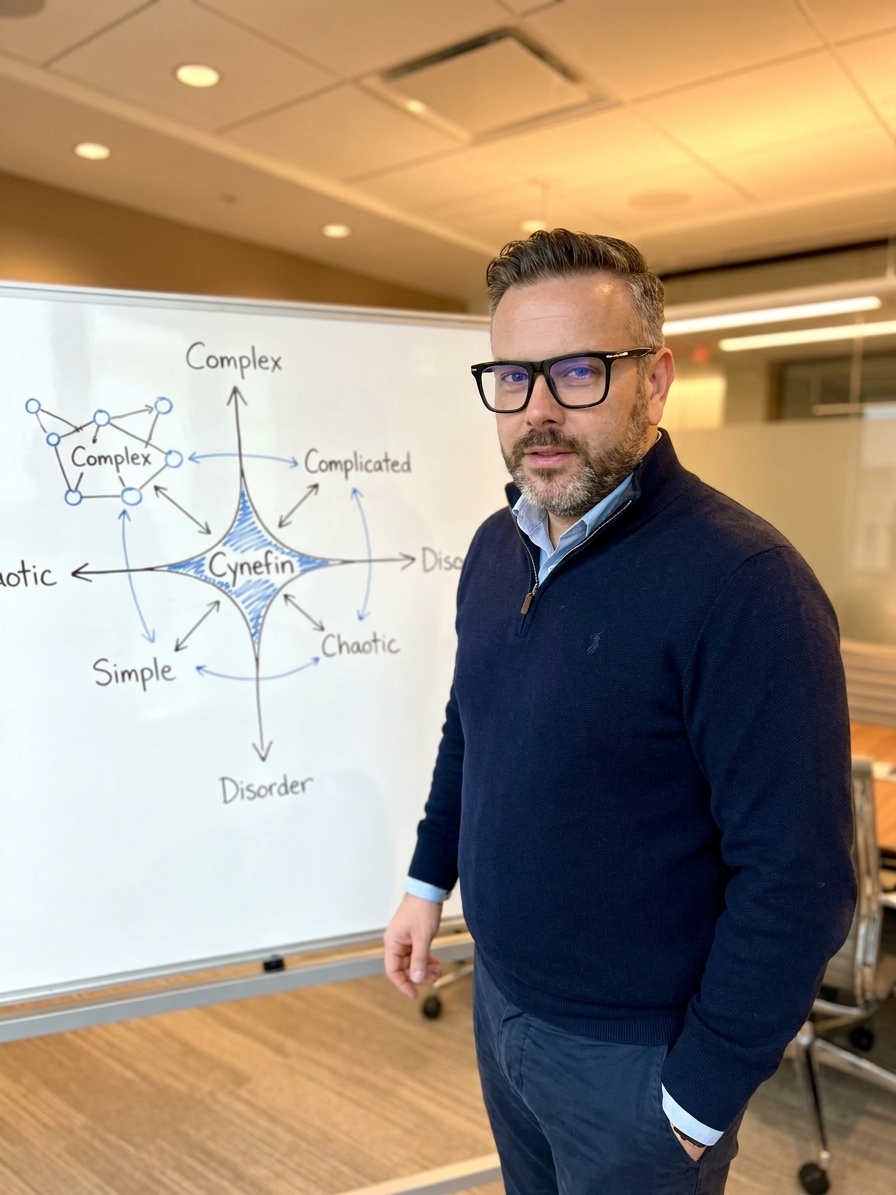
The tool was not inherently wrong; the application was. Organizations repeatedly apply linear problem-solving methods to non-linear problems because their management systems, governed by standards like ISO 9001, treat all failures as if they possess an easily identifiable root cause. The Cynefin Framework, a sense-making model developed by Dave Snowden, forces leaders to diagnose the problem type before selecting the methodology.
Sense-Making and the Five Domains
The Cynefin Framework divides situations into five domains, each demanding a distinct strategic response. In the Clear domain, cause and effect are obvious. You sense the situation, categorize it based on known parameters, and respond with established best practices. This is the natural habitat of standard work and the 8D process.
In the Complicated domain, cause and effect exist but require expert analysis to connect. You sense the situation, analyze it using good practices, and respond. This is where techniques like Design of Experiments (DOE) and advanced statistical analysis earn their keep. There is still a single right answer, but finding it requires deep technical knowledge.
The Complex domain is where linear quality systems fail. Here, cause and effect are only apparent in retrospect. There is no single right answer, only emerging patterns. The correct approach is to probe (run safe-to-fail experiments), sense what happens, and respond based on the outcome. Reductionist root cause analysis is actively destructive here.
The Five Domains of Problem Solving
- ClearSense, categorize, respond. Apply best practices. Standard for routine manufacturing defects.
- ComplicatedSense, analyze, respond. Apply good practices. Requires expert engineering investigation.
- ComplexProbe, sense, respond. Emergent practices. Interacting variables, no linear root cause.
- ChaoticAct, sense, respond. Novel practices. Crisis management and immediate containment.
- ConfusionThe starting state. Gather data to break the situation into one of the four actionable domains.
The Clear and Complicated Domains
A turned shaft arrives at inspection measuring 47.82 mm instead of the specified 48.00 ±0.05 mm. The operator measures it, flags it as non-conforming, and the CAPA process triggers. The root cause is identified as tool wear on the lathe, and the corrective action adjusts the tool change interval. This is the Clear domain, and your existing quality system—PFMEA, control plans, SPC—handles it perfectly.
Consider a PCB assembly with an intermittent failure rate of 0.3% that appears only after 200+ hours of field operation. SPC charts show nothing. An electrical engineer traces the failure to a micro-crack in a specific via caused by a subtle change in the board manufacturer's lamination process. This is the Complicated domain. The cause-and-effect relationship was obscured, but existed. It required patient investigation and technical rigor to uncover.

Most quality professionals are highly comfortable operating in these two domains. DMAIC excels here. We break the system down into its constituent parts, analyze the variables, optimize them, and implement controls. The breakdown occurs when a problem emerges that lacks a linear root cause, and the team forces it into a Complicated framework anyway.
The Complex Domain: Where Standard Tools Fail
A Tier 1 automotive supplier implements a new quality management system. They document every process, train every operator, and pass their IATF 16949 surveillance audit with zero nonconformities. Over the next eighteen months, their customer PPM (Parts Per Million) complaint rate doubles. Root cause analysis reveals nothing definitive. The operators followed procedures, and inspections were performed.
The problem emerged from the interaction of multiple factors—shift communication rhythms, slight delays in escalation, and subtle shifts in process ownership created by the new documentation requirements. This is the Complex domain. There is no single root cause. There are only interacting variables. Applying 8D root cause analysis to this problem forces a linear narrative onto a non-linear reality.
When you apply DMAIC to a complex organizational problem, the Define phase creates a boundary that artificially excludes the human interactions driving the issue. The Measure phase quantifies easily measurable parameters while completely missing the emergent, cultural properties causing the failures. The Improve phase optimizes a localized subsystem while actively degrading the overall system.
Approaches to Complex Quality Problems
The standard 8D approach
- Forces a single, linear root cause identification
- Implements rigid corrective actions based on initial assumptions
- Excludes interacting human and cultural variables through tight scoping
- Results in shifted blame and recurring systemic failures
The probe-sense-respond approach
- Runs multiple, safe-to-fail experiments simultaneously
- Observed emergent patterns guide the next intervention
- Adjusts shift communication protocols without rewriting procedures
- Amplifies successful behaviors while dampening ineffective routines
Responding to Chaos and Shift
A plant discovers that a critical safety component has been produced with an unapproved material substitution for three weeks. The parts are already in the field, and the failure mode is catastrophic. This is the Chaotic domain. There is no time for DOE or cross-functional analysis. The priority is to act immediately to establish stability and prevent harm.
Your quality response here is containment. You recall the parts, quarantine the inventory, notify the customer per AS9100 or IATF requirements, and halt the line. A CAPA system requiring three levels of management approval before action is dangerous in this scenario. The best organizations build crisis-response pathways that bypass normal governance, granting pre-authorized power to stop production.
Problems rarely stay in one domain. A Chaotic crisis, once contained, shifts into a Complex problem as you begin to investigate the systemic gaps that allowed it. As patterns emerge, it shifts into the Complicated domain for rigorous engineering analysis. Finally, it settles in the Clear domain where new standard work prevents recurrence. Your methodology must evolve as the problem shifts.
Forcing complex organizational problems into a linear 8D framework doesn't resolve them; it simply makes you feel better about not solving them.
Diagnosis Before Solution
I have audited plants where highly capable engineers were burning out because they were applying Complicated-domain tools to Complex problems. Before opening an 8D template, teams must diagnose the environment. If a team member says 'we have seen this before,' it is a Clear problem. If they say 'I have some hypotheses,' it is a Complicated problem requiring systematic investigation.
If the team says 'something is wrong but the pieces do not add up,' they are sensing a Complex problem. The correct response is to probe and experiment rather than force a root cause analysis. Developing this shared pattern language allows teams to quickly align their problem-solving approach with the reality of the failure mode on the shop floor.
Training must focus heavily on this diagnosis phase. Teach people how to identify the problem type before teaching them how to deploy the solution toolkit. A brilliant Kepner-Tregoe investigation applied to a Complex cultural problem is wasted effort. A well-designed safe-to-fail experiment applied to a Clear tool-wear issue is unnecessary complexity.
Building an Adaptable Quality System
Reductionism—breaking systems into parts and optimizing each one—built modern quality management. It delivered Six Sigma processes, zero-defect manufacturing, and ISO 9001 consistency. But the problems that remain, the systemic failures that drive escapes and customer dissatisfaction, do not yield to reductionist thinking. They emerge from the complexity of your supply chain and organizational culture.
Quality leaders must diversify their organizational toolkit. If your management system only contains tools for the Clear and Complicated domains, it will fail when complexity arrives. Invest equally in capabilities for the Complex domain: experimentation frameworks, narrative sense-making methods, cross-functional collaboration skills, and the leadership behaviors required to tolerate ambiguity.
Your organization does not need more rigorous corrective action procedures. It needs better diagnostic capability. The next time a defect appears, pause before opening the 8D template. Determine if the cause is obvious, if it requires expert analysis, if it requires iterative probing, or if the facility is on fire. That initial diagnosis determines everything that follows.