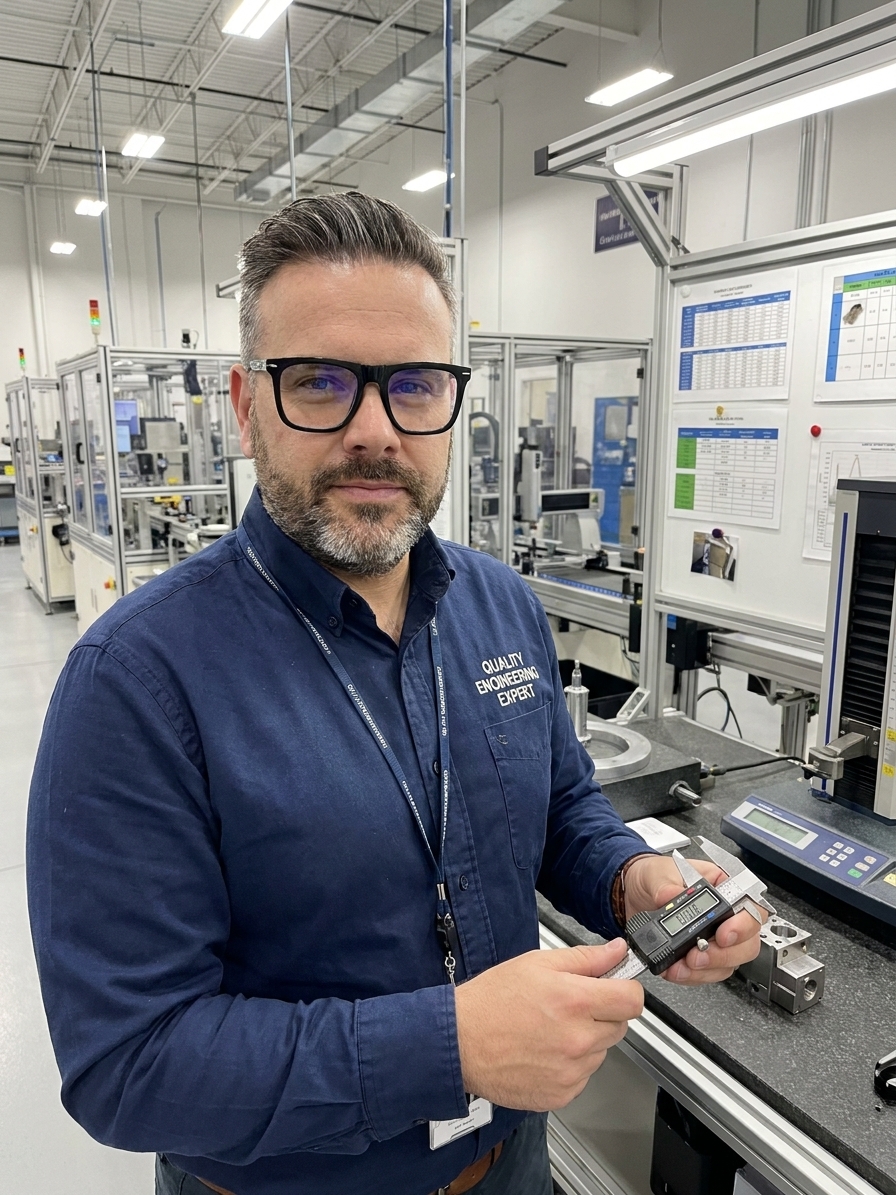
An inspector working a standard eight-hour shift will make hundreds of conformity decisions. Visual checks, dimensional verifications, and surface quality assessments each require deliberate analytical effort. By early afternoon, the cognitive reserve required to weigh evidence against acceptance criteria is severely depleted.
A borderline part reaching the station at 14:45 gets judged under fundamentally different cognitive conditions than the first part of the day. Under optimal conditions, the inspector pulls the reference sample and compares it under proper lighting. After 400 prior decisions, the brain switches to energy conservation mode. The inspector passes a marginal part without even realising the rigour is gone.
Three weeks later, that part drives a customer warranty claim. The 8D root cause analysis traces the failure back to a single human decision that was neither negligent nor malicious. It was simply tired. I have audited plants where the entire continuous improvement pipeline was chasing process variables, completely blind to the reality that inspector cognition is a depleting resource.
Decision fatigue is the deterioration of decision quality after a long session of making choices. It is a fundamental limitation of human neurology. Your IATF 16949 or AS9100 quality system is built squarely on top of this finite biological constraint, whether you acknowledge it or not.
The Mechanics of Cognitive Depletion
The prefrontal cortex operates on a limited daily energy budget. Each time an engineer signs off on a corrective action or an inspector judges a surface finish, that resource drains. The brain does not stop deciding when the budget runs out. It simply starts deciding poorly.
The mechanism is well-documented. In a landmark study of parole board decisions, experienced judges granted parole in roughly 65 percent of cases at the beginning of the day. That approval rate dropped to nearly zero just before a scheduled meal break, then immediately rebounded afterward. The merit of the cases remained constant. The variable was the judge's cognitive depletion level.
Translate that directly to the quality floor. When cognitive resources run low, the brain abandons careful analysis and relies on heuristics. Satisficing takes over: the inspector accepts the first option that looks reasonably good rather than evaluating the part against all seven points of the visual control plan.
Anchoring compounds the problem. If the previous five parts were acceptable, the brain assumes the sixth is acceptable too. Fatigued decision-makers also become highly susceptible to interpersonal pressure. A supervisor's glance toward the production schedule is enough to push a depleted inspector toward an acceptance call.

Detecting Fatigue Signatures in Your Quality Data
The symptoms of decision fatigue are already hiding in your quality management system data. The most common indicator is the afternoon drift. Defect detection rates peak during the first two hours of a shift and gradually decline as cognitive reserves drain.
Quality managers frequently misdiagnose this pattern. They attribute the detection drop to lighting changes, batch variation, or operator fatigue. They launch PPAP reviews and equipment calibrations. But a significant portion of this decline is pure cognitive depletion, and no amount of measurement systems analysis (MSA) will correct it.
The default drift toward acceptance is another red flag. Rejecting a part requires justification, documentation, and confrontation with the production team. Accepting requires none of that. When the brain's energy is low, it defaults to the path of least resistance. Decision fatigue does not make inspectors reckless. It makes them agreeable.
The Afternoon Conformity Decline
Organisational Practices That Amplify the Problem
Many standard management practices actively accelerate cognitive depletion without anyone realising it. The worst offender is the quality bottleneck. When every nonconformance, deviation, and borderline call must route through a single quality manager, that person becomes a decision factory. By mid-afternoon, they are not making quality decisions. They are making exhausted decisions that happen to be about quality.
Context switching imposes an even heavier cognitive tax. A quality engineer who jumps from an internal audit finding to a supplier dispute to a customer complaint pays a substantial mental penalty on every transition. The metabolic cost of shifting analytical frameworks is significantly higher than making the same number of decisions within a single domain.
Meeting-heavy corporate cultures waste the analytical hours before the shift even touches the product. An engineer who spends three hours in morning management meetings making dozens of micro-decisions arrives at the first PFMEA review of the day already depleted. You are assigning your most critical analytical work to an exhausted brain.
The high-stakes nature of safety-critical components makes the situation worse. The stress of knowing a regulatory submission or aerospace part carries severe consequences actually depletes cognitive resources faster. The decision quality deteriorates most rapidly precisely when the stakes are highest.
Engineering the Decision-Aware Process
You cannot eliminate decision fatigue through training or discipline. It is human neurology. But you can design process controls that compensate for it. This means applying poka-yoke principles not just to the hardware, but to the human cognitive load required to run it.
Reduce ambiguity at the inspection station. Go/No-Go gauges replace the cognitive burden of a dimensional measurement. Limit samples with physical accept and reject boundaries remove the need to mentally compare a part against a printed specification. Digital checklists enforce sequence, preventing the shortcut cascade where a seven-point inspection silently degrades into a three-point glance.
Error-proofing isn't just about preventing mistakes. It's about reducing the decision burden that makes mistakes more likely.
Audit your control plans for decisions that do not require human judgment at all. Every automated optical inspection, every measurement that triggers an automatic machine reject, is a cognitive conservation measure. These automations preserve the inspector's daily cognitive budget for the complex, borderline judgments that genuinely require human expertise.
Rotation is essential process design. No inspector should execute the same high-density visual judgment for more than ninety minutes without a structural break. This does not mean standing idle. It means switching to a different cognitive activity, such as updating equipment calibration records or sorting raw material, before returning to the line.
Scheduling and Tracking Critical Decisions
If you have high-consequence inspections — safety-critical automotive welds, aerospace sub-assemblies, regulatory submissions — schedule them for the beginning of shifts. When your most important conformity decisions are made at 15:00 simply because that is when the parts arrive, you have a scheduling problem masquerading as a quality problem.
Redesigning the Inspection Shift
- 01Shift startAssign critical safety and regulatory inspections first
- 0290-minute markRotate to low-density tasks like calibration or documentation
- 03Mid-shiftNutrition break to restore blood glucose and analytical function
- 04Afternoon blockLeverage automated gauging and strict go/no-go limits
The metabolic component is equally critical. Blood glucose levels directly affect analytical performance. If your quality inspectors are working straight through eight-hour shifts without scheduled, unrestricted access to nutrition, you are not saving labour hours. You are borrowing afternoon defect escapes to pay for morning efficiency. Short, frequent breaks with complex carbohydrates measurably improve downstream detection rates.
Finally, start tracking decision timing in your quality data. If your SPC charts show a predictable time-of-day pattern in inspector variation, you have found the fatigue signature. If your nonconformance reports and 8D root causes cluster heavily in the afternoon, you have confirmation. The data is already being captured in your QMS. You simply need to query it against the shift clock.
Leading the Finite System
Every quality leader has experienced decision fatigue. You recognise the foggy state at the end of a day filled with back-to-back audits, capability studies, and supplier escalations. You know your own judgment is sharper at 08:00 than at 17:00. Most leaders naturally protect their own cognitive state by deferring critical emails or taking walks between confrontational meetings.
The challenge is extending that same structural understanding to every operator and inspector on the floor. Your personnel are not sensors. They do not possess infinite measurement capability. They are biological instruments with a strictly limited daily budget for the exact kind of analytical judgment your IATF 16949 system demands.
Every control plan you approve, every shift schedule you authorise, and every workload you assign either respects this biological constraint or ignores it. Organisations that engineer their processes around cognitive capacity do not just achieve better Cpk targets. They build quality systems that remain robust and sustainable across the full length of every working shift.