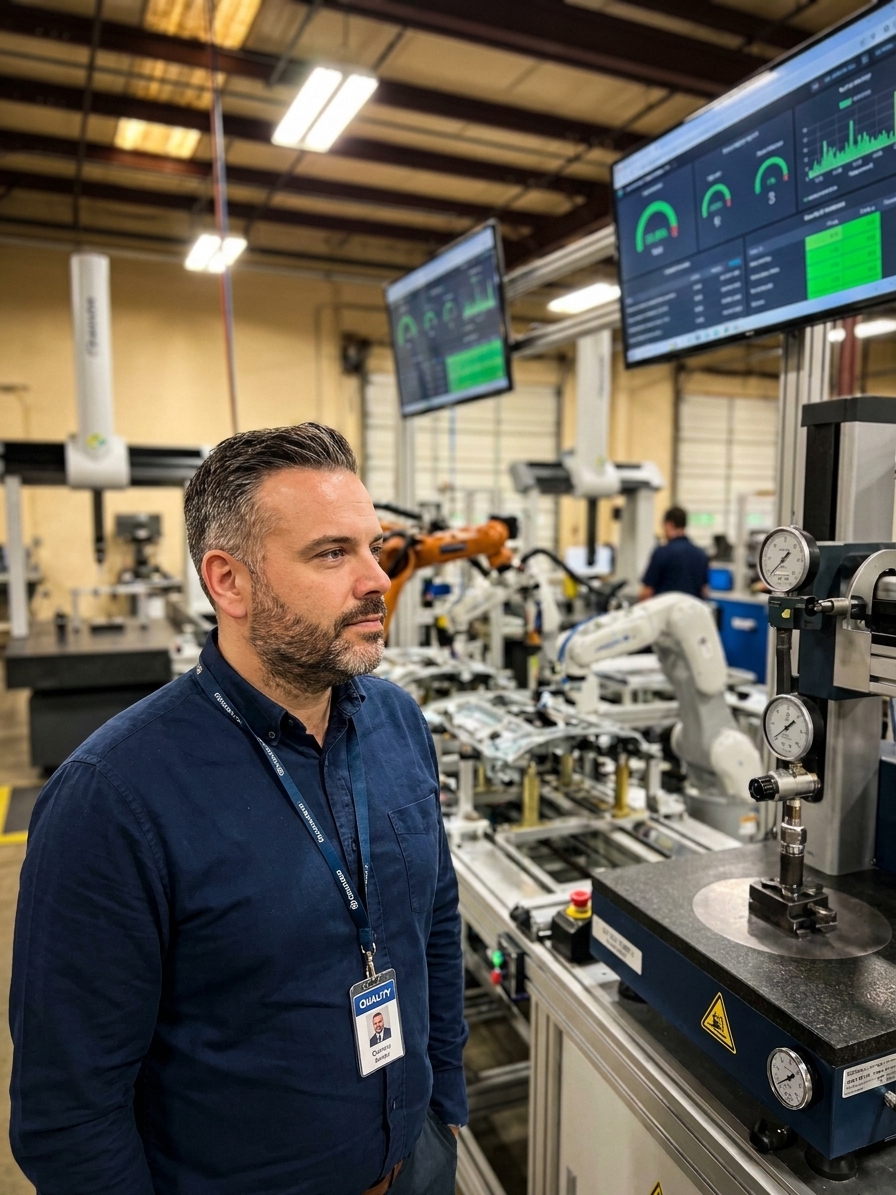
There is a defect on your production line right now that your team has stopped seeing. It did not disappear. No one fixed it. It is still there: visible, measurable, recurring every single shift. But the operators and inspectors who walk past it daily have categorised it differently than they did during the first encounter. Where it once triggered containment and 8D root cause analysis, it now triggers nothing.
In psychology, this is the Mere Exposure Effect. First described by researcher Robert Zajonc in 1968, the principle is simple: people develop a preference for things simply because they are familiar with them. The more a human encounters a stimulus, the more positively they evaluate it. The brain decides that familiar equals safe, or at least acceptable.
In quality management, this translates to the systematic normalisation of deviations. I have audited plants where chronic defects had been absorbed into standard shift handovers. These failures become invisible without a single management decision or policy change. The quality system fails not because the tooling broke, but because the observer adapted.
The Mechanism of Perceptual Erosion
The human brain optimises for cognitive efficiency. When you encounter an unfamiliar process deviation, the brain treats it as a threat. It allocates attention, triggers investigation, and demands an explanation. This alarm response is your IATF 16949 or AS9100 quality system working exactly as designed.
However, the brain rapidly learns to suppress responses to predictable stimuli. The second time a defect appears, the threat allocation is smaller. By the tenth occurrence, the deviation is reclassified as background noise. The neural pathways that initially fired in alarm have been dampened by repetition.
This is not carelessness, negligence, or a failure of training. It is a fundamental feature of human cognition. The defects most likely to escape your quality system are not the new, surprising anomalies. They are the old ones. The recurring ones. The ones your team has seen so many times that they no longer generate the signal that says this is wrong.
How Conventional Tools Miss Chronic Failures

Standard quality tools share a critical assumption: that the people operating the system can still perceive the defect. Control charts are only as good as the data fed into them. When operators stop perceiving a deviation as abnormal, they stop recording it. The chart shows stability, masking a process that is chronically out of control.
PFMEAs are living documents in theory, but static artifacts in practice. The failure modes identified during initial analysis capture the team's perception at a specific moment in time. As familiarity sets in, risk priority numbers assigned to recurring failures lose their relationship to actual risk.
Layered process audits suffer the same fate. Auditors exposed to the same deviation across multiple cycles experience perceptual adaptation. A critical nonconformity flagged in audit one becomes a minor observation in audit five. By audit twenty, it is noted as standard practice, requiring no action.
The Four Phases of Defect Normalisation
- 01AlarmA new defect appears. Containment is deployed and management is notified. The system reacts with urgency.
- 02ToleranceThe defect recurs. Operators develop informal workarounds. The emotional charge diminishes with each shift.
- 03IntegrationThe defect becomes a routine characteristic. It is treated as a known quirk of the machinery rather than a failure.
- 04InvisibilityThe defect is entirely absorbed into standard training. The team loses the cognitive ability to classify it as wrong.
The Accounting Cost of Acceptance
The financial impact of normalised defects is difficult to quantify because the accounting systems tracking quality costs suffer the same drift as the operators. When a defect is reclassified from a problem to a characteristic, it stops being counted as a quality cost. It becomes standard operating expense.
The cost of the workaround, the rework, and the material waste disappears into the baseline. The organisation loses the ability to see what it is actually spending on problems it has chosen to tolerate. This often masks the true cost of poor quality, inflating perceived OEE and skewing profitability metrics.
You can observe the symptoms in your customer complaint data. Customers do not suffer from the Mere Exposure Effect. They encounter the defect for the first time. What your internal team dismisses as a managed characteristic, your customer experiences as a critical failure. Escalating complaints about issues your plant considers resolved is the signature of internal adaptation.
Disrupting the Effect: Engineering Countermeasures
The Mere Exposure Effect cannot be eliminated, but it can be counteracted through deliberate QMS interventions designed to restore perceptual freshness. The most effective weapon against adaptation is rotating the observers.
Implement a rotation system where auditors, inspectors, and quality engineers regularly swap lines and product families. No one should audit the same process for more than two consecutive cycles. The person seeing a recurring defect for the first time will perceive it with the alarm that the regular team has lost.
Introduce variability into how quality data is presented. The brain stops responding to predictable formats. Change the layout of dashboards periodically. Reverse the axes on a control chart. Group defects by a different taxonomy. The goal is to prevent automatic processing mode and force deliberate cognitive engagement.
The quality system's greatest vulnerability isn't the novel catastrophic failure; it's the familiar, chronic one.
Fresh Eyes and Automated Detection
Build a structured process for capturing the observations of new employees and temporary workers. Their insights are invaluable precisely because they have not been through the exposure cycle. Formalise a first-30-days interview where a quality leader systematically captures what surprised the new hire before their perception adapts.
The Mere Exposure Effect operates at the level of human judgment. Detection, the raw perception that something is different, is more resistant but still flawed in people. Separate these two functions. Automated inspection systems and statistical process controls do not suffer from perceptual adaptation.
A machine vision system flags a deviation on the hundred-thousandth part with the same urgency as the first. Use technology to handle detection and reserve human judgment for the decisions that actually require context and interpretation.
Anatomy of an Invisible Defect
Leadership and the Perpetual Challenge
The Mere Exposure Effect impacts leaders and managers with equal force, but greater consequences. A quality director who has reviewed the same complaint data for three years is less likely to champion a project to fix it. Familiarity at the executive level shapes the resource allocations and capital expenditure priorities of the entire organisation.
Leaders must actively cultivate their own perceptual freshness. This means visiting the Gemba with the specific intention of seeing what has been stopped seeing. It means reading raw customer complaints directly, rather than relying on filtered summaries that have been sanitised by familiar interpretation.
Schedule quarterly defrost reviews. Convene a cross-functional team tasked specifically with questioning accepted norms. The core question is not what are our quality problems, but what are the quality problems we have stopped talking about. This forces the team to consciously simulate the state of perceptual freshness that repetition has stolen.
The most insidious aspect of this effect is that it mimics process maturity. When a team stops reacting to recurring defects with alarm, it looks like composure. When metrics stop fluctuating, it looks like control. Do not confuse comfort with competence. The defect you have stopped seeing is the one costing you the most.