A quality director sets a corporate objective to reduce customer PPM by forty percent. Six months later, the final inspection team has tripled its sorting capacity, overtime costs have exploded, and customer complaints remain unchanged. The strategic intent was sound, but the translation mechanism was broken. This is the most expensive invisible failure in manufacturing: the gap between executive intent and operational reality.
Organisations routinely confuse goal cascading with strategy deployment. They issue targets downward through management layers, assuming the instructions retain their original context. They do not. Each management layer subconsciously translates strategic targets into locally manageable metrics, fundamentally altering the required action. Without a structured deployment framework, the translation error compounds at every layer.
Hoshin Kanri solves this by replacing unidirectional target-setting with bidirectional negotiation. Developed in post-war Japan and refined at Toyota, the system forces rigorous dialogue between strategic intent and operational capability. Across two decades in automotive and aerospace quality management, I have never seen a target cascade succeed without this structured pushback mechanism.
How Strategic Intent Mutates Through Management Layers
Diagnostic failure begins with assuming logical alignment exists simply because a target was issued. When a corporate quality goal navigates through operations, logistics, and human resources, each layer optimises for its own constraints. The supply chain team interprets a scrap reduction target as a mandate to source cheaper material. Manufacturing interprets it as a mandate to increase end-of-line inspection.
These local interpretations are not malicious; they are rational responses to conflicting performance metrics. The supply chain manager is evaluated on piece price, while the quality manager is evaluated on defect rates. When a strategic target enters this environment without cross-functional alignment, each department pursues the goal in a way that protects its own KPIs. The net result is organisational paralysis disguised as progress.
The diagnostic test is simple: ask a shift supervisor how their daily actions support the annual quality objective. If the answer involves a different metric or a different timeline than the one published by leadership, the deployment mechanism has failed. The strategic target has been lost in transmission, replaced by locally generated priorities that consume resources without advancing the actual goal.

Identifying the Symptoms of Misaligned Deployment
Misaligned strategy deployment presents measurable symptoms long before the year-end review reveals the failure. The most obvious indicator is the proliferation of disconnected improvement projects. When a plant has twenty active initiatives all claiming to support customer satisfaction, the organisation has substituted activity for focus. Hoshin Kanri demands that resources concentrate on three to five breakthrough objectives, full stop.
Another symptom is the frequency of emergency interdictions. If a quality director spends the majority of their week resolving supplier escalations and production stoppages, the daily management system has failed. In a properly deployed Hoshin Kanri environment, standard work and routine process control handle these deviations, freeing the quality function to focus on strategic breakthroughs rather than firefighting.
Audit findings provide a third diagnostic indicator. Internal audit programmes often reveal the same nonconformances across consecutive cycles. This recurrence signals that the organisation is treating symptoms rather than root causes. Without the rigorous review structure that Hoshin Kanri enforces, corrective actions become paperwork exercises that close findings without addressing the underlying systemic failure.
Diagnostic Indicators of Deployment Failure
Activity Substitution
- Twenty active improvement projects competing for resources
- Quality leadership functioning as primary escalation manager
- Repeat nonconformances across consecutive internal audit cycles
- Targets cascaded vertically without upward operational feedback
Strategic Alignment
- Three to five breakthrough objectives with dedicated funding
- Standard work handles routine deviations autonomously
- Monthly reviews demand 8D-grade root cause analysis evidence
- Catchball negotiation aligns targets with operational reality
The Mechanics of Catchball as a Stress Test
Catchball is frequently misunderstood as a suggestion box for middle management. It is, in reality, an operational stress test. When leadership proposes reducing warranty claims by thirty percent, the engineering and quality teams must evaluate the feasibility against existing capacity, tooling maturity, and supplier capabilities. The negotiation forces both sides to confront constraints and adjust the target or allocate additional resources.
In plants where I have implemented this dialogue, the initial response is often resistance. Middle managers interpret pushback as career risk. Overcoming this requires explicit psychological safety from executive leadership. If a manager identifies a resource gap that makes a target impossible, leadership must address the gap rather than penalise the messenger. Without this safety, catchball produces no real negotiation, only silent compliance.
The output of a successful catchball cycle is a target that every level of the organisation has stress-tested and endorsed. When manufacturing commits to a Cpk improvement target, they do so knowing that maintenance response times and gauge calibration schedules have been factored into the commitment. The target is no longer an executive wish; it is a contract backed by operational reality.
Engineering Out the Translation Gap with the X-Matrix
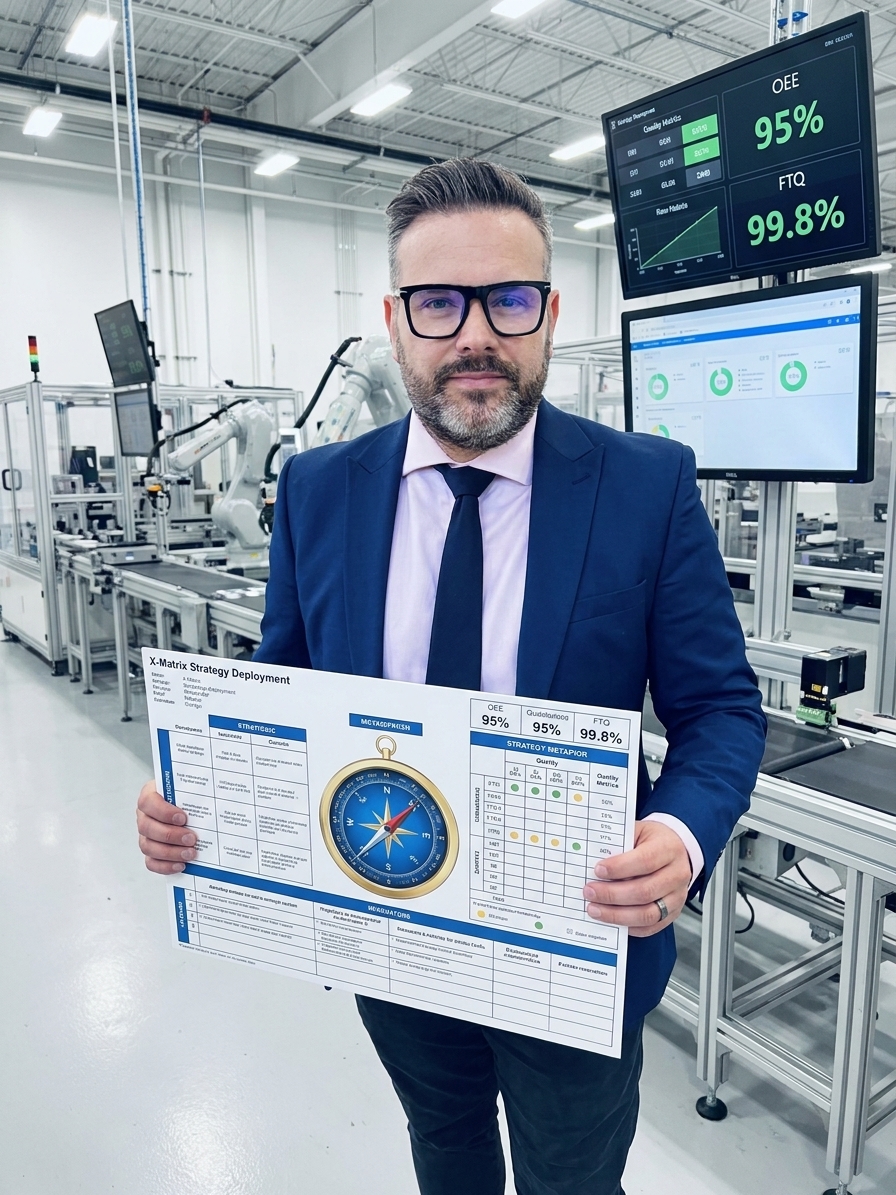
The X-Matrix is the primary diagnostic tool of Hoshin Kanri. It forces leadership to map the complete chain of logic from a long-term strategic vision down to specific shop-floor actions on a single A3 document. The visual layout immediately exposes orphan initiatives, conflicting priorities, and resource constraints that traditional planning documents conveniently obscure.
The bottom quadrant defines the long-term objectives. The left quadrant lists this year's three to five breakthrough priorities. The top quadrant specifies the exact metrics and targets. The right quadrant details the required action plans, project owners, and allocated resources. The corners of the X create intersection points that force leadership to explicitly draw lines connecting these four elements.
The exercise is uncomfortable by design. When a quality team attempts to link their annual Cpk improvement target to a specific action plan, they often discover that the required machine upgrade is not funded. The X-Matrix makes this disconnect visible immediately, rather than allowing it to surface as a missed target in November. The matrix is a mechanism for exposing organisational contradictions before they become operational failures.
A strategic target without an interconnected action plan is not a priority; it is a wish.
Enforcing Strategic Rigour in Monthly Reviews
The review cadence is where deployment survives or dies. Most manufacturing organisations hold monthly performance reviews, but these typically devolve into status reporting. The Hoshin review applies a fundamentally different standard. Each breakthrough objective is interrogated against hard data using the rigor of a formal 8D investigation, not the optimism of a project manager.
When a Cpk target stalls, the review must identify why. 'Supplier quality issues' is not an acceptable explanation. The review demands a verified root cause, corrective actions with named owners, and realistic deadlines. If engineering changed a tolerance without updating the PPAP submission, that systemic failure must be identified and corrected in the review, not buried in a footnote.
I have audited plants that confidently reported green status on strategic targets every month, only to finish the year with customer PPM completely unchanged. The reviews were theatrics. The data was manipulated to avoid conflict, and the systemic issues festered until the annual results exposed the failure. Effective Hoshin reviews prevent this by focusing on process behavior, not project status.
The Monthly Hoshin Review Sequence
- 01Data InterrogationCompare actual performance against the agreed X-Matrix metrics using hard statistical evidence.
- 02Gap IdentificationIf targets are missed, isolate the specific process parameter or systemic failure causing the deviation.
- 03Root Cause AnalysisApply 8D methodology standards; reject anecdotal explanations and demand verified causal evidence.
- 04Corrective AssignmentAssign specific countermeasures to named owners with rigid deadlines, integrating them into daily work.
Sustaining the Deployment Discipline
Embedding Hoshin Kanri requires two to three years of relentless discipline. Organisations commonly abandon the practice during the first year, when the catchball process feels slow and the X-Matrix exposes uncomfortable resource gaps. This is precisely the period when the old habits of target cascading and status reporting fight hardest to survive. Leadership commitment is the only variable that overcomes this resistance.
The integration with daily management is what ultimately sustains the system. Standard work, autonomous maintenance, and real-time process control must feed data directly into the strategic review mechanism. When the daily management system operates effectively, the quality function can finally transition from reactive firefighting to proactive systemic improvement. The strategic targets become a shared organisational reality rather than an executive mandate.
The diagnostic capability of Hoshin Kanri is its most undervalued attribute. It tells an organisation exactly where its strategy is broken and provides the structured framework to repair it. For quality leaders tasked with delivering step-change improvements, it provides the structural integrity required to ensure that strategic intent actually reaches the production line intact.