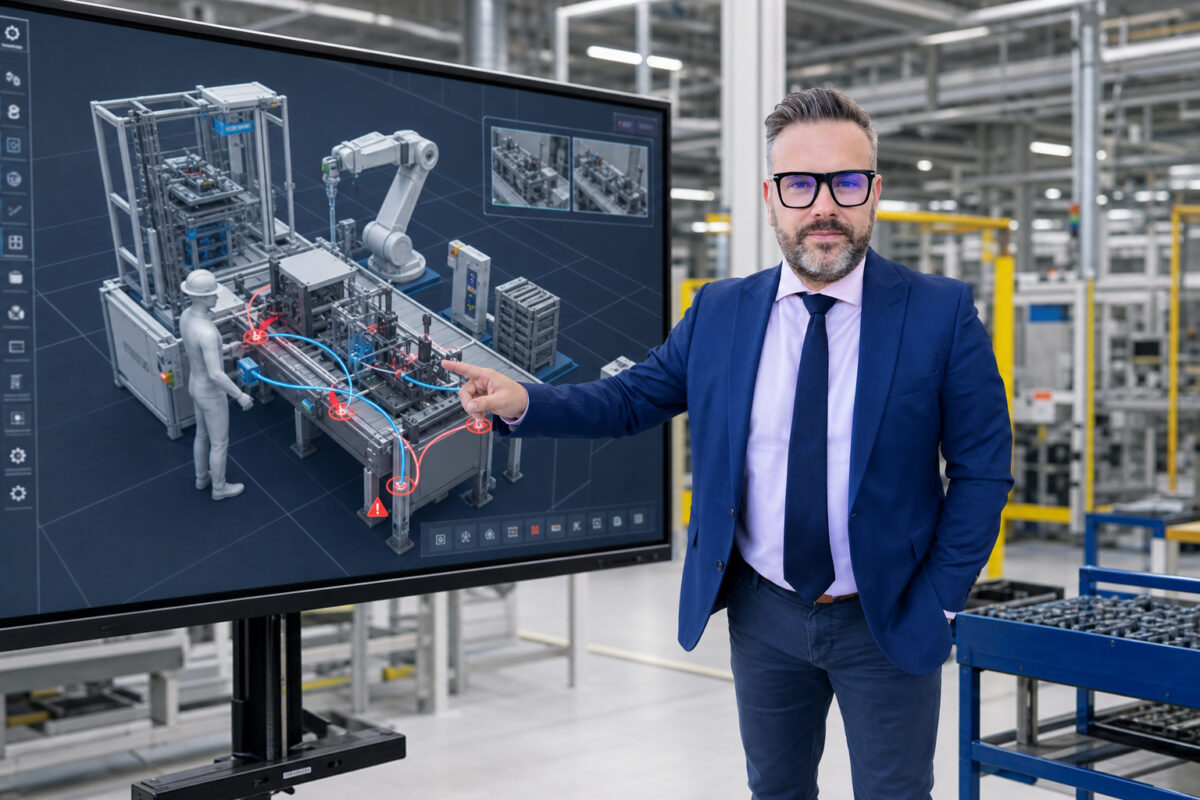
Manufacturing has always tolerated a specific level of human error. You cannot eliminate mistakes entirely, but you can engineer the environment so that errors become impossible to complete. That is the core promise of poka-yoke, formalised by Shigeo Shingo in the 1960s. The objective is to make a defect physically impossible to pass downstream.
What has changed is the toolkit. A new generation of digital twin technology allows engineers to simulate assembly processes, test error-proofing logic, and validate fixture designs before cutting steel. In theory, this collapses the cost of mistake-proofing dramatically. In practice, the technology rarely touches the quality management system.
Across two decades in automotive and aerospace quality, I have seen most manufacturers use digital twins as expensive 3D models. They impress visitors in conference rooms but possess no modelled failure modes. To deliver value, a process twin must bridge the gap between geometric simulation and active defect prevention.
Defining a Quality-Focused Digital Twin
The term digital twin has been stretched to cover everything from a static CAD file to a real-time physics simulation fed by IoT sensors. For the purpose of mistake-proofing, a useful twin must meet three strict criteria. Anything less is visualisation, not engineering. It must actively contribute to the PFMEA.
First, it must represent the physical process with geometric and behavioural fidelity. This goes beyond product geometry. The twin must model the assembly sequence, tool paths, human reach envelopes, and fixture interactions. It must reflect the reality of how the station operates on the shop floor.
Second, a quality-focused twin must simulate error states. A model that only shows the happy path is a marketing tool. It must simulate what happens when a part is loaded upside-down, when a fastener cross-threads, or when an operator skips a station. Modelling these deviations is the entire point of the exercise.
Third, the twin must feed insights back into physical error-proofing devices. Whether adjusting sensor thresholds, repositioning a proximity switch, or rewriting PLC logic, the twin must influence the real poka-yoke implementation. Without this closed loop, the simulation produces no measurable quality outcome.
Designing Error-Proofing Before Steel is Cut
Traditionally, error-proofing devices are designed and built during tooling tryout. This is late in the launch phase, when changes are expensive and schedules are compressed. A process twin shifts this left. It allows engineers to test whether a proposed poka-yoke mechanism actually works in software, long before committing to physical fixtures.
Consider an automotive tier-one supplier building a new assembly cell. The engineering team models the housing, the fixture, the robot, and the operator reach. They simulate multiple loading scenarios, including several incorrect orientations. The simulation reveals that two incorrect orientations would falsely pass a proximity sensor check.
The false pass occurs because the housing geometry presents a reflective surface at a similar distance to the correct orientation. Acting on this simulation data, the sensor gets repositioned and a mechanical locater pin is added. The fixture is manufactured with the error-proofing already optimised, rather than relying on post-launch firefighting.
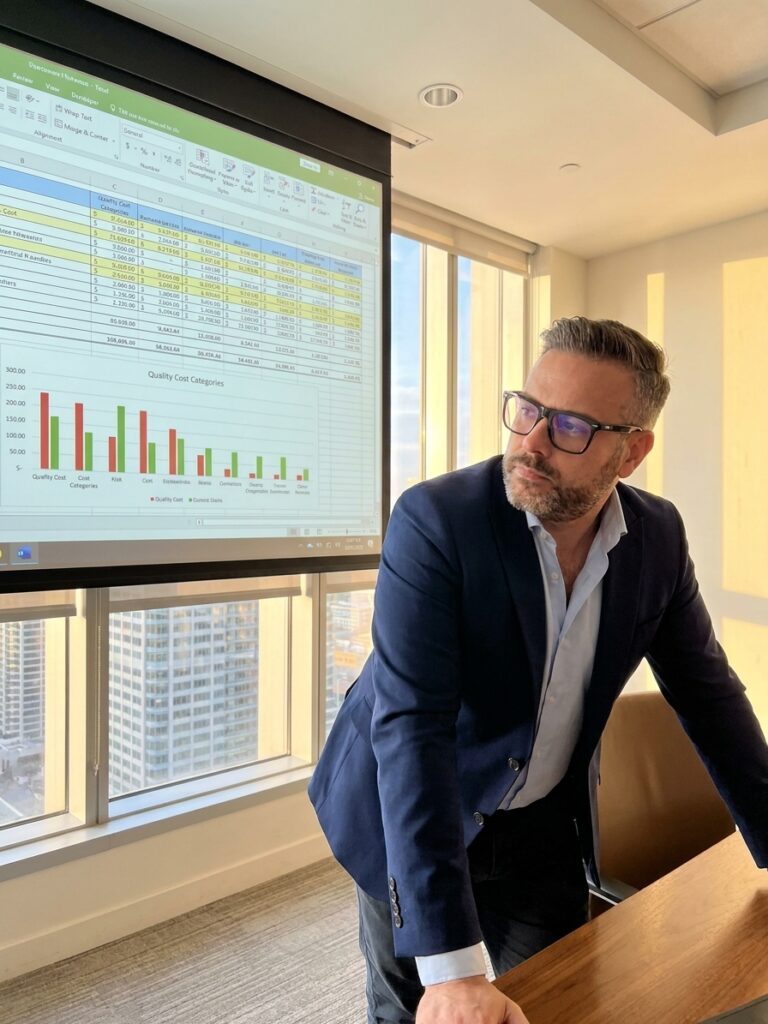
This approach also validates assembly sequences for error propagation. Errors rarely happen in isolation. A digital twin models the full build sequence and flags where a sequencing error produces an undetectable defect downstream. This is critical in complex electro-mechanical assemblies where a single misplaced part compromises the entire unit.
The Anatomy of a Failed Twin Initiative
Despite the clear potential, most digital twin initiatives never reach the point of influencing defect prevention. The failure modes are remarkably consistent across automotive and aerospace plants. They usually stem from a disconnect between the digital team and the quality engineering function.
The most common trap is IT-led ownership. Digital twin projects are frequently initiated by IT or digital transformation teams with no background in quality engineering. The focus immediately shifts to data integration, dashboard aesthetics, and technology demonstrations. The resulting model lacks any input from someone who has designed a poka-yoke device or conducted an 8D investigation.
Static models in a dynamic world represent another structural failure. A digital twin built once and never updated becomes inaccurate within months. Products change, fixtures wear, and processes are rebalanced. If the twin lacks clear ownership and update triggers tied to engineering change orders, it diverges from reality and loses all credibility.
Visualisation vs. Validated Twin
The IT Dashboard
- Focuses on data integration and visual appeal
- Models only the nominal, happy-path geometry
- Owned by teams detached from the PFMEA process
- Serves as a static exhibit for executive briefings
The Quality Tool
- Models error states, sensor logic, and variation
- Validates fixture design before steel is cut
- Feeds inputs directly into the control plan
- Owned by engineering and updated with ECNs
Finally, simulation without physics provides false confidence. Many twins are geometrically accurate but mechanically naive. They show parts fitting together but ignore forces, tolerance stacks, thermal expansion, and material behaviour. A poka-yoke device that works perfectly in a CAD animation may fail entirely on the floor due to dimensional variation.
Building a Twin That Models Variation
Real parts deviate from nominal dimensions. Real fixtures wear over time. Real operators apply different forces and follow slightly different motions. A useful digital twin incorporates these realities. It must model tolerance stacks, process variation, and human factors rather than relying on idealised CAD animations.
This requires using Monte Carlo methods and tolerance analysis tools. The twin must answer a highly specific question: given the documented variation in incoming parts, how often will this poka-yoke sensor fail to detect a misloaded component? If the simulation only proves the sensor works on perfect parts, it has no engineering value.
A model that only shows the happy path is a marketing tool, not a engineering instrument.
This connects directly to operator training. Standard work instructions and shadowing do not naturally expose trainees to failure modes. You do not deliberately let a new operator install a seal backwards to observe the consequence. A process twin allows operators to interact with a virtual station, attempt the assembly, and receive immediate feedback when they commit an error.
Key Validation Parameters
By simulating rare but critical failure modes, operators develop motor memory for the correct sequence before they touch the real product. The twin also creates an executable record of how the error-proofing system works. When a fixture is modified or a new variant is introduced, the twin explains why each device exists and what failure mode it addresses.
Connecting the Twin to the QMS
A digital twin that lives outside the Quality Management System is an orphan. It does not receive defect data, it does not feed into PFMEA updates, and it does not trigger control plan revisions. Quality engineers ignore it because it is not part of their daily workflow. The gap between the digital and quality worlds remains firmly intact.
The most powerful twins are closed-loop. They receive real-time data from PLCs and quality inspection systems, using that data to update their understanding of process behaviour. If a poka-yoke sensor starts triggering more frequently, the twin helps diagnose whether the root cause is part variation, sensor drift, or a genuine process change.
To sustain this integration, a digital twin requires clear ownership. One engineer with both quality and digital skills must be responsible for maintaining the twin, updating it when processes change, and ensuring it remains connected to the QMS. Without explicit ownership written into a role, the twin decays into obsolescence within a single product cycle.
The Closed-Loop Validation Cycle
- 01PFMEA DefinitionIdentify the highest-risk failure modes requiring simulation and error-proofing.
- 02Variation ModellingInput real tolerance stacks, tool wear data, and human reach envelopes into the twin.
- 03Logic ValidationSimulate incorrect loading scenarios to validate sensor thresholds and mechanical interlocks.
- 04Physical DeploymentBuild the validated fixture design and deploy the PLC logic to the shop floor.
- 05Live Data FeedbackFeed actual trigger rates back into the twin to monitor drift and update the control plan.
Measuring the Return on Virtual Validation
The business case for a quality-focused digital twin rests entirely on avoided costs. These include rework, scrap, warranty claims, recall risk, and launch delays. These metrics are notoriously difficult to quantify because they represent events that did not happen. However, several leading indicators can demonstrate clear operational value.
Track the reduction in physical poka-yoke design iterations during tooling tryout. If the simulation is working, the team should need fewer physical modifications after the fixture is built. Another critical metric is faster ramp-up curves on new products. Processes validated virtually reach stable production sooner, with fewer quality escapes during launch.
The ultimate measure is a sustained decrease in escape defects traced to stations modelled in the twin. Additionally, new operators trained against the simulation should reach competency faster and make fewer errors during their initial weeks. These are long-cycle investments; the value compounds as the twin becomes more accurate and more trusted over time.
For most manufacturers, the right approach is not a full-scale factory digital twin. It is a focused pilot on one high-risk assembly station. The pilot must address a specific, documented failure mode that has caused quality escapes in the past. It must prove that virtual validation produces a better error-proofing solution than the traditional build-and-fix approach.