A defect emerges on a production line and resists standard root cause analysis. The quality engineer completes an 8D. The process engineer verifies every machine parameter. Maintenance inspects the tooling. Supplier quality confirms incoming material is within specification. Weeks pass, the customer escalates, and every expert independently concludes the problem exists outside their domain.
This failure mode is structural. It occurs when critical information is distributed across operators, shifts, and departments, but the problem-solving method restricts information flow to a single specialist. I have audited plants where a three-week mystery was solved in thirty minutes simply by placing the parts in front of the four line operators and asking what they observed.
Complex manufacturing defects rarely live within a single engineering discipline. They emerge from interactions between material variation, environmental conditions, tooling wear, and infrastructure changes. Solving them requires a methodology that forces these fragmented observations to collide in a single room.
Why Top-Down Expert Analysis Fails
Assigning a complex problem to a specialist works when the failure mode is well-defined and isolated. It fails when the root cause spans multiple domains. The expert approach creates a paradox: the more you centralise problem-solving in engineering functions, the worse your organisation performs against cross-functional defects that resist standard PFMEA logic.
The standard reporting structure accelerates this failure. An operator informs a team leader, who writes a report for the supervisor, who summarises it for the shift manager. By the time the quality engineer receives the information, eighty percent of the operational context is lost. Reports are lossy compression algorithms that discard precisely the environmental nuances required to solve interactive defects.
Functional silos further guarantee failure. The quality department holds the defect data. Maintenance holds the infrastructure logs. Production holds the operator observations. Supply chain holds the supplier batch records. Each silo contains valid data, but no colony-level intelligence emerges because the silos do not communicate dynamically.

Deploying Distributed Problem-Solving
To solve interactive defects, you must abandon the sequential report and establish rapid, unfiltered information exchange. The goal is to saturate the problem-solving environment with raw, local observations so that patterns emerge organically, rather than forcing a single engineer to deduce the answer from sanitised data.
Mechanisms include unfiltered observation boards at each workstation where operators post physical notes about changes, and cross-functional huddles where these notes are evaluated alongside maintenance logs and quality data. The requirement is simple: observations must be shared immediately, without an approval chain, and without the requirement of proof.
The Swarm Convergence Sequence
- 01Localised DetectionFrontline agents log unfiltered observations (sight, sound, feel) without requiring data validation.
- 02Cross-Functional CollisionObservations from different stations, shifts, and departments are posted together in a single physical or digital space.
- 03Emergent HypothesisThe team identifies connecting variables across domains, forming a testable theory that no single expert constructed.
- 04Distributed ExperimentationMultiple agents execute simultaneous, small-scale tests to validate or invalidate the hypothesis within hours.
Structuring a Swarm Problem-Solving Session
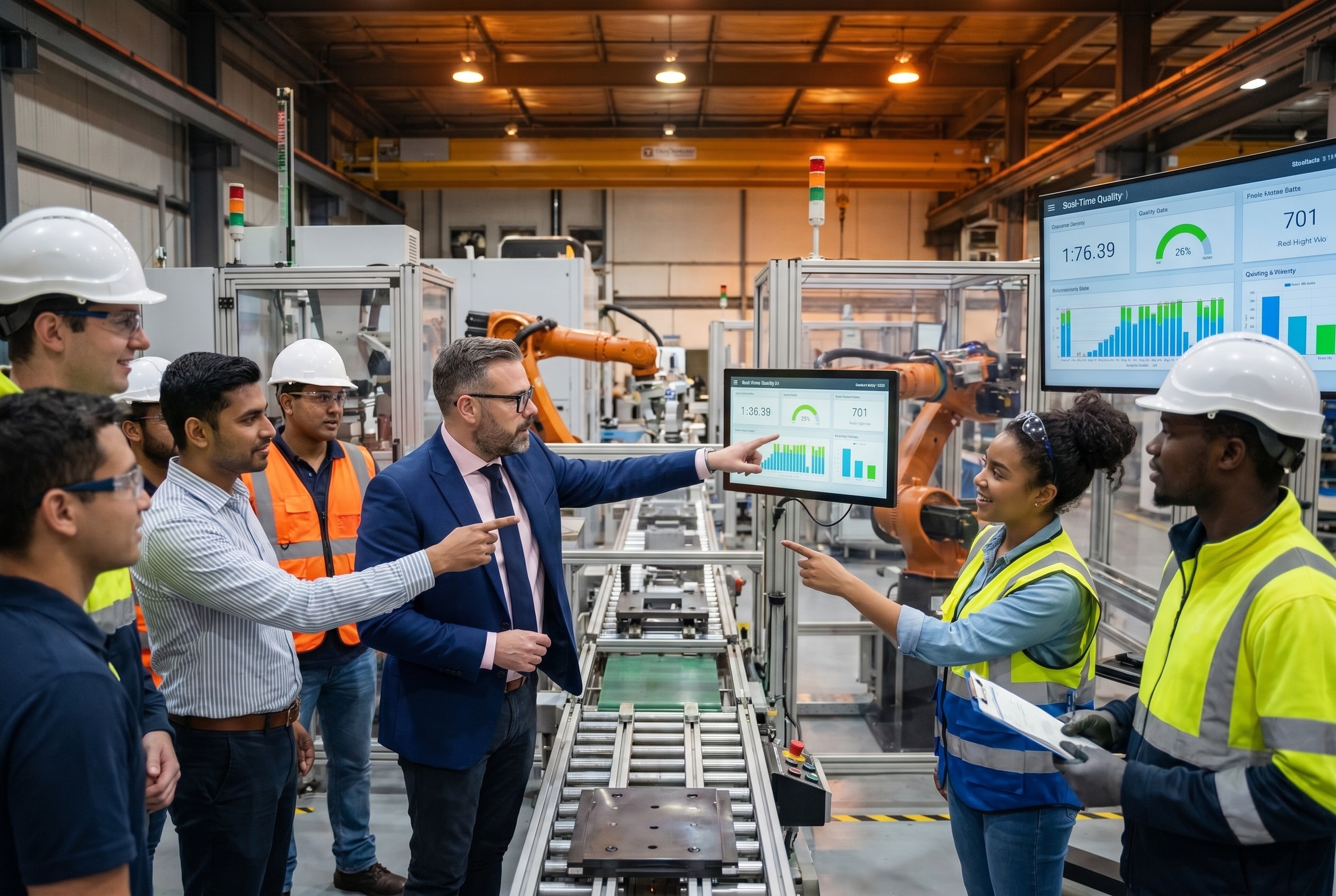
When a defect resists traditional 8D analysis, convene a cross-functional session. Pull six to ten people directly from the value stream: the operators, the maintenance technicians, the receiving inspector, and the process engineer. Provide the defective parts, the raw observation logs, and the SPC charts.
A critical rule is the elimination of formal hierarchy in the room. Management must not direct the conversation or impose a solution. The objective is to map how the operators build on each other’s fragments in real time, linking a supplier lot change to a ventilation modification and a subsequent humidity spike.
Within this structure, a viable hypothesis usually emerges in under an hour. The team then commits to immediate, distributed experimentation. The maintenance technician adjusts airflow. The operator tests a material handling change. This distributed testing generates more actionable data in forty-eight hours than a single engineer could produce in weeks.
Leadership Constraints and System Design
You cannot order a team to collectively solve a problem. Leadership’s role shifts from dictating solutions to designing the system. This means establishing the communication channels, the standing meeting structures, and the cultural safety required for frontline personnel to share unverified observations without triggering blame or excessive paperwork.
If the organisation only rewards personnel for solving crises, personnel will hide observations until they become crises. To build collective intelligence, leadership must explicitly reward the sharing of raw observations. This requires tolerating noise and irrelevant data, as demanding validation before sharing information will instantly suppress the swarm.
If you demand every observation be validated before it is shared, you destroy the information density required to solve complex problems.
Leadership must also protect the process from premature convergence. If a single dominant voice or a high-status engineer proposes a theory too early, the group will likely agree and abandon alternative paths. The facilitator must actively enforce diverse input and protect dissenting observations until multiple hypotheses have been physically tested.
Measuring the Effectiveness of Collective Intelligence
Traditional quality metrics focus on output, such as defect parts per million (PPM) or scrap rates. To evaluate your problem-solving structure, you must measure the input mechanisms. Tracking how information moves through the organisation provides early warning signs of systemic silos before they manifest as missed customer deliverables.
| Indicator | Dysfunctional Organisation | Functional Organisation |
|---|---|---|
| Observation velocity | Zero frontline observations shared per week | Dozens of unfiltered observations shared across shifts |
| Cross-boundary connection | Data remains strictly within departmental silos | Maintenance notes regularly collide with quality data |
| Time to convergence | Weeks of escalating management reviews | Viable cross-functional hypothesis formed in days |
Integrating Swarm Logic into Standard Quality Systems
Implementing distributed problem-solving does not require dismantling your IATF 16949 or AS9100 architecture. The goal is to supplement top-down compliance systems with a lateral network that captures undocumented variables. Your specialists remain essential for well-defined, single-domain failures.
However, for complex, interactive defects, the standard PFMEA and control plan are starting points, not complete solutions. By the time a failure mode is documented in the PFMEA, it has already caused a customer escape. Distributed observation networks identify the precursor variables—the humidity drift, the minor tooling noise, the material feel—that precede an out-of-control process.
The organisation already operates as a complex adaptive system. Every operator, technician, and inspector acts as a sensor processing local data. Structuring your quality system to capture and connect this distributed data transforms the plant from a reactive hierarchy into an organism capable of identifying and neutralising defects before they breach the containment zone.