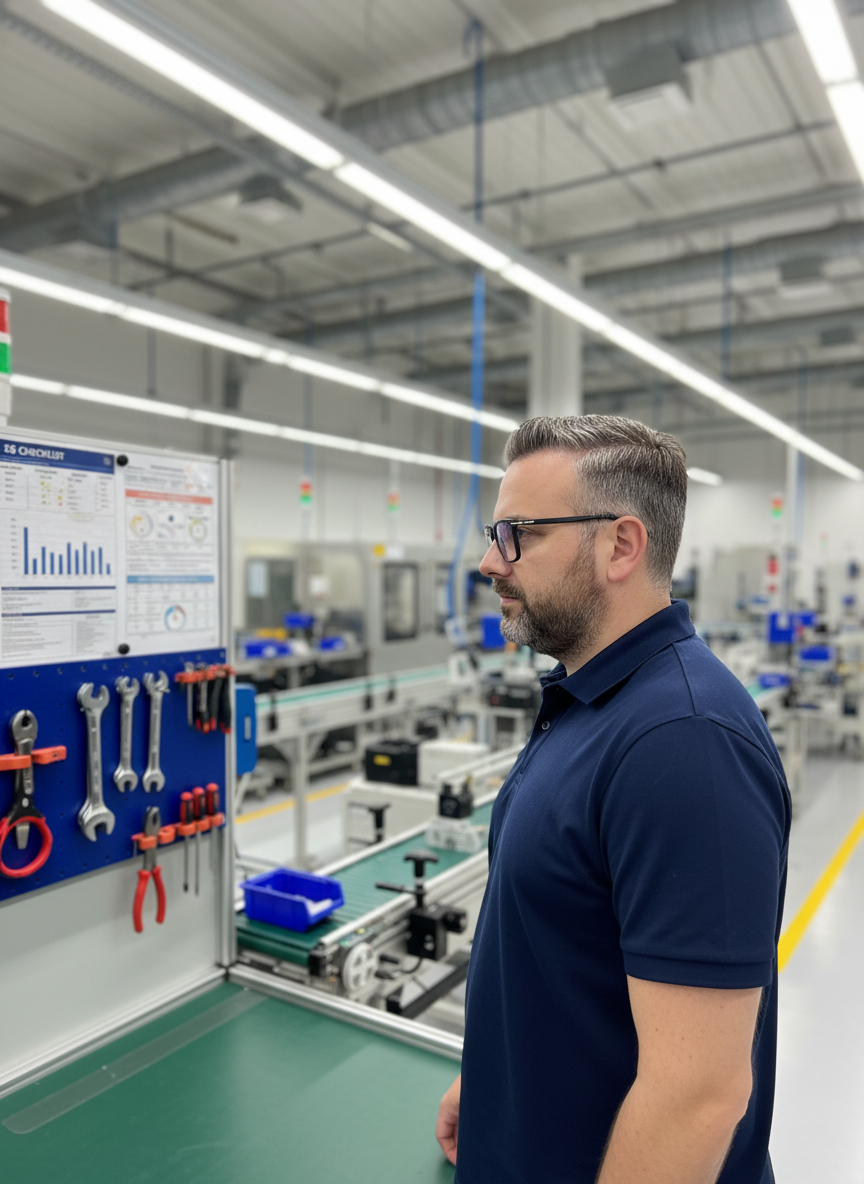
Wilson and Kelling published their broken windows theory in 1982, arguing that visible signs of decay accelerate further decay. New York City applied this in the 1990s by repairing vandalised subway stations and removing graffiti before pursuing major crime. The mechanism is straightforward: visible neglect signals that nobody is watching, which lowers the threshold for the next violation.
Manufacturing floors operate on the same principle. An expired calibration sticker, a work instruction referencing Revision C when the line is running Revision F, a fixture wrapped in tape for six months. These are not cosmetic issues. They are active quality signals that operators read and internalise every shift.
I have audited plants across automotive and aerospace. The correlation is consistent: facilities with degraded environmental standards produce higher defect rates and struggle more with audit findings. The environment is already communicating your quality policy. The question is whether it matches the printed version.
The Mechanics of Tolerance Creep
Tolerance creep does not begin with a major system failure. It starts with a minor deviation left unresolved. An operator notices a scratched locating pin on a fixture and reports it. The supervisor logs a low-priority maintenance request. Two weeks later, the pin is still scratched. The operator registers that urgent fixes are not urgent.
By week three, the same operator notices an inspection gauge sitting outside its calibrated storage case. They mention it. The supervisor explains they are waiting on a new rack. By week four, a different operator sees the scratched pin and the misplaced gauge. They also spot a bin of suspect parts sitting next to good stock with no segregation tag.
That second operator makes a decision. If the system does not enforce basic standards, individual diligence is irrational overhead. They skip a redundant visual inspection step. One part with a burr ships. Nobody notices, because the environment has already established that monitoring is optional. Six months later, a customer rejects the lot.
The corrective action report will list eleven root causes. It will reference insufficient operator training, inadequate Poka-Yoke devices, and a need for stricter final inspection protocols. None of these address the actual origin point. The origin was a scratched pin that communicated, from day one, that precision was negotiable.
The Four Signal Categories That Shape Floor Culture
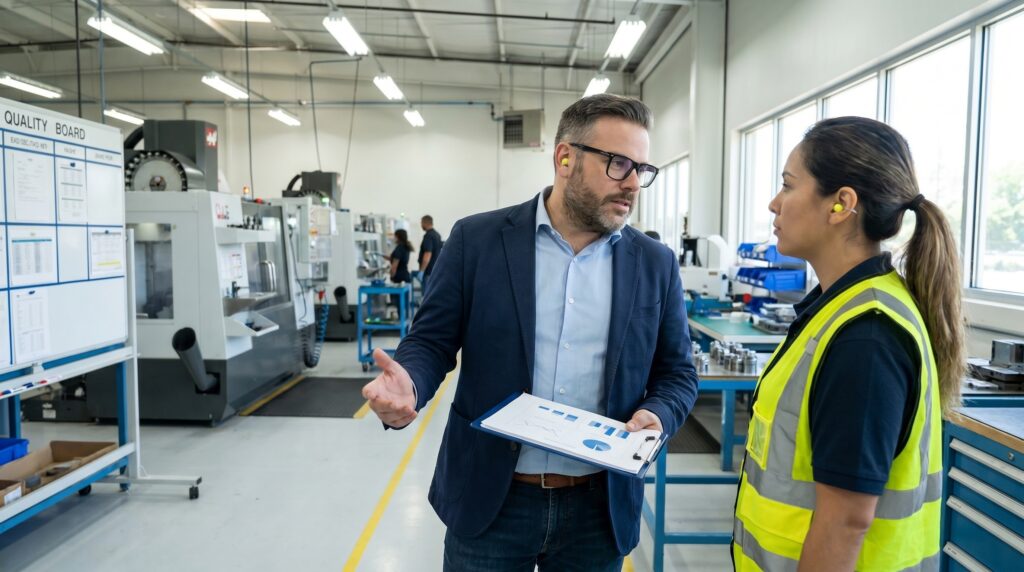
Not all environmental signals carry equal weight. Through implementing ISO 9001 and IATF 16949 systems, I have identified four categories that disproportionately shape operator behaviour. These are the areas auditors should examine first and supervisors must manage daily.
Tool and Equipment Condition
Worn tools and damaged fixtures transmit the loudest quality message on the floor. When an operator picks up a dented bore gauge, a torque wrench with a frayed cable, or a cutting tool long past its replacement cycle, they learn that precision is aspirational. A facility that tolerates degraded MSA equipment cannot credibly demand Cpk compliance.
Visual Management Accuracy
Outdated visual controls are actively corrosive. A production board showing yesterday's OEE numbers or a quality alert for a resolved six-week-old defect tells operators the information system is unreliable. When the posted control plan references Revision C while the line runs Revision F, the PPAP documentation is compromised.
Housekeeping and 5S Compliance
5S is a defect-prevention tool, not a janitorial programme. A disorganised workspace forces dozens of micro-decisions per hour: which tool, which bin, which container. Each decision introduces error probability. When everything has a designated place, the environment enforces the standard. Shadow boards and red-tag zones make abnormalities visible instantly.
Response to Deviations
This is the ultimate signal. When a nonconformance occurs, operator response reveals the true quality standard. If the 8D investigation is swift and the CAPA is verified, operators learn that deviations are critical events. If the response is slow, documentation-heavy, and closes without effectiveness verification, operators learn that corrective action is administrative theatre.
| Signal Category | Operator Interpretation | Quality System Impact |
|---|---|---|
| Damaged fixture taped over | Precision is optional here | Measurement system integrity degrades |
| Outdated work instructions posted | Documentation cannot be trusted | Process standardisation fails |
| CAPA closed as 'operator error' | Investigations are superficial | Systemic root causes go unaddressed |
| Expired calibration sticker on gauge | Nobody checks this equipment | Inspection results become invalid |
The Cost of Superficial Corrective Action
I audited a facility where the work instructions at a robotic welding station were for an entirely different product. They had been incorrect for three months. The operators had developed their own method, passed down verbally across shifts, which bore only passing resemblance to the engineering requirement.
When I asked why nobody reported the discrepancy, the response was direct. The last time someone pointed out a documentation error, nothing changed. So they stopped looking. This is the cost of ignoring broken windows: operators do not merely tolerate the degraded environment, they actively adapt to it.
The most damaging signal is not the scratch or the clutter. It is the unresolved corrective action that everyone knows about. The 8D report that blamed operator error because investigating the fixture alignment was too difficult. The CAPA that was closed without effectiveness verification. These do not just signal apathy. They signal that apathy is the official standard.
A Protocol for Environmental Correction
Fixing environmental signals requires a structured protocol, not ad hoc maintenance. The objective is to ensure the physical workspace accurately reflects the documented quality management system. This demands specific, repeatable actions from leadership.
First, implement an environmental quality walk. This is distinct from a standard gemba walk or Layered Process Audit. The sole purpose is to observe what the floor communicates to a new hire. Look at the bench organisation, the wall postings, the tool conditions. Assess whether the space teaches the intended standard.
Second, establish a zero-tolerance list. This is a short, non-negotiable set of environmental standards that trigger immediate production stops until corrected. No scheduling delays, no waiting for the next maintenance window.
The Environmental Correction Protocol
- 011. Environmental WalkObserve the floor as a new hire would, without contextual bias or historical exceptions.
- 022. Zero-Tolerance TriggerIdentify any item on the non-negotiable list, such as expired labels or mixed parts.
- 033. Immediate ContainmentStop production at the affected station and correct the environmental defect.
- 044. Cultural ReinforcementAcknowledge the operator who escalated the issue, reinforcing that vigilance is expected.
Implementing Ownership and Accountability
The zero-tolerance list must include expired calibration labels, unsegregated suspect material, outdated work instructions at the point of use, damaged safety or quality devices, and illegible status markings. If any of these appear, production stops until they are resolved. This teaches the workforce that these signals are critical.
Environmental ownership must reside with the operators in the space. They need authority to stop the line when they identify a broken window. This is not a formal escalation requiring three signatures. It is an expected, supported part of the daily operating procedure.
The most damaging broken window is the CAPA closed without effectiveness verification. That does not signal apathy; it signals that apathy is official policy.
When an operator stops the line for a damaged fixture, the response must be immediate gratitude, not frustration over lost cycle time. If supervisors react with annoyance, the operator learns that reporting issues is a career risk. The broken window remains, and the next operator keeps their observations to themselves.
Finally, apply the new-hire litmus test. Ask your newest operator, after their first week, what they have learned about quality from observing the environment. Their answer reveals the true training curriculum of your shop floor. If their observation does not match the quality policy, the policy is irrelevant.
Sustaining the Standard Through Leadership Behaviour
The broken windows theory operates in both directions. When an operator sees a scratched fixture replaced within one shift, they learn that standards are enforced. When they see outdated work instructions corrected the same day they are reported, they learn that accuracy is expected. Consistent leadership response rewires the floor culture.
Every time a manager walks past a broken window without addressing it, they endorse the degradation. Silence is a communication. It tells the team that the degraded condition is acceptable and that leadership does not prioritise the standard. The strongest quality cultures treat every broken window as an immediate priority.
At WITTE Automotive and a major aerospace manufacturer, I observed that facilities maintaining strict environmental discipline also maintained the lowest cost of poor quality. The environment is upstream of every Cpk calculation, every audit score, and every delivery metric. Fix the physical signals, and the performance data follows.
You are likely thinking of a specific broken window on your floor right now. The fixture you have walked past a dozen times. The label that has been illegible for months. Your operators have not stopped seeing it. They have simply stopped expecting you to fix it. Address it today.