Defect rates climb for weeks. The quality team exhausts the usual variables: raw material certifications, operator training records, environmental conditions, and shift schedules. The investigation goes cold because the investigation is looking at the inputs and the outputs, but ignoring the mechanism in between.
When the equipment itself finally comes under scrutiny, the root cause is often a slow, invisible degradation. A hydraulic pressure gauge reading 12 percent high. A calibration cycle missed by six months. The machine operated outside its specification window for months while the control plan reported normalcy.
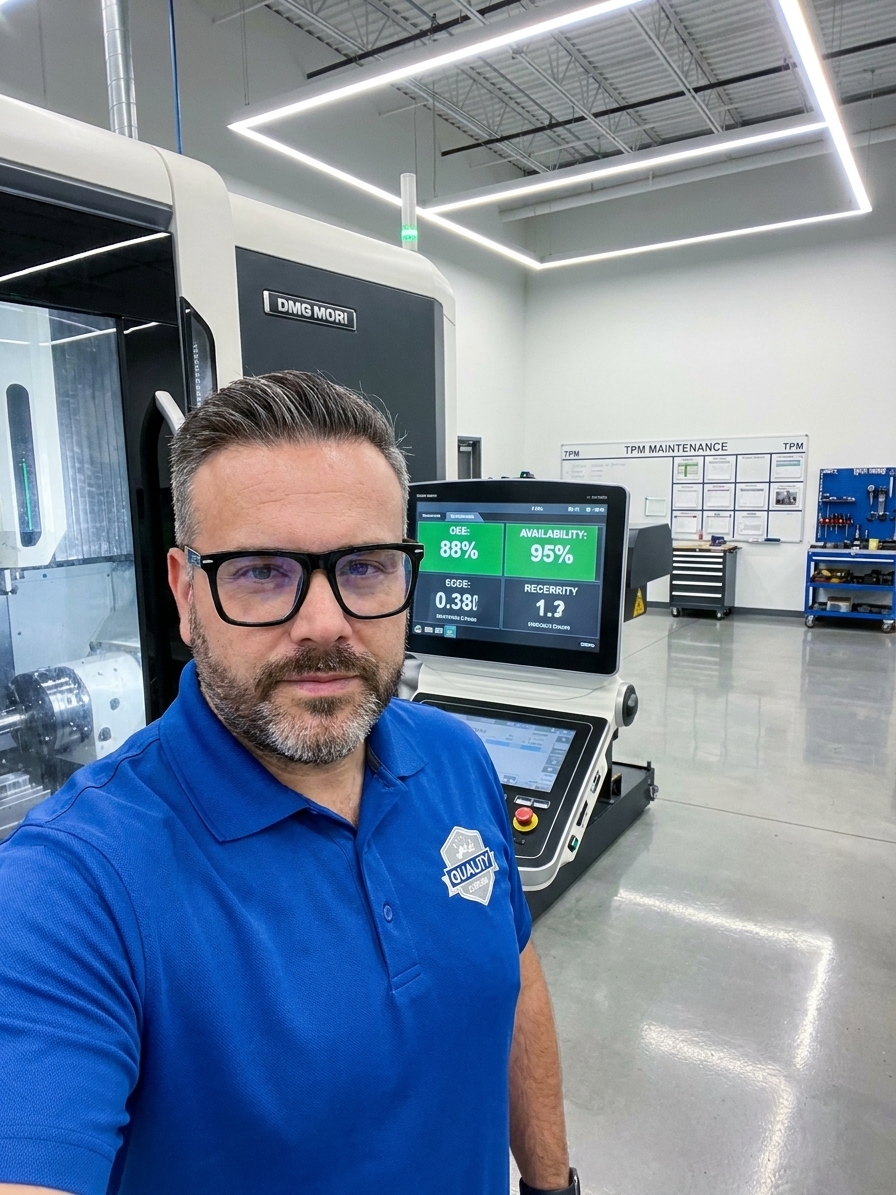
I have audited plants where Cpk data looked excellent on paper, yet the customer complaint rate was rising. The disconnect was always the same: the quality system measured parts, but nobody measured the machine conditions producing them. Total Productive Maintenance (TPM) is the discipline that bridges that gap.
Why TPM Is a Quality Strategy
Total Productive Maintenance is widely misunderstood as a maintenance program. It is a manufacturing improvement strategy that treats equipment effectiveness as the foundation of process capability. The Japan Institute of Plant Maintenance (JIPM) formalised TPM around eight pillars, each addressing a specific category of equipment-related loss.
The core premise is straightforward: your process can only be as capable as the equipment executing it. You can have perfect materials, trained operators, and flawless procedures. If your machine is vibrating outside its design envelope, your quality will degrade. The degradation is invisible until a critical dimension breaches tolerance.
For quality engineers, this reframes the entire assurance model. Instead of detecting defects after the process produces them, you identify and maintain the specific equipment conditions that prevent defects from occurring. Quality control shifts from reactive inspection to proactive condition management.
Quality Maintenance: Mapping Conditions to Characteristics
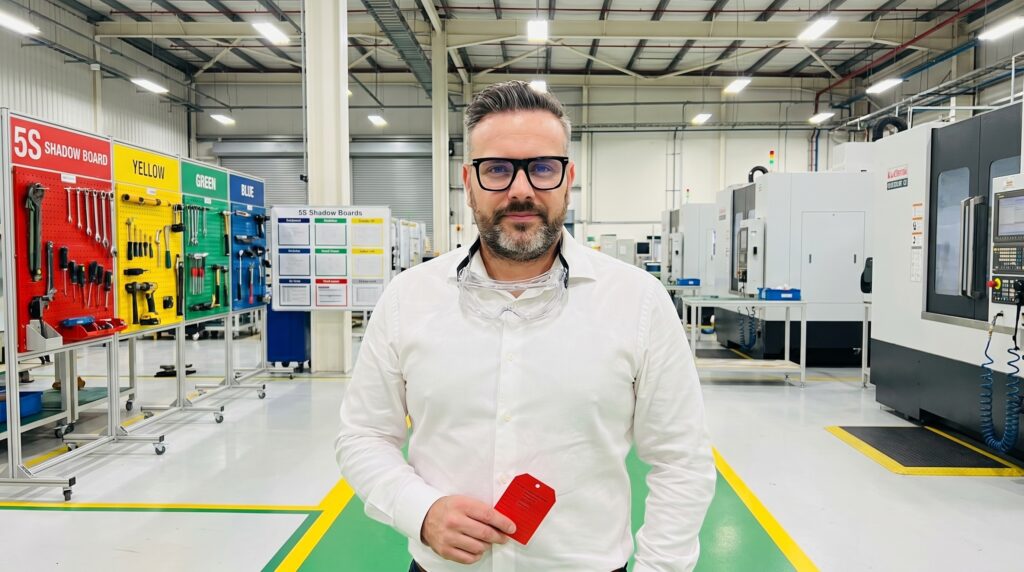
Quality Maintenance is the TPM pillar most directly tied to the work of a quality department. It operates on a principle most organisations have never formally articulated: every quality characteristic is the direct result of specific, measurable equipment conditions.
Dimensional accuracy depends on tool wear, thermal expansion, and vibration levels. Surface finish correlates to spindle condition, coolant flow, and cutting speed. Material properties rely on temperature profiles, pressure curves, and timing precision. Every characteristic an IATF 16949 or AS9100 auditor cares about is produced by a set of machine conditions you can control.
The methodology requires mapping each critical-to-quality (CTQ) characteristic to its underlying equipment variables. Once mapped, you establish the ideal conditions for zero defects — not acceptable conditions, but the exact operating state where the process produces conforming output consistently.
The Quality Maintenance Mapping Process
- 01Identify CTQsFilter for characteristics affecting safety, regulatory compliance, or critical function.
- 02Map to equipmentLink each dimension or property to the specific machine parameters producing it.
- 03Establish ideal stateDefine the exact operating conditions that yield zero defects, not just acceptable tolerance.
- 04Monitor conditionsShift from inspecting the final part to measuring the machine variables in real time.
- 05Restore proactivelyCorrect condition drift before it results in a nonconforming product.
OEE: Measuring Hidden Quality Losses
TPM introduced Overall Equipment Effectiveness (OEE) to manufacturing. The metric combines three factors: Availability, Performance, and Quality. World-class OEE is 85 percent. The average plant operates around 60 percent. That 25-point gap represents enormous wasted capacity, material, and embedded quality cost.
OEE is powerful because it prevents local optimisation. A plant might report 98 percent quality, but if availability sits at 90 percent and performance at 80 percent, the cumulative OEE is 70.6 percent. The hidden losses in machine downtime and reduced cycle speed are bleeding operational efficiency, even when the scrap rate looks acceptable.
Tracking OEE at the individual machine level turns the metric into a diagnostic tool. It pinpoints exactly where equipment-related losses are concentrated. When a specific station drags the line OEE down, the investigation moves from a generic process review to a targeted equipment capability analysis.
Autonomous Maintenance and Operator Ownership
Autonomous Maintenance generates the most resistance in TPM implementation. Maintenance professionals often reject the idea of operators performing basic care tasks like cleaning, lubricating, and inspecting. The concern is that untrained operators will miss mechanical faults or create safety hazards.
Autonomous Maintenance is not about replacing technicians. It is about creating a partnership. Operators who clean their own machines learn to see abnormalities that remain invisible to a maintenance technician who visits quarterly. They develop an intuitive understanding of the machine's normal baseline, making deviations immediately obvious.
Your process capability index is a fiction if the equipment producing the parts is degrading undetected.
The process follows a structured seven-step approach: initial cleaning, eliminating contamination sources, developing tentative standards, general inspection training, autonomous inspection, standardisation, and full self-management. The result is an operator who detects a subtle vibration change or an unfamiliar sound long before a dashboard alarm triggers.
The Compounding Cost of Equipment Variability
Organisations chronically underestimate the cost of poor equipment maintenance. They see direct costs: repair parts, labour, and downtime. They miss the cascading costs that flow through the quality system and the supply chain, compounding at every downstream process.
Equipment in poor condition produces output with higher variability. Higher variability widens process distributions. Wider distributions lower capability indices like Cpk and Ppk. Lower capability forces more inspection, more sorting, more buffer stock, and higher scrap rates. The cost is rarely attributed to its root cause because it hides inside overhead accounts and quality budgets.
The Cost Paradigm Shift in Equipment Management
Traditional maintenance view
- Tracks repair parts, labour, and downtime costs
- Fixes equipment only when it breaks or fails audit
- Accepts process variability as inherent to the machine
- Quality inspects parts to catch the output of degradation
TPM quality view
- Tracks scrap, rework, and lost capacity tied to drift
- Maintains equipment to prevent breaks and deviations
- Reduces variability to drive Cpk and Ppk higher
- Controls machine conditions to prevent defects by design
Integrating TPM with Industry 4.0
Predictive maintenance is one of the most cited benefits of Industry 4.0. IoT sensors, vibration analysis, and digital twins monitor equipment condition in real time. But predictive maintenance only works if you know what conditions actually matter to product quality.
Organisations that deploy smart sensors without a TPM foundation often drown in data. They capture vibration signatures for every bearing and temperature profiles for every motor, but they lack the contextual framework to act on it. They cannot distinguish between a harmless deviation and a condition that will push a critical dimension out of specification.
TPM provides that framework. Quality Maintenance identifies exactly which parameters dictate final part quality. Industry 4.0 provides the capability to monitor those specific parameters continuously. Together, they transform raw equipment data into targeted preventive action.
Implementation Discipline
Implementing TPM is not technically complicated. The OEE calculations, the maintenance schedules, and the inspection standards are straightforward engineering. The difficulty is cultural. TPM demands cross-functional collaboration between maintenance, production, quality, and engineering that challenges traditional departmental silos.
Sustained discipline is the primary differentiator between success and failure. The organisations that succeed with TPM are not the ones with impressive kickoff events. They are the ones still executing daily cleaning and inspection routines three years later, when the initiative is no longer novel.
Treat equipment as the precision instrument your quality system assumes it to be. Every defect reaching a customer was produced by a machine allowed to drift from its ideal condition. TPM closes that gap systematically, integrating equipment health directly into the quality management system.