
A quality manager walks into the morning meeting and announces they are losing twelve percent of output to rework. The room reacts. Management authorizes an emergency kaizen, pulls engineers from other projects, and calls in a consultant.
Upstairs, the operations director looks at the same data and frames it differently: the line is achieving eighty-eight percent first-pass yield. That sounds acceptable. She schedules it for next month's review.
Same data, same defect rate, same process. The organization mounts two completely different responses because of the frame. This is the framing effect, and it is quietly undermining your IATF 16949 and AS9100 systems. The problem is not deliberate spin. The danger is that the language your team uses to describe nonconformities determines which problems get solved, which solutions get chosen, and which defects persist.
The Mechanics of the Quality Framing Trap
The framing effect is a cognitive bias where presenting identical information in different formats alters decision-making. Documented by Tversky and Kahneman, it proves that human brains do not process raw data objectively. We process stories, and the frame around the story dictates the response. In quality management, this means a single metric can trigger aggressive corrective action or total indifference depending entirely on the adjective used.
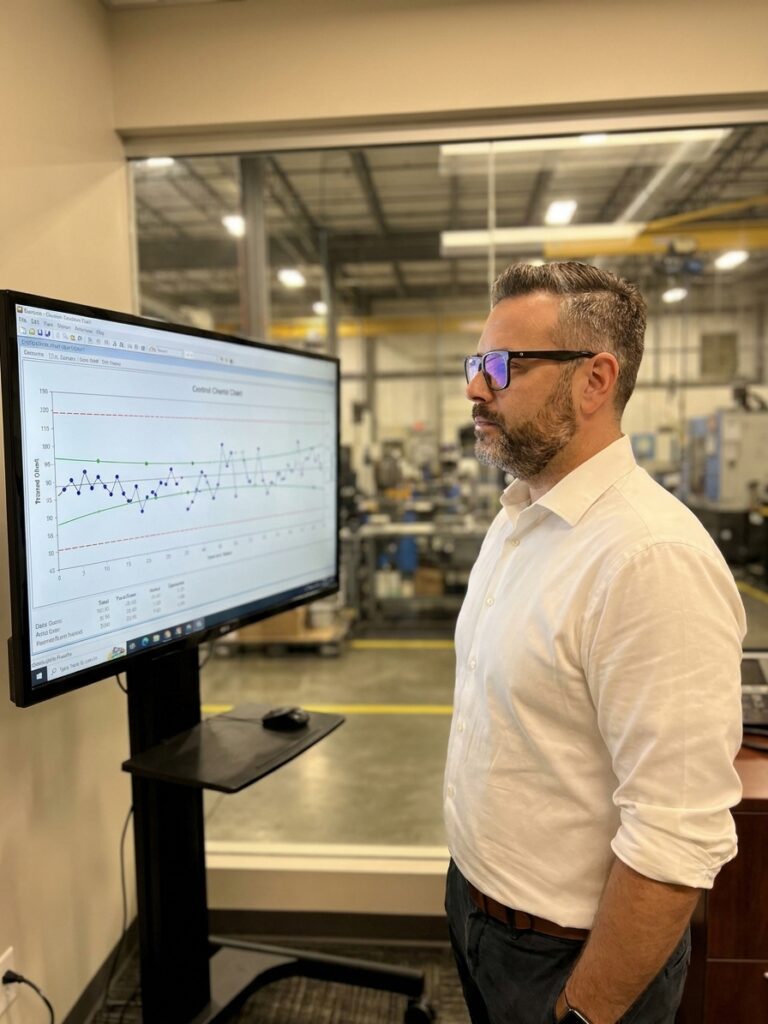
Consider how your team handles statistical process control. A point beyond the upper control limit can be framed as a process out of control, triggering an immediate containment response. Alternatively, that same data point can be framed as a one-off anomaly, triggering dismissal. The chart is identical. The organizational response is dictated entirely by the linguistic frame.
The risk is that most quality professionals do not recognize the frames they apply daily. You cannot mitigate a cognitive bias you do not see. To build a resilient quality system, you must acknowledge that factual accuracy does not guarantee a rational decision. Selective presentation of true information routinely drives bad containment and corrective action (CAPA) outcomes.
The Yield Trap and the Currency of Quality
Quality managers routinely struggle to secure funding for improvement projects because they report metrics in percentages. Telling the executive board that a line achieved ninety-seven percent yield sounds like a victory. Telling them you shipped thirty defective parts to a key customer last week sounds like a crisis. Both statements describe the same reality on a line producing a thousand units daily, but they trigger radically different resource allocations.
Percentages are abstract. Dollars, component counts, and customer names are concrete. When you frame quality problems in abstract terms, you secure abstract commitment. When you reframe that same yield loss as $847,000 in scrapped material this quarter, the Chief Financial Officer becomes your loudest ally. The frame dictates the urgency.
I have audited plants where management accepted a Cpk of 1.1 because it was presented as compliant with internal targets. When we reframed that exact metric as a high probability of producing nonconforming parts outside the specification limit, the plant manager halted the line for process analysis. Same data, different frame, entirely different operational priority.
Reframing Quality Metrics for Action
The Abstract Frame (Low Urgency)
- 97% first-pass yield achieved this quarter
- Supplier maintains a 99% on-time delivery rate
- Three customer complaints logged this month
- All KPIs operating within target specification
The Concrete Frame (High Urgency)
- 30 defective parts shipped to key automotive customer
- Supplier missed one critical shipment, causing a 4-hour line stoppage
- Customer complaint rate has tripled this month
- Four KPIs trending aggressively toward lower limit
Breaking the PFMEA Blind Spot
Process Failure Mode and Effects Analysis (PFMEA) teams fall into the framing trap constantly. Ask an engineer what could go wrong with a process, and you will get a conservative list. They will list historical failures and known issues. Ask that same engineer what would have to happen for this process to produce a catastrophic failure that shuts down the plant, and you get a completely different set of failure modes.
The first frame activates recall. The second frame activates imagination. Both are necessary for effective risk assessment, but most FMEA meetings default to the recall frame and never explore the catastrophic frame. The question you ask determines the risks you see. If your templates only use one frame, your risk assessments have a blind spot exactly the size of the frame you failed to use.
I facilitated an FMEA session for an aerospace supplier where the initial risk assessment identified twenty-three failure modes. When I reframed the exercise, asking the team to imagine the component had failed in the field and work backwards, they identified fourteen additional failure modes. Three of those new modes carried severity ratings higher than anything in the original list.
Compliance Versus Prevention in VDA 6.3
How your organization defines quality dictates the system you build. Framing quality as the need to pass an audit produces compliance behaviour. Teams generate minimum viable documentation, implement surface-level fixes, and build a system designed to satisfy an auditor rather than serve the customer. This is a common failure mode in organizations maintaining ISO 9001 certification.
Framing quality as the need to build a process that makes defects impossible produces entirely different behaviour. It drives systemic thinking, poka-yoke implementation, and preventive controls. The quality system becomes robust enough that audits become trivial because actual operational performance exceeds the standard requirements.
If you frame quality as compliance, you get compliance. The effort is similar. The results are not.
The budget allocated to the quality department is often the same. The difference is entirely structural. I worked with an automotive supplier whose quality team spent eighty percent of their time preparing for and responding to customer audits. They restructured around defect prevention. Within eighteen months, the same staff had reduced defect rates significantly and cut audit preparation time by seventy percent.
Building Systematic Reframing into Quality Processes
You cannot eliminate the framing effect because it is baked into human cognition. You can, however, build organizational habits that counteract its most damaging consequences. The most effective countermeasure is deliberate reframing. For every significant quality decision, require at least two frames before authorizing action. If someone reports a high yield, demand the inverse in scrapped units and financial impact.
This practice must be integrated into your core quality processes. Add reframing checkpoints to your FMEA, CAPA, and management review cycles. Require a recall frame and an imagination frame during risk analysis. Before closing an 8D report, ask if a different frame would suggest a different root cause. In management reviews, present every KPI in both a positive frame and a challenging frame to force analytical rigour.
Counteracting Framing Bias in 8D Problem Solving
- 01Initial DefinitionDefine the problem using the primary data frame.
- 02D2 Reframing CheckpointTranslate the problem into at least one alternative frame (units, cost, percentage).
- 03Resource AllocationApprove containment resources based on the full picture, not the initial frame.
- 04Root Cause AnalysisInvestigate using the system frame, explicitly rejecting the operator error frame.
- 05Preventive ClosureVerify the solution holds under all identified frames before closing the 8D.
Operator Error Versus System Vulnerability
The most damaging frame in root cause analysis is operator error. It is a frame that ends the investigation. Reframing the event as a system vulnerability exposed by human variability forces a completely different response. The system frame demands that you examine training records, procedure clarity, equipment maintenance, environmental factors, and scheduling pressures before concluding human error caused the defect.
Most quality professionals know this intellectually. Under production pressure, they still default to the blame frame because it is faster and emotionally satisfying. It assigns responsibility to someone who cannot defend themselves. But the blame frame only generates punitive action. It does not prevent the next operator from making the identical mistake in the identical system.
The system frame requires effort, but it is the only frame that leads to genuine preventive action. When you reframe the problem, you shift from fixing blame to fixing the process. The quality of your root cause analysis is entirely dependent on the frame you choose to apply during the investigation.
Operationalizing Reframing as a Habit
To make reframing a standard practice, you must train your team to recognize cognitive biases. Most quality professionals have never received explicit training in this area. Run a workshop using real examples from your organization's quality history. Pull the last ten significant quality decisions your team made and examine the frames used. Identify where a different frame would have produced a better outcome.
Make frames visible in your meetings. Before any quality decision, write the current frame on a whiteboard. State explicitly: the frame we are using today is X. Ask the room what a different frame would look like. This forces the team to acknowledge that framing is happening, invites alternative perspectives, and creates a record for future review.
The framing effect will never disappear. It is a permanent feature of human cognition. But deliberate, systematic awareness transforms it from an invisible bias into a visible tool. In quality management, the difference between an invisible bias and a visible tool is the difference between a system that looks compliant and a system that actually prevents defects.