
Classroom leadership training fails predictably because it separates learning from context. In a seminar room, problems are clean, data is complete, and people react logically. On the line, the environment is entirely different: production pressure, incomplete information, and operators who have their own reasons for deviating from the standard.
Adult learning research consistently shows that knowledge delivered in a lecture format decays rapidly if it is not applied immediately. In manufacturing quality, this decay rate is fatal. Leadership in a high-stakes environment is not a theoretical framework you memorise; it is a skill that must be rehearsed in real situations, with real operators, and real mechanical or process consequences.
Gemba-Based Coaching solves this disconnect. It fuses the Japanese principle of gemba—the actual place where value is created—with structured coaching methodologies. The leader does not analyse a hypothetical case study. They stand at the machine, observe the actual work, and receive immediate, context-driven feedback from a coach who forces them to see what they are missing.
The Disconnect in Traditional Leadership Development
I have audited dozens of automotive and aerospace plants where the disconnect between management theory and shop-floor reality is a systemic failure mode. Managers return from certification training in IATF 16949 or AS9100 with a strong theoretical grasp of requirements, yet they freeze when a machine repeatedly stops during a shift.
They freeze because the training conditioned them to look for a clean root cause, but the floor offers only noise and fragmented symptoms. The traditional manager approaches a stopped line looking for someone to instruct or a quick fix to implement. They want to solve the problem immediately rather than understanding the system that created it.
The consequence is a culture of containment. Leaders patch issues to hit the shift's OEE target, but the underlying process variation remains untouched. Quality becomes a function of reactive firefighting rather than engineered stability, and the manager's expensive leadership training simply becomes an unused binder on a shelf.
Core Mechanics of Gemba Coaching
Gemba-Based Coaching is a highly structured methodology, not an informal plant tour. It requires a coach and a leader to spend 30 to 45 minutes directly at the point of execution. The coach observes the leader observing the process. The focus is entirely on building the leader's diagnostic capability.
During the observation phase, the coach must exercise absolute discipline: no intervening, even when a deviation occurs. The objective is to evaluate how the leader perceives reality. Does the leader notice the operator compensating for a flawed fixture? Do they recognise the missing visual aid? The coach watches the leader's awareness.
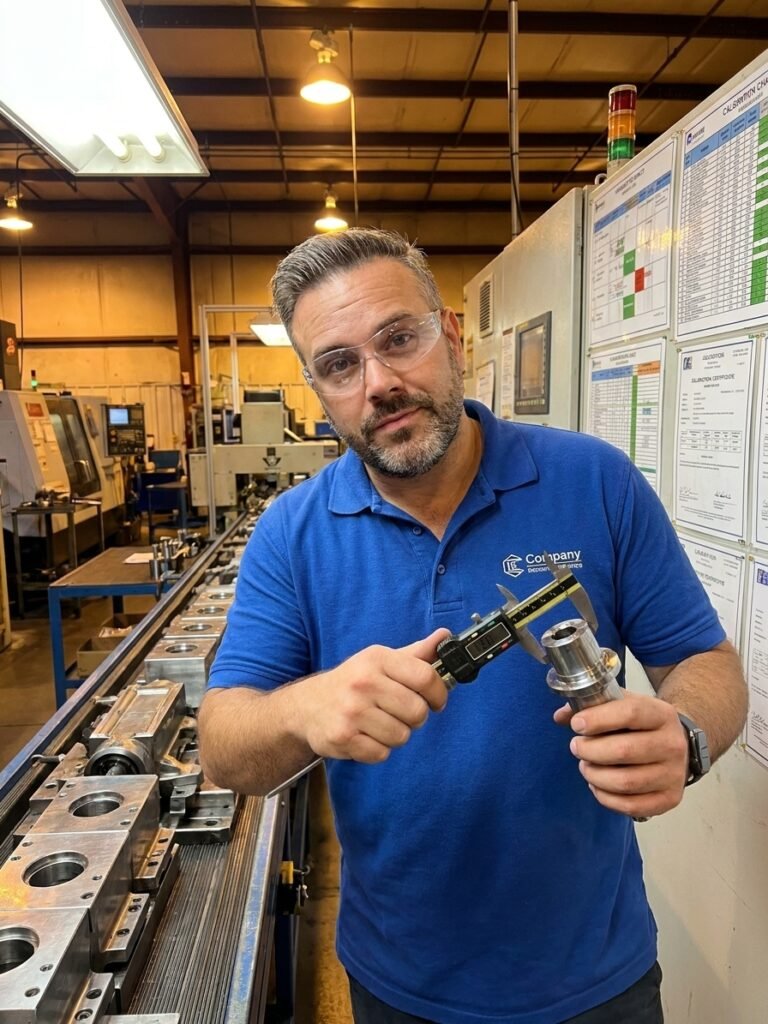
After observation, the coach and leader step away from the immediate work area to avoid disrupting the operators. The coach then drives the reflection phase using targeted questions. They ask what the leader observed, what surprised them, and what the gap is between the observed reality and the defined ISO 9001 standard.
The leader must formulate their own action plan. The coach does not supply the solution. Instead, the coach evaluates whether the leader's proposed countermeasure is specific, measurable, and time-bound. This forces ownership and builds the analytical muscle required for autonomous problem-solving.
Developing the Three Levels of Observation
Inexperienced leaders arrive at the line and see only chaos. Their immediate instinct is to diagnose and fix. Gemba coaching forces them to slow down. The coach restricts them to a single task: describe exactly what is happening right now. This builds the foundational discipline of observing without premature judgment.
The Three Levels of Observation
- Level 3: Ideal StateVisualising zero-defect conditions and anticipating systemic improvements before failures occur.
- Level 2: AbsencesSpotting what is missing, such as unposted standard work or bypassed poka-yoke devices.
- Level 1: RealityStripping away assumptions to describe exactly what the process and operators are doing right now.
The second level of observation shifts the focus to what is absent. An experienced quality leader walks the floor and immediately notices the missing standard operating procedure, the unused torque wrench, or the absent andon signal. Recognising absence is a critical step in building a proactive quality culture rather than a reactive one.
The highest level of observation involves visualising the ideal state. The leader stands at the station and sees not just the current defects, but the design of a flawless process. The coach asks: "If this station achieved zero defects, what would be different?" This reframes the leader's perspective from troubleshooting to process engineering.
Building Competence Through Structured Inquiry
I coached a new production manager who had returned from an intensive leadership course but could not resolve a recurring machine stoppage. Instead of giving him the answer, I had him meet me at the line every morning at 6:30 AM. My role was to ask questions and let him discover the mechanism of failure himself.
The first week, he was frustrated, seeing the stoppage but not the cause. I told him to ask the operator. By the second week, he learned that a sensor was failing to recognise the part. I asked if the sensor was broken; he did not know. I told him to find out. The coaching process required him to gather data, not assumptions.
By the third week, he discovered the sensor was functioning correctly, but a slight variation in the supplier's surface treatment was causing the read failure. The actual defect was upstream. He implemented a parameter adjustment and tightened the supplier tolerance. One A3 report later, the stoppages ceased entirely.
The solved machine stoppage was a secondary benefit. The primary outcome was a behavioural shift. In four weeks, the manager transformed from a frustrated administrator into a leader capable of driving root-cause analysis using structured inquiry, operator engagement, and real-time floor data.
Essential Capabilities of the Gemba Coach
The hardest part of floor coaching is holding your silence when you already know the answer.
Not every quality manager can function as a gemba coach. The role requires a specific, highly restrained skill set. The coach must possess a silent presence, operating like a shadow on the line without drawing attention away from the operators or disrupting the takt time. They are there to evaluate the leader, not the process.
Interrogation vs Discovery on the Shop Floor
Interrogation approach
- "Why did you do it that way?"
- "Don't you know the standard?"
- Demands immediate corrective action
- Focuses on operator fault and blame
Discovery approach
- "What would happen if we changed this?"
- "Where is the work instruction located?"
- Forces independent root cause analysis
- Focuses on system gaps and process design
Masterful questioning is the coach's primary tool. Instead of asking why an operator deviated from the standard, the coach asks what would happen if the standard were changed. Instead of asking if the leader knows the inspection requirement, the coach asks where the documented PFMEA is physically located. These questions open new perspectives.
Systemic thinking ties these skills together. The coach must look past the immediate defect and help the leader see the connections between the upstream supplier process, the machine parameters, and the human workflow. Building this capability ensures that leaders engineer quality into the system rather than inspecting defects out at the end of the line.
Measuring the Impact on Quality Performance
Demonstrating a tangible return on investment for leadership development is traditionally difficult. Gemba-Based Coaching provides a distinct advantage: the results are immediately visible in shop-floor metrics. Performance improvements can be tracked directly against the lines where the leaders received active coaching.
In my experience implementing this methodology across manufacturing operations, the measurable outcomes are rapid. Internal rejection rates drop significantly because leaders identify process deviations before they cascade into scrap. Reaction times to quality alerts decrease because leaders are already present at the point of failure, not waiting for a report.
Coaching Impact on Core Quality Metrics
Layered Process Audits (LPA) consistently improve. When leaders spend structured time on the floor, they enforce adherence to standard work and immediately close gaps in visual management. The frequency of process drift drops, creating a more stable and predictable manufacturing environment aligned with IATF 16949 expectations.
Operator turnover also decreases. Leaders who actively walk the gemba understand the physical friction and frustration their teams experience daily. When a leader shifts their question from "why did you make this error?" to "what prevents you from doing this job correctly?", the entire team dynamic changes from defensive compliance to active improvement.
Implementation Pathway for Plant Management
Plant directors and quality managers must resist the urge to scale this methodology instantly across all departments. Effective implementation requires a phased rollout that builds the coaching capability organically. The focus must remain on changing daily management habits before attempting cultural transformation.
In the first month, managers must start with themselves. Select one critical line or process. Commit 15 minutes every day to pure observation. Do not intervene, do not correct, and do not instruct. Simply observe and document what is actually happening compared to what the control plan specifies.
During the second and third months, begin engaging the operators through open inquiry, and identify an experienced internal or external coach to structure the leadership development. By the sixth month, standardise the coaching process. Select two or three key shift leaders to become coaches for their own teams, establishing a clear cadence and documentation method.
The ultimate validation of this approach occurs when a quality alert triggers. If the leader's automatic reflex is to walk directly to the machine instead of opening a dashboard on their office computer, the gemba coaching methodology has succeeded. Quality is built at the point of execution, and that is where leadership must reside.