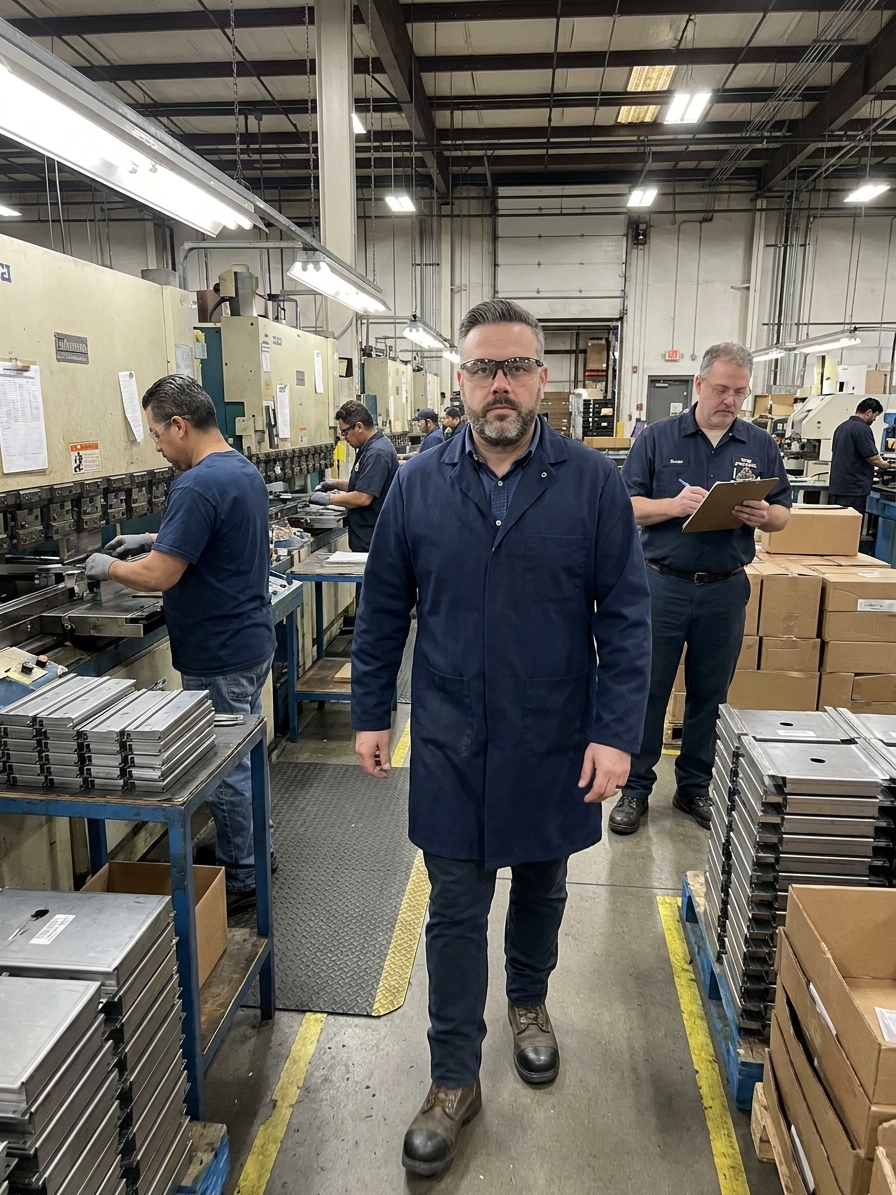
You scheduled the walk for 10:00 AM. Your leadership team gathered in the conference room first. Everyone walked out to the floor together, and for the next forty-five minutes, you toured the production line. You saw operators working, machines running, and work-in-progress piling up between operations. You noticed the operator who had improvised a fixture from scrap material.
Then you walked back to the conference room, said something about good progress, and returned to your emails. The observations stayed in your head. The waste is still there. The operators you passed have seen this walk before, when a different group of leaders walked the same route, saw the same things, and did exactly the same nothing.
This is the Gemba walk in most manufacturing organisations: a scheduled tour that produces zero learning and zero improvement. It has the form of Lean leadership. It has none of the substance. Taiichi Ohno, the architect of the Toyota Production System, required managers to stand in a circle drawn on the factory floor and simply observe for hours. Not direct. Not solve. Just watch, until they could see the waste that was previously invisible to them.
The Procession and the Theme Park Tour
When Gemba walks involve eight people from different departments walking together, they become a procession. The operators see you coming and straighten up. They stop doing whatever they were doing, which is precisely the thing you needed to see, and perform normalcy. The group moves through the area, and by the time you have passed, reality snaps back into place behind you.
Nobody sees anything real because the group's presence has altered the behaviour you came to observe. This is compounded by the theme park tour, where a middle manager has pre-selected the cleanest, best-performing areas of the plant. You walk through areas that were tidied up yesterday and see demonstration boards updated for your visit.
By the time you reach the end of the route, you have seen a curated version of the factory that exists only when leadership walks through. The fix for both failure modes is structural. Walk alone or with one other person. Do not accept a planned route. Go to the area with the highest scrap rate or the most WIP. Go to the area that the plant manager actively steers you away from. The discomfort of your hosts is a reliable signal that you are about to see something real.

The Checklist Walk and the Drive-By
In an effort to make Gemba walks systematic, many organisations have created checklists. Safety conditions verified. 5S compliance confirmed. Standardised work posted. The walk becomes a series of boxes to tick, and the ticking replaces the actual thinking. A checklist tells you whether the trappings of Lean are present. It tells you nothing about whether they are working.
Standardised work is posted, but is it being followed? Visual management boards are updated, but do operators actually look at them during the shift? The checklist walk is often combined with the drive-by: the walk lasts fifteen minutes, you cover six departments, and you spend an average of two minutes in each area.
That is enough time to see that people are working, but nowhere near enough time to observe a full work cycle, identify abnormalities, or understand material flow. The drive-by produces a general impression, but no specific, actionable observations. It is the leadership equivalent of driving past a factory and deciding operations are healthy because the car park is full.
Replace the checklist with a single question after every walk: what did I see that surprised me? If the answer is nothing, you were not looking hard enough, or you have been walking the same route so long that you have become blind to it. Spend thirty minutes stationary in one area. Watch one operator complete three full work cycles. Movement creates its own distraction. Stillness forces observation.
The Interrogation and the Solution Tour
Some leaders have been taught that Gemba walks involve asking questions. They walk up to operators and fire off questions about targets and problems. The operator, who has never met this leader and knows that honest answers historically lead to blame, says everything is fine. The leader checks the engaged-with-frontline box and moves on. No problem was surfaced and no trust was built.
The solution tour is the opposite failure. Leaders are problem-solvers by nature. They see a workaround on the floor and they want to fix it immediately. An operator is using an improvised fixture, so the leader orders a proper one. WIP is piling up, so the leader tells the supervisor to clear it. Within twenty-four hours, the fixes are reversed because the underlying root cause was never addressed.
The workaround returns because the bottleneck upstream was never identified. The new fixture does not fit the actual process because nobody asked the operator what they actually needed. I have audited plants where leaders introduced more process variation by solving problems on the floor than the original deviation ever caused. Solutions born from a five-minute observation are almost always wrong because they treat the symptom.
The fix for the interrogation is to ask operators to show you rather than tell you. Ask them to walk you through their standardised work. The question is not whether they are hitting target. The question is what happens when they find a defect. The fix for the solution tour is to resist the urge to act. Capture what you observed and assign someone to investigate, not fix.
Closing the Loop: Assigning Ownership
The walk without a follow-up is the most common failure mode and the most damaging. You walked the floor, saw problems, and wrote some of them down. Then you went back to your office and did nothing. The next month, you walk the same floor, see the same problems, and wonder why nobody has fixed them. The organisation has learned the lesson that Gemba walks are theatre.
Observation without action is just surveillance. It teaches the floor that leadership sees the problems and has chosen to do nothing.
Every Gemba walk must produce at least one committed action within forty-eight hours. This does not mean a solution. A committed action means an 8D investigation assigned to an engineer, a problem placed on a tier board, or a conversation scheduled with the process owner. The action does not need to solve the problem immediately, but it must demonstrate that the observation was genuine.
Without structured follow-up, the walk erodes operator trust. When you finally return to close the loop, tell the people who work in that area what you saw, what you are doing about it, and when they can expect to see a change. Even if the corrective action is weeks away, closing the loop tells the organisation that leadership walks produce action.
A Practical Framework for the Floor
Before you walk, decide what you are looking for. This is not a checklist, but a theme. One week you might focus on material flow and the connection between upstream processes and your bottleneck. The next week, focus on quality at the source and how operators handle non-conformances. A theme gives your observation structure without turning it into a compliance audit.
Leave your entourage behind. Walk with one other person who knows the process well enough to answer technical questions. Do not announce your visit. The element of surprise is not about catching people doing wrong. It is about seeing the process as it actually operates, not as it performs when prepared for visitors.
The Effective Gemba Walk Sequence
- 01Define the ThemeSelect one specific focus area, such as material flow or non-conformance handling.
- 02Observe SilentlyStand in one location and watch at least three complete operator work cycles.
- 03Capture the GapRecord the delta between the documented standard work and the actual observed process.
- 04Assign OwnershipAllocate the investigation to a named engineer within 48 hours of the walk.
- 05Close the LoopReturn to the area, inform the operators of the action taken, and verify the change.
Building the Ability to See Waste
Ohno's circle was not a management technique. It was a training method. He was teaching managers to see, to develop the observational skills that would let them identify problems before they became defects, delays, or costs. The circle forced stillness, patience, and focus. It was the exact opposite of a walk.
The paradox at the heart of Gemba walks is that the walk is the easy part. Any manager can pace a factory floor. The difficult part is seeing what is actually there. Most leaders walk past the very problems they are looking for because they have never developed the ability to distinguish normal from abnormal. To the untrained eye, the floor looks fine. To the trained eye, the floor is signalling deviations everywhere.
Developing that eye requires walking repeatedly with a specific purpose. It requires deep reflection on what you missed, and it requires coaching from someone who can point out the invisible waste. It demands the humility to stand in front of your team and admit that you do not know what you are looking at. Most leaders are not willing to do that, so the Gemba walk takes its place alongside every other Lean tool adopted in form but abandoned in substance.
Performance Walk vs. Observation Walk
What teams typically do
- Walk in a large group on a pre-planned, clean route.
- Ask operators if they are hitting their targets.
- Solve visible symptoms immediately on the spot.
- Tick off a 5S and safety checklist during the stroll.
What actually works
- Walk alone or in pairs to areas with high defect rates.
- Ask operators to demonstrate their standardised work.
- Assign root cause investigation within 48 hours.
- Look for the gap between the standard and the actual.
The Six-Month Effectiveness Test
There is a simple test for whether your Gemba walks are working. Walk the same area six months from now. Look for the exact same problems you noted today. If the process has not changed, your walks have failed. It does not matter that you walked, that you observed, or that you felt engaged with the frontline.
The only measure of a Gemba walk's effectiveness is whether the process has measurably changed between this walk and the next. If the WIP is still piling up and the workaround is still in place, the problem is not the walk itself. The problem is everything that comes after.
Quality is built at the point of manufacture, not in the management review that describes it afterwards. When you treat the Gemba walk as a tool for genuine observation and structured follow-up, you close the gap between the systems you designed and the processes that actually run. That gap is where quality is either made or entirely lost.