A plant manager stands before the leadership team, presenting a flawless quality dashboard. Every box is green. Cpk values sit comfortably above 2.0, PPM is under 10, and customer complaints are zero. The slide deck confirms that our management systems are working perfectly. The meeting ends, and the team moves on to the next agenda item.
Then you walk out to the line. You find an operator running a complex assembly without a work instruction because someone took the laminated copy. The SPC chart at the workstation has not been updated in three days. A critical torque wrench hangs on a rack with an expired, red calibration sticker. Work-in-progress is piled on the floor, temporarily moved to clear a path.
Everything is green on paper. Everything is red in reality. This is the exact failure mode that Gemba Walks are designed to expose. You cannot manage a process from a conference room. You must confront the reality of the line, not the filtered reality of reports, dashboards, and presentations. This is how you find the hidden failures before they become a crisis.
Defining the Purpose of a Gemba Walk
Gemba (現場) is a Japanese term meaning the actual place, the location where value is created. In manufacturing, it is the assembly line. In pharmaceuticals, it is the cleanroom. In software development, it is the codebase. A Gemba Walk is a structured, targeted visit to this actual place, designed to observe value creation firsthand rather than just reading about it in a monthly summary.
The objective is understanding, not policing. You are there to see what actually happens versus what the standard work dictates. You are there to hear what operators say about their daily challenges, rather than what the filtered communication chain reports. You are looking to identify waste, process variation, and Kaizen opportunities that never make it into an 8D report.
Leaders often confuse the Gemba Walk with an ISO 9001 audit, a final inspection, or a micromanagement exercise. It is none of these. You are not hunting for someone to blame, you are not checking every single dimension, and you are not telling operators how to do their jobs. It is also not a casual walk-through where you smile, wave, and leave in sixty seconds without stopping to engage.

Preparing Before You Step on the Floor
Never walk the floor just to walk it. Go with a specific question or a defined theme. Ask yourself what you want to validate. You might investigate how a new poka-yoke device is performing at operation four, or check on the scrap rate trends on the second shift. A focused objective prevents the walk from turning into an aimless tour.
Before you leave your desk, pull the recent data. Review the SPC trends, open the NCR log for the past month, check the Layered Process Audit (LPA) compliance rate for that specific cell, and look at the scrap Pareto chart. This data gives you the context required to ask intelligent questions when you arrive at the workstation.
Define the parameters of your visit clearly. A proper Gemba Walk takes twenty to forty-five minutes of uninterrupted time. Schedule it during active production, never during a shift change or lunch break. For operational managers, this must be a weekly discipline at minimum. Consistency builds operator trust and establishes a reliable baseline for process observation.
Execution: Observation and Inquiry
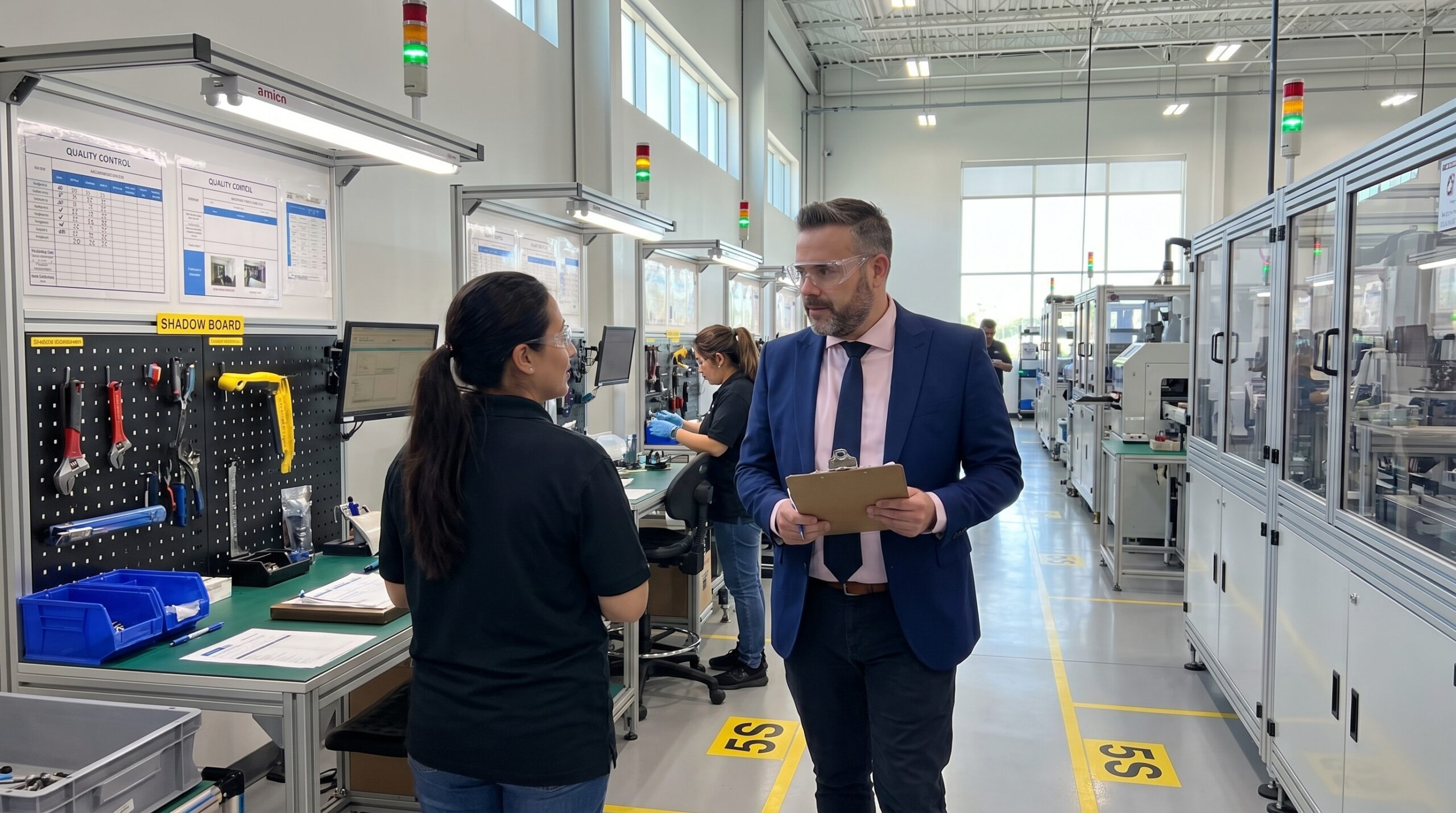
When you arrive at the line, stand still and watch for two to three minutes before saying a word. Look at the environment. Are the work instructions visible, accessible, and current? Are the SPC charts filled out accurately? Is the workstation organised according to 5S principles, or are operators tripping over hoses and extension cords to reach their tooling?
Observe the flow of materials and people. Is anyone waiting for parts? Is someone searching for a specific gauge? Are operators improvising because the standard tool is broken? These micro-stops and workarounds represent massive OEE losses that never appear in the monthly efficiency report. The conflict between the planned process and the actual execution is where you find your best improvement projects.
After observing, engage the operator with open-ended questions. Avoid yes-or-no questions like Are you following the procedure? which immediately put people on the defensive. Instead, ask them to show you how they perform a specific operation. Ask what would help them do the job better. Ask what their biggest obstacle was today. If they could change one thing about the workstation, ask them what it would be.
Operators always know where the systemic failures are. The problem is that nobody asks, and nobody fixes them.
Handling Findings and Avoiding the Trap of Instant Fixes
The most critical part of the walk is actively listening. When an operator tells you that material from a specific supplier always causes dimensional issues, pay attention. When they tell you a machine has been drifting for three months but maintenance ignores the tickets, document it. When they say the pressure to hit volume targets leaves no time for proper inspection, you have just uncovered a massive compliance risk to your IATF 16949 certification.
Resist the urge to fix things on the spot. A Gemba Walk is about systematic observation, not instant firefighting. If you start solving minor problems immediately, you will lose your strategic view of the line, and you will condition operators to bring you only small, easily solved issues. However, there are strict exceptions to this rule regarding immediate intervention.
Intervention Decision Tree During a Gemba Walk
- 01Safety Hazard IdentifiedStop the process immediately. Initiate lockout/tagout and escalate to EHS without hesitation.
- 02Product Quality RiskExecute immediate containment. Quarantine the affected parts and notify the shift supervisor.
- 03Process Non-ConformanceDocument the gap between standard work and actual practice. Take a photo. Log it for the action list.
- 04Systemic Waste or BottleneckRecord the observation for deeper root cause analysis. Assign to the continuous improvement tracker.
The Discipline of Post-Walk Follow-Up
The value of the walk disintegrates if there is no structured follow-up. Immediately after leaving the floor, consolidate your notes. Write down exactly what you saw, what you heard from the operators, and the specific systemic questions these observations raised. Vague memories are useless; you need hard, factual data points to drive the corrective action process.
Share your findings with the relevant engineering and production leaders. You must be completely transparent with the operators. If an operator pointed out a broken fixture or an outdated Control Plan, they must see that their input triggered a documented action. Assign a clear owner and a hard deadline to every issue identified during the walk.
Without visible follow-up, Gemba Walks become a management theatre that breeds cynicism. Operators will quickly realise that pointing out flaws is a waste of their breath. The next time you walk the floor, they will tell you everything is fine. Closing the loop is the only way to build the trust required for a genuine continuous improvement culture.
Common Failures and How to Avoid Them
The most frequent mistake is auditing rather than observing. If you walk onto the floor with a clipboard and a compliance checklist, operators will immediately tense up. They will work to the standard for exactly as long as you are standing there. You will see a showcase operation, not the actual daily reality. Leave the audit checklist in the quality office.
Another failure mode is the five-minute sprint. A manager breezes through the department, asks a couple of superficial questions, and leaves before understanding anything. Nothing is observed, nothing changes, and the walk is just a box-ticking exercise. You must allocate at least half an hour, stand still, and genuinely engage with the people doing the value-adding work.
The Supervisor's Walk: Perception vs Reality
What average teams do
- Arrive with a clipboard and an audit checklist in hand.
- Ask yes-or-no compliance questions that trigger defensiveness.
- Sprint through the department in five minutes without stopping.
- Walk alone, share no findings, and issue no action list.
What effective leaders do
- Arrive empty-handed, focusing purely on observation and flow.
- Ask open-ended questions about daily obstacles and frustrations.
- Stand and observe specific stations for several minutes at a time.
- Bring a process owner, document issues, and assign hard deadlines.
Finally, there is the issue of inconsistency. A manager gets motivated after a seminar and walks the line three times in one week. Then they do not return for three months. This sporadic behaviour confuses the floor and destroys any momentum for improvement. Schedule the walk, block the calendar, and execute it every single week. As the Japanese principle states, Gemba is a discipline, not an event.
Realising the Impact on the Management System
Consider a real scenario from an automotive Tier 1 milling line. During a walk, an operator is found using a work instruction clearly dated from the previous year. The tooling and process parameters have since changed significantly. When asked, the operator openly admits they know the document is outdated, but they are just following the verbal instructions the supervisor gave them last month.
Running a quick root cause analysis reveals the actual systemic failure. Engineering issued an Engineering Change Notice (ECN) to update the tool, but they never routed it to Document Control. Why? Because the ECN process itself lacks a mandatory step for updating affected work instructions. The systemic flaw is in the document control procedure, not the operator's execution.
The corrective action is to modify the ECN procedure, closing the loophole across the entire plant. Without walking the floor, this hidden process failure would have remained completely invisible. It would only have been discovered after it generated a severe dimensional defect, triggered a customer complaint, or resulted in a major finding during an AS9100 or IATF surveillance audit. Walking the line prevents the fire before it starts.