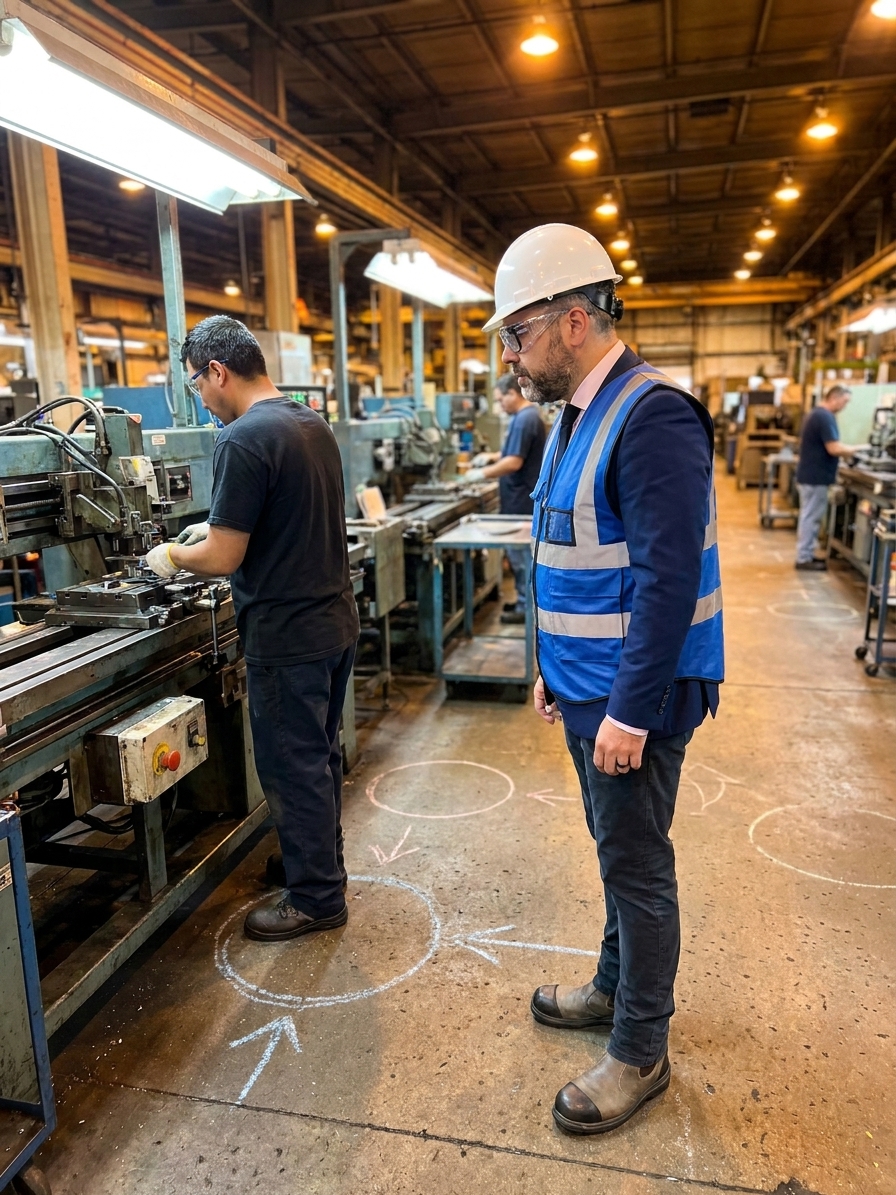
Gemba means the actual place. In a manufacturing context, it is where value is created and where the truth about your process lives. Taiichi Ohno, an architect of the Toyota Production System, enforced this by drawing a chalk circle on the floor and making managers stand in it for hours. They watched a single process until they understood it. The goal was to strip away assumptions and force direct observation.
The promise of this practice is powerful. Leaders who go to the floor see reality, catch constraints early, and build trust with operators. They make better decisions because their actions are grounded in physical observation rather than filtered dashboards. It is one of the most effective tools in lean manufacturing. In most organizations, it has been reduced to an empty ritual.
I have audited plants where the management team proudly presented their gemba walk schedules but could not name a single process change that resulted from them. The walk had become the output. When the activity itself becomes the metric, the organization optimizes for the performance of the walk rather than the discovery of problems. This is how management tourism begins.
The Anatomy of a Factory Tour
A genuine floor observation has specific characteristics that distinguish it from a factory tour. You are there to see something specific: a bottleneck, an 8D root cause, a PFMEA failure mode. You are there to learn from the operator, who knows more about that machine's quirks than you ever will. Your job is to ask questions and listen.
The moment you start directing people during the walk, observation stops. Ohno's chalk circle was about watching, not solving. If you see a problem and immediately prescribe a solution based on zero analysis, you are auditing. Operators will give you the answers they know you want, and truth becomes the first casualty.
What actually happens in most plants is a scheduled parade. The plant manager walks the same route every Tuesday at 10 AM with the same entourage. Supervisors know the route and clean the floor beforehand. Problem areas are hidden or explained away. The walk takes exactly forty-five minutes. Nothing is learned that was not already known.
Compliance Theatre and Data Extraction
The walk is often framed as engagement, but the questions are pure compliance. Managers ask where the control plan is, why a form is missing, or who approved a deviation. This is an IATF 16949 audit in disguise. Everyone treats it like an audit. The operators give defensive answers and the manager leaves with a false sense of control.
Another common failure mode is the data scavenger hunt. The manager walks the floor with a tablet, collecting OEE figures and Cpk values to feed into a monthly report. The operators become data entry clerks for a system that never feeds anything back to them. The information flows upward and dies in a PowerPoint deck.
Sometimes the walk becomes solution delivery. The manager sees something they dislike and immediately issues instructions. They prescribe a fix based on instinct. They leave, and the operators undo the change the moment the manager is gone because the new instruction broke the standard work or created a bottleneck downstream.
The Scheduled Parade vs Genuine Observation
What teams do
- Follow a fixed Tuesday route with a six-person entourage
- Ask compliance questions about missing forms
- Issue immediate solutions for visible symptoms
- Collect OEE data for a monthly PowerPoint report
What works
- Arrive unannounced and spend thirty minutes at one station
- Ask the operator what makes the process difficult
- Generate an investigation request for the root cause
- Close the feedback loop by sharing results with the floor
Why Observation Degrades Into Tourism
The degradation of floor observation into tourism is not random. Managers are often uncomfortable with not knowing. A real observation requires admitting that you do not understand a process and being the least knowledgeable person in the conversation. Many managers find this intolerable and prefer to walk the floor with answers rather than questions.
Organizations also reward the appearance of engagement. The manager who walks the floor regularly gets credit for leadership presence. The metric tracked is the number of walks per month, not the number of quality problems solved through direct observation. When you measure the walk instead of the outcome, you get walks.
Fear works both ways. Operators fear that telling the truth will lead to blame or extra work. Managers fear that hearing the truth will force them to act on things they lack the budget or authority to fix. This mutual fear produces mutual performance. The floor presents a sanitized version of reality and management accepts it.
The Cascading Cost of Fake Walks
The cost of management tourism is not merely wasted time. After a few staged walks, operators learn that management does not actually want to know the truth. They keep the real problems to themselves. The information channel that the walks were supposed to open gets permanently clogged with prepared responses.
The most important problems stay invisible. Systemic quality issues, chronic equipment failures, and design flaws that operators have learned to work around require trust and time to surface. These are exactly the problems that cannot be discussed in a ten-minute staged conversation. A parade provides no psychological safety.
When leaders believe they know the floor because they walk it regularly, they make decisions with false confidence.
This false confidence is dangerous. Leaders reject operator complaints because everything looked fine during their scheduled walk. Improvement efforts misfire because they target visible symptoms like a messy workbench while ignoring the root causes that actually drive defects and downtime. The organization gets better at passing walks without getting better at making product.
Rebuilding the Practice
If your walks have become management tourism, rebuilding them requires honesty. Acknowledge the problem to your teams. Tell them the previous walks were ineffective. The admission itself is the first step toward building the psychological safety required for real observation.
Train your managers how to observe. Observation is a technical skill. Teach them to look for material flow interruptions, operator frustration signals, and variation in cycle times. Teach them what questions to ask and how to listen to the answers without defending the current state.
Stop measuring the number of walks. Start measuring outcomes. Track how many operator-reported problems were addressed. Track the time from observation to corrective action. Track whether operators come to management with problems between walks, which is the true indicator of trust.
Closing the Feedback Loop
- 01Observe without directingWatch cycles repeat and look for workflow interruptions or operator frustrations.
- 02Ask genuine questionsInquire what makes the job difficult, not where the compliance form is located.
- 03Generate action itemsEvery unanswered question generates a commitment and an owner.
- 04Share results backCommunicate what was learned and what will change to the people on the floor.
The Diagnostic Test
To determine if your program is real or theatre, ask yourself a direct set of questions. Can operators predict exactly when you will walk and what route you will take? Do you always see a clean floor and hear positive reports? If the answer to either is yes, your walks are scheduled performances.
Assess your follow-through. Have you ever changed a process, a policy, or a resource allocation based specifically on something you saw during a walk? Do operators come to you with problems between walks? If nothing ever changes and operators never reach out, the walks have failed.
Finally, ask yourself when you last stood in one spot for more than ten minutes. If you cannot remember, you have never actually been to gemba. You have been on a factory tour. Observation requires standing still long enough to see variation. It requires the patience to let the process reveal its failures.
Gemba is a mindset. It is the commitment to grounding your understanding in direct observation rather than secondhand reports. It requires trusting the people who do the work and having the humility to stand in one place long enough to see what is actually happening. If you are not willing to do that, stay in your office.
A bad walk does more harm than no walk at all. It teaches the organization that observation is performance, that questions are interrogation, and that the truth of the factory floor is something to be managed rather than understood. Until leaders are honest about the difference, the walks will continue to be tourism, and the problems will remain invisible.