
The quality report says your first-pass yield is 94%. It says your top scrap driver is weld porosity. It says your open CARs average 12 days to closure. Every number is audited, traceable, and fundamentally incomplete.
Reports compress reality. They take a messy, dynamic process — operators swapping fixtures, a coolant line weeping onto a conveyor, a supplier quietly substituting a lubricant — and reduce it to a Cpk value and a Pareto chart. Genchi genbutsu, the Toyota production system principle of "go and see for yourself," is the corrective. It demands that the engineer who owns a problem physically stands where the problem occurs.
In my experience auditing and restructuring QA departments across automotive and aerospace plants, the distance between management and the gemba correlates directly with the half-life of a corrective action. Plants where quality engineers sit in offices analyzing SPC data remotely consistently cycle through the same 8D closures. Plants where engineers are forced to the floor resolve them.
The Mechanics of Going and Seeing
Genchi genbutsu is not a management walk-around. It is not a safety audit or a chance to praise the shift lead. It is a structured, data-driven investigation that begins at the point of creation and works backward.
When a nonconformance escapes or a KPI trends red, the standard response is to convene a meeting. Attendees debate the meaning of the data. Someone pulls up the PFMEA. A root cause is hypothesised, usually landing on "operator error" or "machine variation," because those are the easiest categories to close in a report.
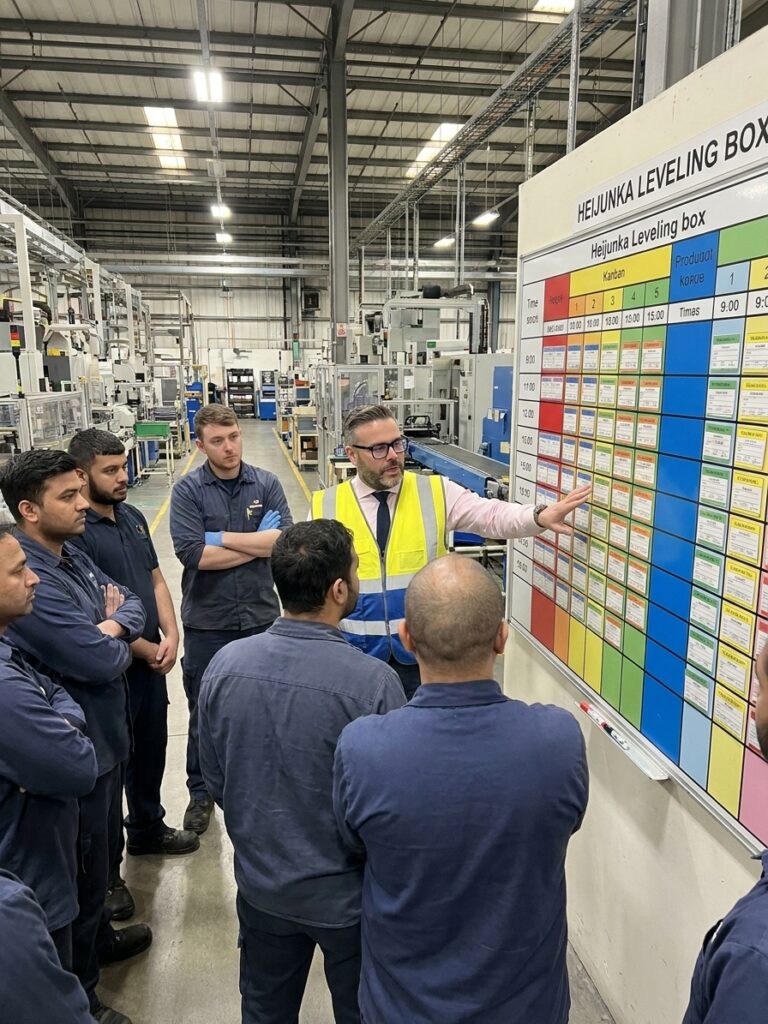
The genchi genbutsu response is different. You take the 8D form, the control plan, and the engineering drawing, and you walk to the station. You watch three full cycles. You ask the operator to explain the work instruction in their own words. You look at the actual scrap bin, not the scrap transaction log.
At a major aerospace manufacturer, I learned that the gap between what a routing sheet describes and what an operator actually does is where lead time and defects hide. By introducing verification KPIs that required physical floor confirmation rather than system sign-off, we cut internal routing lead times by 97%. The data was in the system. The waste was on the floor.
What Reports Conceal
Every data collection system makes assumptions about what matters. If your control plan measures thickness at five defined points, it assumes those five points are sufficient to characterise the part. If the process drifts and the critical variation moves to a sixth point, your Cpk remains green while your customer rejects the batch.
This is the phantom capability problem. The SPC chart says you are in control because you are measuring the wrong thing, or measuring the right thing at the wrong time.
Report-Based vs. Floor-Based Root Cause Analysis
What desk analysis finds
- Statistical outliers tied to specific shifts or operators
- Correlation between environmental logs and defect spikes
- Compliance gaps in the control plan documentation
- Trends suggesting tool wear based on lifecycle data
What floor observation reveals
- Second-shift operator uses a improvised gauge because the calibrated one walks off
- HVAC log is accurate; the sensor is 15 metres from the actual process
- Control plan is followed perfectly but references a superseded drawing revision
- Tool wears early because the preceding station feeds parts with burrs
Building Genchi Genbutsu into the Quality System
Making genchi genbutsu systematic requires more than exhorting engineers to leave their desks. It requires changing what you measure and how you measure it.
When I built the greenfield QA/QC department at SNOP for a 900+ employee plant, the existing escalation procedure routed every nonconformance through a review board. The board met twice weekly. By the time an 8D reached the floor for verification, the specific machine state, tooling batch, and operator context were gone. We eliminated the review board for Tier 1 and Tier 2 nonconformances and replaced it with a mandatory floor verification step inside the first 4 hours.
The standard I implemented requires that any 8D root cause statement contain a timestamped observation from the actual process location. "Operator failed to follow work instruction 4.2" is rejected as a root cause. "Observed at Station 7, 14:30: operator set down finished part on unshielded fixture, transferring coolant residue to subsequent batch" is accepted.
The Floor-First 8D Protocol
- 011. Detect and containQuarantine affected stock and halt the process. Log the exact machine state, tool ID, and material lot.
- 022. Observe at sourceThe lead engineer watches a minimum of three production cycles at the point of nonconformity before opening the PFMEA.
- 033. Interview the operatorAsk the operator to demonstrate the task. Compare execution against the current work instruction revision.
- 044. Form hypothesisOnly now, with physical evidence, does the team propose a root cause mechanism and map it to 5-Why or fishbone.
- 055. Verify countermeasureTest the corrective action live on the floor. Confirm the defect rate drops before updating the control plan.
VDA 6.3 and the Auditor's Blind Spot
Process audits like VDA 6.3 and IATF 16949 are designed to catch system failures. They are not designed to catch the daily drift that erodes quality between audits. An auditor checks whether your PFMEA links to your control plan. They rarely check whether the control plan reflects what the operator actually does on a Tuesday afternoon when the logistics team is short a forklift and material is being hand-carried through the paint line.
This creates a false confidence. Management relies on audit scores to indicate system health. Audit scores measure conformance to the documented system. They do not measure whether the documented system controls the real process.
A Cpk of 1.33 means your measurement system is stable. It does not mean your process is capable.
Genchi genbutsu is how you close that gap. It is the mechanism by which you discover that the documented system and the actual system have diverged, and it gives you the evidence to bring them back into alignment.
Why Engineers Resist It
Quality engineers resist genchi genbutsu for predictable reasons. Floor time is seen as unproductive. Analytical work — building spreadsheets, updating dashboards, preparing for layer process audits — feels like the real job. Standing on a concrete floor watching a press cycle feels like something a supervisor should do.
This is a structural failure in how quality departments define their mandate. If your quality engineers are not spending at least 30% of their week at the gemba, they are doing analysis on stale, filtered, or missing data. Every hour spent generating a report that a manager could have read is an hour stolen from direct process observation.
The resistance also comes from what engineers find. When you go and see, you invariably discover that your own control plan is wrong, your own risk assessment missed a variable, or your own department signed off on a process change that created the defect. Genchi genbutsu is uncomfortable because it exposes the quality system's own failures, not just operations.
Operationalising the Principle
To make genchi genbutsu permanent, build it into the cadence of the quality system. Tie layered process audits to specific high-risk process steps, not random sampling. Require that every PPAP submission include a video of the actual production run, not just the dimensional results. Make floor observation a mandatory gate in your engineering change control process.
When you stop trusting reports as the primary source of truth and start treating them as hypotheses to be tested against reality, your defect rates drop, your 8D cycle times shorten, and your audit findings shift from systemic failures to isolated deviations. The data was never the problem. The distance from the data was.