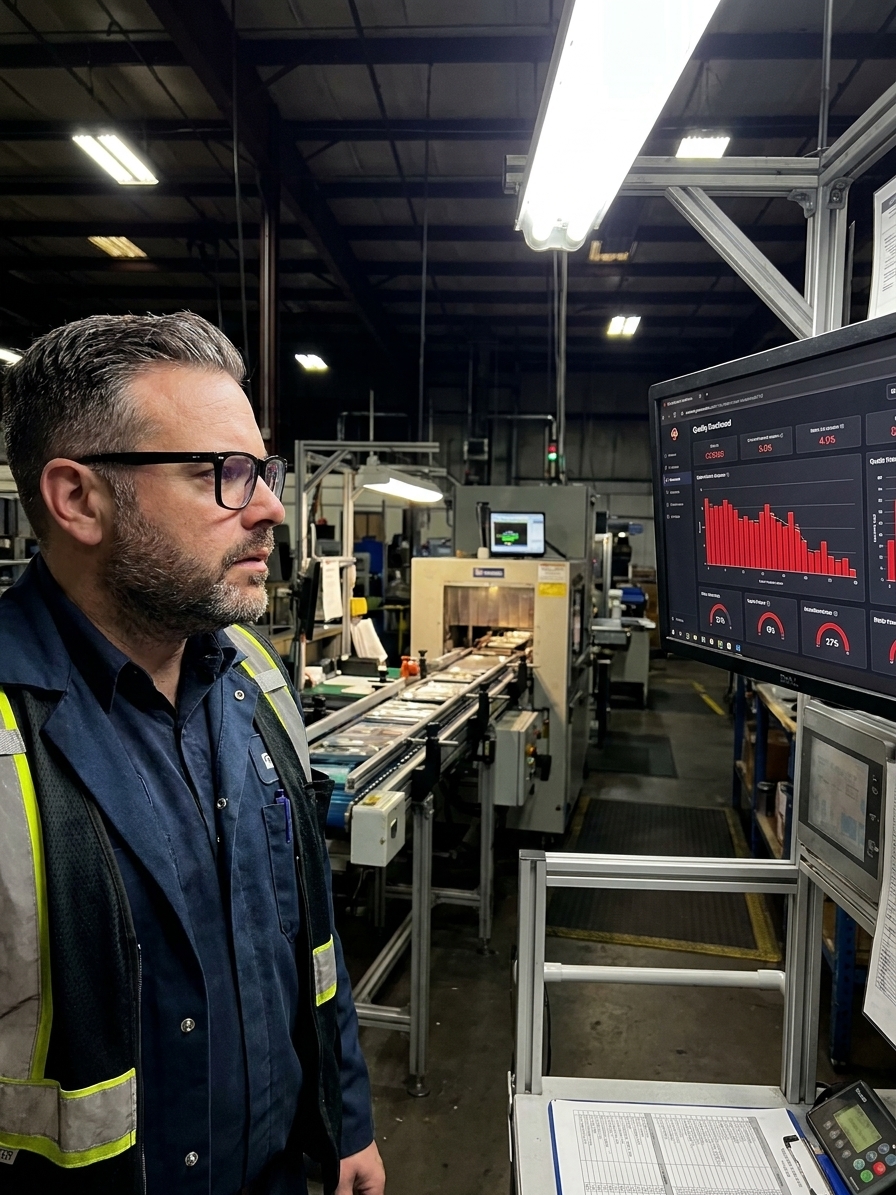
A pattern runs through manufacturing plants globally, and it is devastating in its simplicity. A supervisor walks the production floor convinced the night shift cuts corners. Inspectors review parts from a particular line assuming defects are lurking. Engineers design poka-yoke devices around the belief that operators will inevitably make every mistake possible. Slowly, the people being watched and second-guessed begin to deliver exactly the poor performance expected of them.
This is the Golem Effect. In organizational psychology, it describes a phenomenon where low expectations placed upon individuals lead to diminished performance. It is the dark mirror of the Pygmalion Effect, where high expectations elevate output. Both are powerful and clinically observable. But in manufacturing and quality management, the Golem Effect does the more insidious damage because few organizations recognize that their quality problems originate in the minds of the managers, not the hands of the operators.
The mechanism is psychological and structural. When leaders communicate through their inspection regimes, disciplinary policies, and investment decisions that they expect poor performance, the recipients internalize it. Effort decreases and engagement collapses. Why flag a defect when the response is suspicion rather than appreciation? Why invest yourself in a process designed around the assumption that you will fail?
How the Golem Effect Takes Hold on the Shop Floor
Consider a midsize automotive components plant producing machined aluminum housings for transmission systems. The tolerances are tight, surface finish requirements demand consistent tooling maintenance, and the IATF 16949 customer audit schedule keeps everyone on edge. The plant manager, an engineer by training, has watched defect rates fluctuate and gradually built an elaborate system of controls to trap them.
The manager adds multiple inspection stations, 100% final inspection on critical dimensions, rework authorization forms requiring supervisor sign-off, and a disciplinary policy tying scrap rates directly to performance reviews. The intent behind every measure was noble: to reduce defects and satisfy the customer. But the cumulative message to the operators was unmistakable. Management does not trust them to get it right independently.
I have audited plants where the operators responded to this environment in entirely predictable ways. They stopped caring about subtle machine signals—the slight change in vibration, the barely audible shift in cutting tone—because they knew inspectors downstream would catch anything missed. They stopped suggesting fixture improvements because previous ideas were ignored. They began putting in the minimum effort consistent with not being fired.
The defect rate did not improve. In some months, it worsened. The plant manager’s response was to add more inspection steps. The operators' response was to withdraw further. The cycle continued indefinitely, costing millions in scrap and rework while the actual root cause remained entirely invisible to the management team.
The Psychological Mechanism: Four Stages of Decline
Research in organizational psychology identifies a four-stage process through which the Golem Effect operates. It begins with Expectation Formation, where a manager forms a low expectation based on historical data, stereotypes, or a single negative experience. The expectation may be entirely inaccurate. What matters is that it exists, it is rigid, and it influences how the manager interacts with their team.
The second stage is Behavioral Communication. The manager's expectation manifests in concrete action. Supervisors hover over operators they consider unreliable. Corrective action requests are issued with a tone of accusation rather than inquiry. Training opportunities are withheld from employees deemed unlikely to benefit. Standard work instructions become longer, more prescriptive, and deeply patronizing.
The third stage is Recipient Response. The targets of these behaviors adjust accordingly. Motivation drops, effort decreases, and the willingness to take initiative evaporates. In most cases, this is an unconscious, automatic human response to being undervalued and distrusted. Engagement with continuous improvement activities collapses entirely. Workers focus on survival rather than excellence.
The final stage is Outcome Confirmation. The diminished performance confirms the original low expectation, reinforcing the manager's belief. The supervisor sees the rising defect rate and feels validated for not trusting the team. The operators feel the increased scrutiny and resign themselves to the fact that nothing they do will ever be good enough. The loop closes, tightens, and repeats.
The Golem Cycle in Quality Management
- 011. Expectation FormationManager assumes a specific shift or operator is incapable of meeting tolerances.
- 022. Behavioral CommunicationManagement increases surveillance, tightens rules, and issues punitive 8D responses.
- 033. Recipient ResponseOperators disengage, ignore process drift, and withhold tacit knowledge.
- 044. Outcome ConfirmationDefect rates rise due to disengagement, confirming the manager's initial bias.
Where Distrust Hides in Quality Systems
The Golem Effect rarely announces itself. It embeds in the ordinary machinery of quality management, wearing the mask of due diligence and risk mitigation. The most common hiding place is over-inspection. Every inspection station acknowledges the previous step might have been done incorrectly. But when inspection layers accumulate beyond what the PFMEA justifies, operators stop taking ownership of quality at their own station. The over-inspection becomes a self-fulfilling prophecy.
Blame-oriented corrective action is another vector. The difference between an 8D investigation asking 'what went wrong with the system?' and one asking 'who is responsible?' is the difference between a learning organization and a Golem-generating one. When root cause analyses consistently converge on operator error without examining system conditions, operators learn to hide problems. They invest energy in self-protection rather than quality improvement.
Training as remediation is a third indicator. Organizations affected by the Golem Effect deploy training almost exclusively as a response to problems. The implicit message is that training is a punishment for failure rather than an investment in growth. The word 'training' becomes synonymous with inadequacy. Operators categorized as needing remediation are never offered the advanced skills development that could actually elevate the process.
Finally, the exclusion of operators from problem-solving cements the damage. In many plants, kaizen events and Six Sigma projects are dominated by engineers and quality professionals. The operators performing the work are excluded entirely or included as tokens. This communicates that the organization does not value frontline knowledge. Operators respond by withholding the exact process insights that could solve the engineers' problems.
When standard work attempts to eliminate all operator judgment, it guarantees operators will stop thinking entirely.
The Structural Cost to the Organization
The damage inflicted by the Golem Effect extends far beyond immediate defect rates. It corrodes the foundational elements of a quality culture. The most severe casualty is the loss of tacit knowledge. Experienced operators accumulate an enormous body of implicit understanding—the subtle signs of tool wear, the feel of a proper fit, the instinct for when a process is drifting out of control. When distrust causes disengagement, this knowledge is neither applied nor shared.
Psychological safety is destroyed alongside it. Quality improvement requires people to speak up about problems, challenge assumptions, and experiment with new approaches. In an environment where low expectations are the norm, admitting to a defect becomes an act of self-sabotage. Reporting a near-miss is treated as a confession of incompetence. Suggesting an improvement is viewed as an act of defiance against the engineering team.
Continuous improvement dies at its source. People who are not expected to contribute anything beyond minimal compliance do not look for ways to improve. They look for ways to survive the shift. The financial impact is severe and highly measurable. More defects mean more scrap, rework, and warranty claims. More inspections mean labor hours devoted to finding defects rather than preventing them. High turnover drives up training costs and extends ramp-up periods.
Measuring the Impact of Distrust
Breaking the Cycle: Structural Interventions
Reversing the Golem Effect requires a fundamental shift in how an organization views its people. It is not sufficient to add a positive thinking module to the next all-hands meeting. The change must be structural, sustained, and embedded in the quality management system itself. It starts with redesigning inspection as support rather than surveillance. Cross-train inspectors and operators so that each understands the other’s work.
Rotate inspection responsibilities so the role is not permanently associated with policing. Share SPC data with operators in real time, not as a report card but as a tool for self-correction. When operators experience inspection as a resource rather than a judgment, they engage with it rather than resist it. They begin using the data to adjust the process before defects are generated.
Corrective action must also be reframed. When a defect occurs, the first question in the 8D process must be 'what in our system allowed this to happen?' rather than 'who is responsible?' This does not mean abandoning accountability. It means directing accountability at the system first and the individual second. Organizations that master this distinction create environments where people report problems early, when they are small and solvable.
Finally, measure engagement alongside quality. Most plants track defect rates, scrap rates, and customer complaint volumes with meticulous precision. Very few track operator morale with the same rigor. Employee engagement surveys, anonymous feedback mechanisms, and turnover rates by line and shift are all leading indicators. They can reveal a Golem problem months before it manifests in the PPM defect data.
Surveillance vs. Enablement Quality Models
Distrust-Driven System
- Relies on 100% final inspection to catch defects after they occur.
- Uses retraining as a punitive response to operator errors.
- Issues 8D corrective actions focused on finding individual blame.
- Standard work attempts to eliminate all human judgment completely.
Enablement-Driven System
- Embeds in-process checks so operators control quality at the source.
- Invests in advanced skills training before problems arise.
- Conducts root cause analysis focused on systemic vulnerability.
- Standard work provides clear boundaries while utilizing operator skill.
Aligning Systems with Human Capability
The Golem Effect is ultimately a failure of system design. Every inspection station you add, every punitive corrective action you issue, every problem-solving meeting you hold without your operators communicates a clear message. The question is whether what you are communicating builds capability or destroys it. Quality systems must reflect a genuine belief in the capability of the people executing them.
The plants that consistently achieve the highest quality are not the ones with the most sophisticated inspection systems or the most elaborate control plans. They are the ones that have aligned their ISO 9001 and IATF 16949 systems with a genuine respect for operator intelligence. They inspect because process risk analysis demands it, not because they distrust the workforce. They train because they want people to grow, not because they need people to be fixed.
Quality is not just a technical discipline. It is a human one. The tolerances on your drawings, the Cpk indices on your control plans, and the algorithms in your statistical software are necessary, but they are not sufficient. The most advanced quality management system in the world will chronically underperform if the people operating it believe they are not trusted to do it well.
Expect more. Trust more. Invest systematically in the people closest to the work. When the quality system shifts from catching failure to enabling success, the people you previously doubted will consistently exceed the expectations you never thought to set.