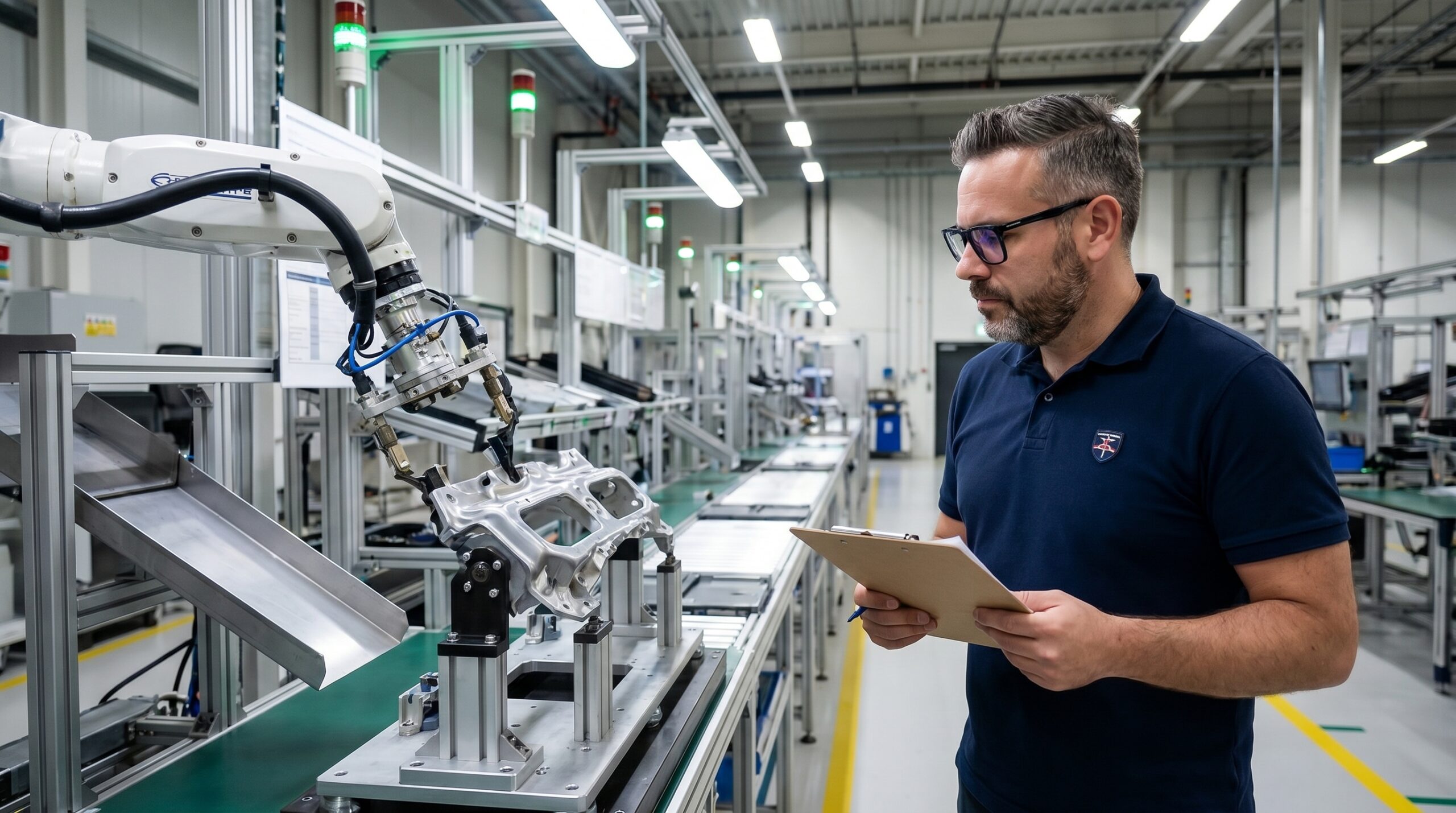
On any production line, the cycle ends and the operator does what operators everywhere do: manually unloads the finished part from the fixture. It takes perhaps three seconds. Three seconds that appear insignificant in isolation, but that silently dictate the rhythm and capacity of the entire line.
Repeat that manual removal three hundred times per shift, five days a week, and the numbers become impossible to ignore. A single station consumes over a hundred hours per year simply moving a component from point A to point B. The task adds no value, performs no inspection, and occupies the operator's hands and attention on an activity a mechanism could handle.
This is the waste of motion—a flaw so embedded in standard work that most engineers never classify it as a problem. The Toyota Production System gave the solution a name: Hanedashi (はね出し), the automatic ejection of a part the moment the operation completes.
Defining Hanedashi in TPS Context
Hanedashi is an automatic mechanism that ejects a finished part from a fixture, tool, or station once the operation is complete. The mechanism does not need to be sophisticated. A spring-loaded pin, a pneumatic cylinder, or a gravity chute all qualify. The governing principle is absolute: when the work is done, the part leaves the station under its own physics, without human intervention.
The concept is tightly bound to Jidoka, or autonomous production. Jidoka ensures a machine stops when it detects an abnormality. Hanedashi ensures the fixture automatically releases the part when the cycle finishes. Together, they form the foundation of a self-flowing line—one where the operator loads the next part immediately without waiting for the machine to open or manually extracting the previous piece.
Most facilities focus on reducing machine cycle time. Hanedashi targets the hidden intersection where human wait time meets manual handling. By removing the operator from the extraction sequence, you allow the machine and the operator to work in parallel. The operator loads while the machine processes, and the finished part clears the station automatically.
The Anatomy of Motion Waste
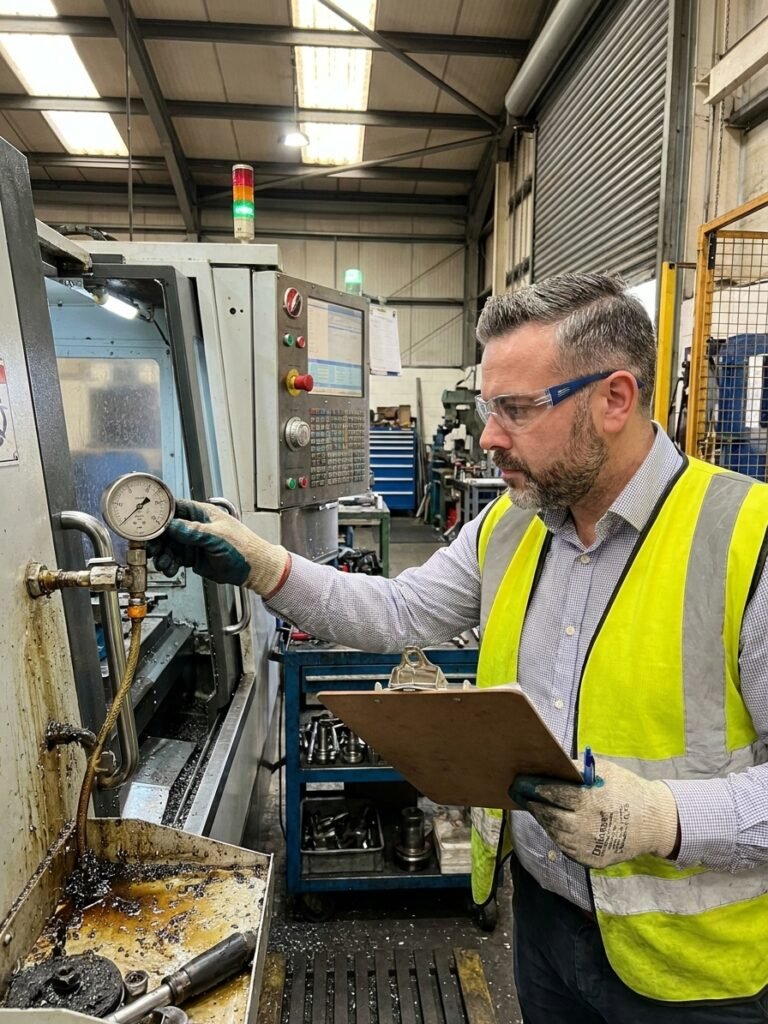
When quality engineers discuss waste, they picture excess material, long lead times, or scrap. Motion waste—the unnecessary physical manipulation of a part by the operator—is the most underreported loss on the floor. It does not appear as a line item in the daily scrap report. It hides inside the standard cycle time, making it invisible to traditional KPI tracking.
Every manual extraction forces the operator to bend, reach, or twist. Multiplied across a shift, this is thousands of repetitive motions. In automotive manufacturing, where ergonomics directly drive absenteeism and turnover, this physical tax is a measurable financial drain. Hanedashi reduces this load, extending operator career longevity and stabilising the workforce.
Manual removal also introduces variability. An operator might clear a fixture in three seconds, or in five if they are fatigued. This inconsistency destabilises the takt time. Hanedashi standardises the step. The mechanism takes exactly the same duration every cycle, creating the reliable, repeatable rhythm required for heijunka and flow production.
The Compounding Cost of Manual Handling
Implementing Automatic Ejection: A Practical Sequence
Implementing Hanedashi requires systematic observation, not complex technology. The goal is to identify where operators manually interact with completed parts and sever that link with a mechanical solution. The process must be deliberate, starting with data and ending with a durable, maintained mechanism.
Do not wait for a perfect engineering solution. The best Hanedashi designs are the simplest ones. I have seen plants over-engineer this concept, demanding PLC programming and sensor networks for a part that could slide down a sheet of stainless steel. If the mechanism requires complex controls, you have overcomplicated the task.
Build a crude prototype from materials available on the shop floor. Test it with real parts at production speed. Once the prototype proves reliable, document the parameters, integrate it into the TPM plan, and deploy the concept to the next station. The goal is a continuous process of waste elimination.
The Five-Phase Hanedashi Deployment Cycle
- 01Identify Candidate StationsVideo the operator. Look for manual part removal after the machine cycle completes.
- 02Analyse Part MechanicsDetermine part weight, shape, ejection trajectory, and safety constraints.
- 03Select the MechanismMatch the physics—gravity, spring, or pneumatic—to the part requirements.
- 04Prototype and TestBuild a rough solution on the floor. Validate reliability and check for part damage.
- 05Standardise via TPMDocument the fixture, set maintenance intervals, and roll out to similar stations.
Integration with TPS and Quality Standards
Hanedashi does not operate in isolation. It acts as a critical node within the wider Lean architecture, amplifying the effect of other TPS tools. When combined with Jidoka, the machine stops on defect and ejects the part automatically, meaning the operator only intervenes when the andon signals a genuine abnormality.
Paired with Chaku-Chaku (着々) loading, the line transforms into a continuous flow. The operator simply loads parts into sequential stations because each station automatically clears its finished piece. The operator never waits for a machine, and the machine never waits for an operator.
Within a Standardized Work framework, Hanedashi secures the cycle time. Because the ejection duration is fixed, the total cycle time becomes highly reproducible. This predictability is essential for PFMEA control plans and for maintaining Cpk targets, as process variation drops significantly when human handling variability is removed.
Hanedashi is not just a mechanism; it is the physical infrastructure that makes true one-piece flow possible.
Real-World Impact: A Case Study
I led a Hanedashi implementation across a 12-station line in a Central European automotive plant. Operators were manually unloading parts at every step. The average manual extraction time was 3.8 seconds per station. We systematically designed and installed gravity chutes and pneumatic ejectors across all 12 stations over a three-month period.
The line takt time dropped from 28 seconds to 24 seconds—a 14% throughput increase achieved without adding a single machine or operator. Ergonomic complaints, tracked via internal health and safety audits, fell by 40%. The automatic mechanisms eliminated the drops, scratches, and misplacements that occur during manual transfer.
Damage to parts during handling dropped by 65%, with scrap rates falling from 0.3% to 0.1%. The total cost for all 12 mechanisms was under 3,000 euros. Payback was achieved in under three weeks. The most significant outcome, however, was cultural: operators began submitting their own Hanedashi designs for other stations.
When you remove the mundane physical burden, operators redirect their attention to quality. They look for deviations because they finally have the cognitive space to see them. This shift is the core objective of any quality management system.
Common Failure Modes and Pitfalls
The most frequent error is assuming Hanedashi requires a robotic pick-and-place cell. This belief paralyzes action. Most automotive and aerospace applications need nothing more complex than a pneumatic cylinder or a precisely angled piece of metal. If a solution requires complex PLC programming for a simple extraction, you have missed the point.
Another critical failure is treating Hanedashi as a one-time installation. Ejector pins wear, springs lose tension, and pneumatic lines collect moisture. Without integrating the mechanism into your TPM (Total Productive Maintenance) routine, the Hanedashi will fail within weeks. A broken spring immediately reintroduces motion waste and destabilises the takt time.
Teams also reject Hanedashi because they claim they have enough capacity. This ignores flow. Hanedashi is not about adding capacity; it is about removing friction so the line can breathe. A line that cannot clear its own parts mechanically will accumulate WIP, mask process bottlenecks, and inflate lead times.
Finally, consider Industry 4.0. In automated and hybrid cells, Hanedashi remains highly relevant. Integrating a simple sensor into the ejection chute confirms part departure without requiring a separate vision system. This closes the control loop cleanly, providing real-time data for Quality 4.0 dashboards while keeping the mechanical design stubbornly simple.