Manufacturing leaders want predictable, smooth production. Instead of fire-fighting, Heijunka promises a calm factory producing exactly what customers need at a sustainable rhythm. As a core pillar of the Toyota Production System, production leveling bridges takt time and pull systems. When implemented correctly, it prevents the chaos of large-batch manufacturing.
I have spent over two decades auditing factories that claim to practice Heijunka. Most of them do not. What they practice is a rough approximation that looks acceptable on a presentation slide and collapses the moment a real customer order arrives. The leveling boxes on their walls are relics, colorful but empty, ignored by the operators they were designed to guide.
The core mechanism is deceptively simple. Suppose a customer orders 100 units of Product A, 50 of Product B, and 50 of Product C daily. A traditional approach runs all of Product A first, minimizing changeovers but creating massive inventory. Heijunka demands a repeating cycle of A-A-B-A-C throughout the day, ensuring every product appears regularly and inventory stays low.
The Heijunka Box: Working Tool or Museum Exhibit
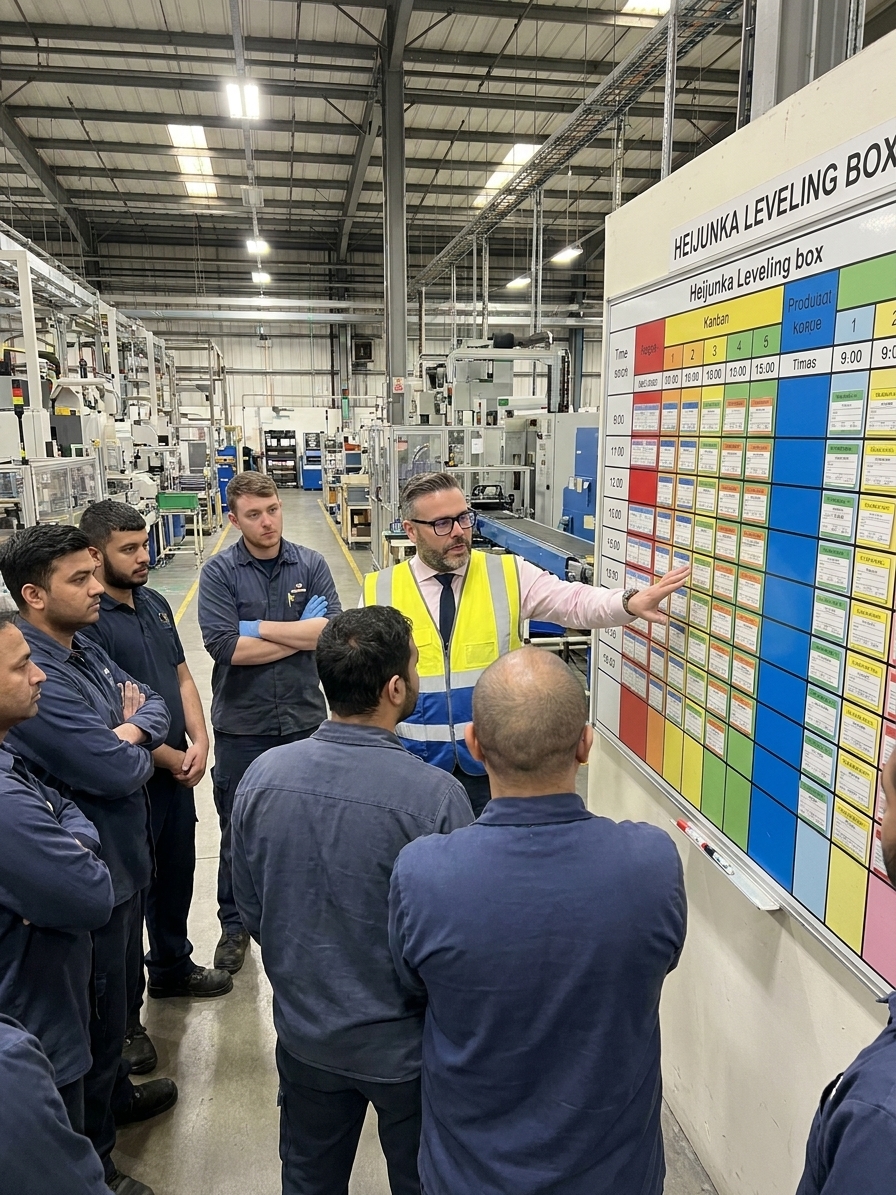
The iconic symbol of production leveling is the Heijunka box, a physical grid of slots representing time intervals and product types. Each slot contains kanban cards defining what to build in that period. Operators pull cards in sequence, and the visual board shows whether production is ahead, behind, or on track.
In plants where leveling works, the box is alive. Cards move constantly, supervisors glance at it, and operators adjust based on what they see. It functions as an active scheduling tool. In plants where Heijunka has failed, the box sits on a wall collecting dust, built during a lean implementation blitz and photographed for a company newsletter.
The first symptom of failure is that the leveling tool becomes a museum exhibit. The cards inside are weeks old. Nobody remembers what the columns mean, and the row labels correspond to products discontinued two revisions ago. Once the tool is dead, the practice it represents is dead too, even if the term Heijunka still appears in the annual quality report.
Changeover Capability and Demand Volatility
Leveling requires producing in smaller batches with frequent changeovers. If a changeover takes four hours, the plant loses capacity every time it switches. The answer is SMED, or Single-Minute Exchange of Die. But SMED is sustained, difficult work, and many organizations give up after initial gains, reducing changeovers from four hours to two and stopping.
At two hours, small-batch leveled production remains economically painful. Plants revert to large-batch production, and Heijunka dies. The plants that make production leveling work are the ones that pushed SMED from four hours to under twenty minutes. That is where the mathematical economics of small batches finally become viable.
Leveling also requires a reasonably stable demand signal to design the repeating cycle. In many plants, customer demand appears to swing massively week to week. The typical response is a declaration that leveling is impossible. This is a half-truth. Demand is rarely as volatile as the order pattern suggests, because batch ordering and internal sales incentives distort the signal.
Some of this volatility can be smoothed upstream in the supply chain, but it requires genuine effort. Sales and operations planning, or S&OP, must function as a weekly cadence where demand signals are actively reviewed and adjusted. When plants merely pass customer orders through to production without buffering or negotiation, they are reacting, not leveling.
The Breakdown of Schedule Governance
Every plant has special orders. A key customer needs something expedited, or a new product launch requires trial runs. These exceptions are real, and a mature Heijunka system can absorb them by reserving perhaps ten to fifteen percent of capacity for variability. But in practice, the exception pipeline grows relentlessly.
Sales starts promising custom runs to win deals. Engineering schedules changeovers for prototype builds that consume the entire day. Within months, exceptions consume forty percent or more of available time, and the leveled schedule exists only on paper. This is a governance failure, not a technical one.
Nobody has the authority to say no or push the special order into the normal planning cycle. In plants where leveling works, exceptions require approval from a cross-functional team, not just a sales representative. There is a clear, enforced rule: if the exception breaks the cycle, it goes into next week's plan unless it is a genuine emergency.
Governance for Exception Handling
- 01Request SubmittedSales or engineering submits a deviation from the Heijunka cycle.
- 02Cross-Functional ReviewOperations, quality, and planning assess schedule impact.
- 03Cycle Integrity CheckIf the request breaks the leveled sequence, it is deferred.
- 04Next Planning CycleNon-emergency deviations are absorbed into the next standard plan.
Metrics and Supplier Reliability
The silent killer of Heijunka is local optimization. The production manager's bonus is tied to equipment utilization. Finance measures cost per unit, which favors long runs with minimal setup. The planning department is scored on on-time delivery, which they protect by building ahead. These departmental metrics actively contradict the goals of production leveling.
When the metrics fight the method, the metrics win every time.
Heijunka optimizes for total system performance, aiming for minimum total inventory and maximum flexibility. But individual departments are measured on local metrics that reward batch thinking. Plants that succeed measure total lead time, inventory turns, schedule adherence, and changeover time as primary KPIs, actively resisting the pull of utilization metrics.
Leveling production also requires materials to arrive predictably. If suppliers cannot deliver on time, the plant builds a buffer of incoming inventory to protect itself. I have audited plants where the incoming warehouse grew larger after implementing Heijunka. They leveled their own production but could not level their supply chain, absorbing all variability in raw material stock.
How Production Leveling Supports Other Lean Tools
Production leveling does not exist in isolation. It is the foundation that makes several other lean practices viable. When plants abandon Heijunka, they usually do not realize they have also undermined their pull systems, standard work, and continuous improvement programs. The symptoms show up elsewhere, but the root cause traces back to the missing foundation.
| Lean Practice | Dependency on Heijunka |
|---|---|
| Kanban Pull System | Pull systems assume a repeating rhythm. Without leveled production, kanban cards circulate erratically and generate false signals. |
| Standard Work | Standardized work assumes a stable sequence. If the mix and volume shift daily, standard work becomes theoretical. |
| Just-In-Time | JIT requires delivering the right part at the right time. Without leveling, the right time is a moving target nobody can hit. |
| Continuous Improvement | Kaizen thrives on stability. Leveling creates the baseline conditions that make problems visible and improvement measurable. |
Kanban systems rely on a predictable rhythm to function. If the production mix shifts wildly from day to day, kanban cards circulate erratically, triggering false signals and destroying the pull mechanism. Similarly, standard work cannot be sustained if the volume and product mix shift unpredictably. The standardized sequence becomes theoretical rather than practical.
Rebuilding Production Leveling the Right Way
For organizations that want to rescue a failed implementation or build one properly, the sequence is clear. Start with changeover reduction before designing a leveled schedule. Invest heavily in SMED to get changeovers under thirty minutes for the target product family. Without this technical capability, every small-batch cycle bleeds capacity and the economics push back toward large batches.
Pick one product family, not the whole plant. Choose a family with relatively stable demand, manageable complexity, and a team open to experimentation. Calculate the takt time, design a sequence that produces the right mix, and test it for a week. The cycle will evolve, which is normal. Prove the concept in a contained environment before scaling.
Build governance around exceptions and measure total system performance. Track total inventory, lead time, schedule adherence, and customer service level. Once internal leveling is stable, extend the conversation upstream. Share the production rhythm with key suppliers and co-design a supply pattern that works for both sides, replacing adversarial positioning with partnership.
Diagnostic Thresholds for Heijunka Viability
Heijunka is ultimately about discipline and trust. Discipline to follow a plan when it feels easier to react, and trust that the plan was built with real data and cross-functional input. If your organization is struggling with production leveling, the answer is not a new tool or better scheduling software. The work begins with an honest assessment of whether you have the foundational conditions to make leveling possible.